




















Which costs determine the payback of an extraction steam turbine
The payback of an extraction steam turbine is determined by the net annual cash benefit it creates after all incremental costs are counted—not by the turbine purchase price alone. A low quoted equipment price can still produce a weak investment if steam demand is unstable, the electrical output displaces only low-value grid power, or the project requires extensive boiler, piping, electrical, and control-system modifications.
The financial question is therefore more precise than “How much does the turbine cost?” It is: what is the discounted value of useful electricity and process steam over the operating life, after capital, fuel, maintenance, outage, and financing effects? The answer depends heavily on the site’s steam balance and operating profile.
Payback starts with the correct cash-flow boundary
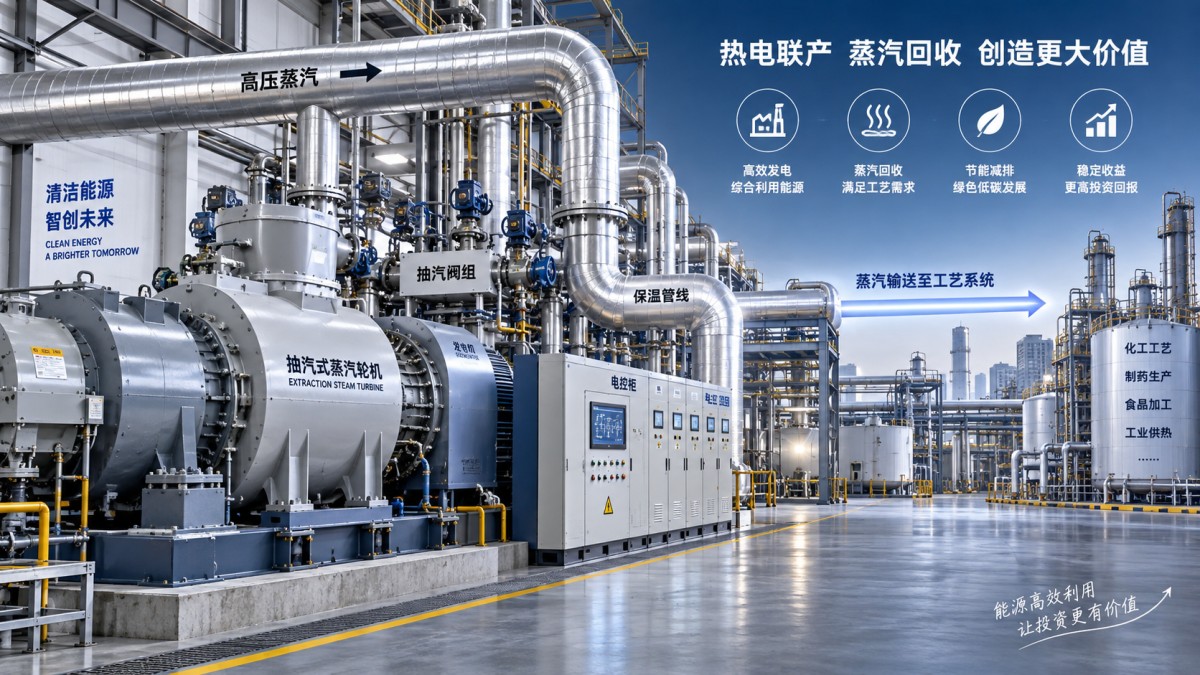
An extraction steam turbine takes high-pressure steam from a boiler or heat-recovery source, expands part of it to generate electricity, and extracts steam at one or more intermediate pressures for process use. Its value comes from using the pressure drop that would otherwise be reduced through a pressure-reducing valve. In a well-matched cogeneration arrangement, the plant receives process steam and on-site electricity from the same steam flow.
A meaningful investment model should isolate the difference between two operating cases:
- Reference case: process steam is supplied through pressure reduction, while electricity is bought from the grid or generated by another source.
- Project case: steam passes through the extraction turbine, electricity is produced on site, and the process receives steam at the required pressure and temperature.
The annual net benefit is not simply turbine output multiplied by the electricity tariff. It should include avoided purchased power, export revenue where applicable, changes in fuel use, avoided or added boiler costs, variable operating expenses, maintenance provisions, taxes, and any change in production availability. A simple-payback calculation may be useful for initial screening, but approval should normally also examine net present value (NPV), internal rate of return (IRR), and downside performance under less favorable operating conditions.
A useful first expression is:
Annual net cash benefit = power value + steam-system savings + other avoided costs − fuel and utility changes − operating and maintenance costs − outage-related losses.
Each term needs plant-specific assumptions. Generic efficiency figures cannot substitute for a site steam-and-power balance.
Capital cost is wider than the turbine package
The turbine-generator package, auxiliaries, controls, and factory testing are visible budget items, but they often represent only part of installed cost. The payback calculation should include every item required to place the extraction steam turbine into reliable commercial service.
Scope items commonly missed in early estimates include inlet and extraction steam piping, valves, drains, separators, desuperheaters, supports, insulation, civil foundations, building modifications, lubrication systems, cooling arrangements, switchgear, transformers, protection systems, synchronization equipment, and distributed control system integration. If the existing boiler plant has limited pressure margin or insufficient capacity, boiler upgrades may dominate the investment case.
Electrical interconnection can also materially alter capital cost. A facility that only offsets internal demand faces a different scope from one that exports power, operates in parallel with a utility grid, or must maintain critical loads during disturbances. Protection studies, metering, utility interface requirements, harmonics assessment, and relay coordination should be identified before the financial model is treated as decision-ready.
Engineering, permitting, freight, import duties, construction management, commissioning, performance testing, operator training, initial spares, and contingency should be included in the approved budget. For cross-border projects, foreign-exchange exposure and customs timing can affect both final cost and the date at which revenue begins.
The steam profile determines whether generation is genuinely valuable
An extraction turbine only earns value while it has suitable inlet steam flow and a useful pressure drop. That makes the process-steam demand profile one of the most important financial inputs.
If a facility has stable year-round demand for extraction steam at a defined pressure, annual generation can be relatively predictable. If steam use follows batch production, seasonal demand, or irregular operating campaigns, the turbine may spend substantial time at reduced load or unavailable because the steam balance does not support operation. A model based on nameplate electrical output will then overstate savings.
Attention is required where process demand can fall below the turbine’s practical extraction range. The plant may need bypass stations or pressure-reducing valves to maintain steam supply when the turbine is offline, during startup, or at low load. Those systems are operationally necessary, but they reduce the share of steam that can produce electricity and add capital and maintenance expense.
Extraction pressure control also has an economic consequence. Raising extraction pressure to meet process requirements leaves less enthalpy available for expansion and lowers electrical generation. The relevant question is not the maximum rated output at design conditions; it is the expected output at the actual inlet pressure, inlet temperature, extraction pressure, extraction flow, and seasonal operating pattern.
Electricity value must be measured at the meter, not at the generator terminals
Every megawatt-hour generated has a different value depending on what it replaces. Power used behind the meter may avoid an energy charge, demand-related charges, transmission and distribution components, taxes, or other tariff elements. Exported power may receive a lower contracted price and can be subject to curtailment, settlement rules, or dispatch restrictions.
The model should distinguish between:
- electricity that reliably offsets imported power during operating hours;
- electricity produced when site demand is already low;
- electricity eligible for export under a defined agreement; and
- generation lost through auxiliary consumption, transformer losses, and planned or forced outages.
Demand-charge savings deserve particular care. A turbine can reduce imported peak demand only if it is operating at the moments that establish the billing peak. Credit should not be assumed merely because average grid purchases decline. Likewise, a tariff may vary by time of use, season, voltage level, or contracted capacity. A single blended electricity price is often acceptable for a preliminary estimate, but it is weak support for final capital approval.
Fuel economics depend on the steam source
The fuel impact of an extraction turbine is sometimes misunderstood. If high-pressure steam is already required and would otherwise be let down through a valve, routing that steam through a turbine can generate electricity with little or no incremental boiler fuel in the immediate comparison. However, the conclusion changes if extra steam must be raised solely to maximize generation, if boiler efficiency declines at the revised load, or if additional auxiliary power and water treatment are required.
Fuel cost should be calculated from the whole steam system. Relevant inputs include boiler efficiency across load range, fuel price and supply terms, feedwater temperature, condensate return rate, blowdown, makeup-water treatment, emissions-control requirements, and the energy required for any supplementary firing. If steam is produced from waste heat or a process off-gas source, the opportunity cost and availability of that source still need to be defined; “free steam” is rarely a complete financial assumption.
Where a project is being compared with a new gas-fired generation option rather than a pressure-reduction baseline, the comparison must be made on equivalent boundaries. A Gas Turbine may have a different fuel exposure, heat-recovery configuration, dispatch capability, and maintenance cycle. Comparing only electrical efficiency can obscure the value—or limitation—of process steam integration.
Operating hours and availability have more influence than small efficiency differences
For many projects, a realistic annual operating-hour forecast has a larger effect on payback than a modest change in quoted turbine efficiency. The forecast should account for production schedules, boiler outages, turnaround periods, grid interruptions, steam demand variability, startup and shutdown periods, and expected maintenance windows.
Availability should not be represented as an unexplained percentage. The model should identify which equipment can stop generation: the turbine itself, the gearbox where used, generator and excitation equipment, control systems, lubrication equipment, boiler plant, extraction piping, electrical interconnection, and process-side constraints. It should also recognize whether lost turbine generation forces more expensive grid purchases or affects process steam continuity.
The financial impact of an outage is asymmetric in some plants. A planned shutdown during a low-tariff period may have modest cost, while an unplanned loss during peak production can create high replacement-power expense. This is why availability assumptions should be paired with the plant operating calendar, rather than treated as a generic technical warranty item.
Maintenance is a lifecycle cost, not a minor annual allowance
Routine inspections, lubricants, filters, instrumentation calibration, valve maintenance, alignment checks, and operator support are recurring costs. More significant are periodic inspections and overhauls, which may require rotor work, bearing replacement, seal work, control upgrades, generator servicing, and specialist labor. The timing and scope depend on turbine design, steam quality, cycling duty, operating hours, and the manufacturer’s maintenance recommendations.
Financial models should include both annual maintenance expense and scheduled major-event expenditure in the specific years it is expected. Spreading overhaul cost evenly across all years can be acceptable for a high-level lifecycle comparison, but it can conceal a cash-flow dip that matters for debt-service coverage or capital planning.
Steam quality has direct financial relevance. Carryover, corrosion products, inadequate drainage, or poor condensate chemistry can shorten component life and increase outage risk. Budgeting for suitable steam conditioning, monitoring, and water-treatment discipline is usually less costly than assuming those responsibilities sit outside the turbine investment case.
Financing terms can lengthen the apparent payback even when plant economics are sound
Simple payback measures when cumulative undiscounted savings recover initial investment. It does not show the cost of capital, debt repayment profile, interest during construction, or the value of delayed commissioning. A project with acceptable operating economics can still place pressure on cash flow if construction spending occurs early while revenue is deferred.
Approval models should therefore test at least three cases: the base operating plan, a conservative case with lower operating hours or lower electricity value, and a stressed case combining delay, cost overrun, and reduced steam demand. Sensitivity analysis is especially important where electricity tariffs, fuel prices, exchange rates, or export arrangements are uncertain.
Escalation assumptions should be explicit. If future electricity prices, fuel costs, labor, or maintenance expenses are escalated, the basis should be consistent across both the reference and project cases. Selectively escalating savings while holding costs flat can make a marginal project appear attractive without improving its underlying economics.
What a defensible approval case should show
A credible extraction steam turbine proposal is traceable from process conditions to cash flow. It should show the hourly or representative-period steam balance, expected net generation, electricity disposition, installed-cost scope, maintenance plan, and financing assumptions. It should also state which variables are contractual, which are measured site data, and which remain estimates.
The strongest projects are not necessarily those with the shortest headline payback. They are those in which process steam demand is durable, the pressure drop is genuinely recoverable, electricity has clear avoided-cost value, installed scope is defined, and the downside case remains tolerable. When these conditions are not demonstrated, a low equipment quotation is not evidence of a low-risk investment; it is simply an incomplete view of the cost that determines payback.
- ▶ How to assess overload capability in a 50 MW steam turbine
- ▶ What foundation conditions are needed for a 50 MW steam turbine
- ▶ How condenser selection affects 50 MW steam turbine performance
- ▶ What drives the installed cost of a 50 MW steam turbine
- ▶ How grid connection requirements shape a 50 MW steam turbine project
- ▶ Which costs determine the payback of an extraction steam turbine
Search from here
Leave a message
