




















How condenser selection affects 50 MW steam turbine performance
How Condenser Selection Affects 50 MW Steam Turbine Performance
For procurement teams evaluating a 50 MW steam turbine, condenser selection directly affects output, heat rate, availability, maintenance exposure, and total lifecycle cost.
The overall purchasing judgment is straightforward: specify the condenser around verified site conditions and operating duties, rather than selecting only by turbine nameplate capacity.
Start With the Performance Question Procurement Must Answer
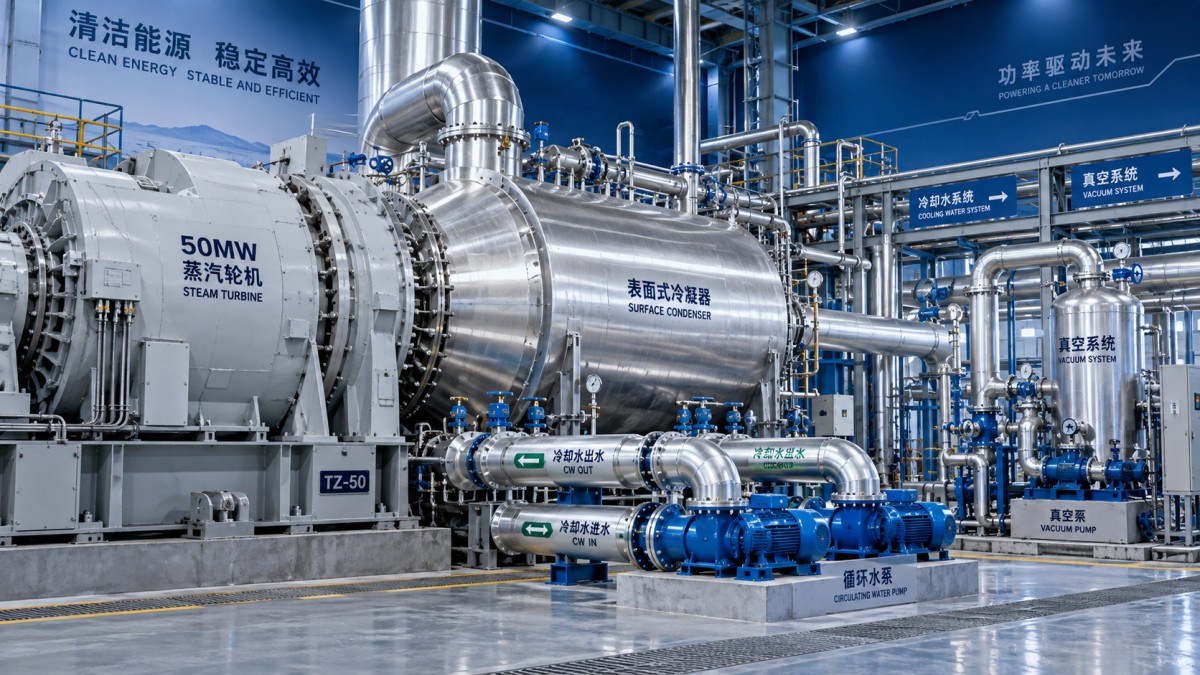
A condenser establishes the turbine exhaust pressure, commonly called backpressure. Lower stable backpressure allows more steam expansion and improves 50 MW steam turbine power generation.
However, the lowest theoretical backpressure is not always the best commercial choice. Water availability, ambient conditions, fouling risk, construction cost, and operating flexibility matter.
Buyers should ask suppliers for guaranteed turbine output and heat rate at stated condenser conditions, including cooling-water temperature, flow rate, cleanliness factor, and atmospheric pressure.
These guarantees must distinguish between rated conditions and realistic annual conditions. A project can meet its nameplate point while underperforming during the hottest operating season.
The commercial consequence can be material. A small increase in exhaust pressure may reduce generation capacity, increase specific steam consumption, and weaken project revenue expectations.
For this reason, condenser selection should be reviewed together with the steam turbine heat balance, cooling system design, vacuum equipment, and expected dispatch profile.
Why Exhaust Pressure Has a Large Effect at 50 MW Scale
In a condensing 50 MW steam turbine, exhaust steam contains significant latent heat. The condenser removes that heat and maintains a vacuum at the turbine outlet.
When cooling performance deteriorates, condensing temperature rises. The resulting increase in turbine backpressure reduces the available enthalpy drop across the final turbine stages.
This reduction can lower megawatt output even when boiler steam flow and inlet steam parameters remain unchanged. Operators may then need additional fuel to maintain dispatch targets.
Procurement documents should require a supplier calculation showing output correction curves across a practical range of condenser pressures, cooling-water temperatures, and load levels.
Those curves help buyers compare bids fairly. They also reveal whether a lower initial equipment price could create a higher long-term efficiency penalty.
Review both guaranteed and expected cases. Guaranteed values define contractual protection, while expected values help estimate annual energy production and operating economics.
Match the Condenser Type to the Site Cooling Strategy
Surface condensers are generally selected where cooling water is available and condensate recovery quality is important. Steam and cooling water remain separated by tube walls.
This design supports closed-feedwater-cycle operation, but its performance depends strongly on tube material, cooling-water chemistry, tube cleanliness, and circulating-water system reliability.
Air-cooled condensers use ambient air instead of cooling water. They are useful in water-constrained regions, but performance can decline sharply during high ambient temperatures.
For hot and dry sites, procurement teams should evaluate summer output loss carefully. Oversizing air-cooled equipment may reduce losses but adds capital cost and auxiliary power demand.
Hybrid cooling arrangements can offer operational flexibility where seasonal water restrictions, temperature swings, or grid requirements justify a more complex system architecture.
Direct-contact condensers may suit specific industrial duties, but they are usually less appropriate where high-quality condensate recovery is essential for boiler feedwater chemistry control.
Specify Cooling-Water Conditions Beyond the Design Temperature
Many weak specifications state only one cooling-water inlet temperature. That is insufficient for assessing annual 50 MW steam turbine performance and investment risk.
Request performance cases for minimum, normal, and maximum cooling-water temperatures. Include seasonal profiles where weather data and cooling-source measurements are available.
Also define design circulating-water flow, allowable pressure drop, inlet fouling assumptions, and the expected deterioration allowance over the planned cleaning interval.
A condenser with low hydraulic resistance can reduce circulating-water pump power. This benefit must be evaluated alongside heat-transfer area, tube velocity, and erosion risk.
Very low tube velocity may encourage sediment deposition and biological growth. Excessive velocity can accelerate tube wear, vibration, and erosion-corrosion under difficult water conditions.
The best selection is therefore a balanced thermal and hydraulic design, supported by site-specific water quality data rather than generic assumptions.
Tube Material and Water Chemistry Drive Reliability
Tube failure can contaminate condensate, disrupt vacuum operation, and create costly outages. Material selection should reflect the actual cooling-water chemistry, not just the lowest bid.
Freshwater, brackish water, seawater, reclaimed water, and industrial cooling loops create different risks from chloride attack, ammonia, suspended solids, microbiological activity, and scaling.
Buyers should request the supplier’s material recommendation, corrosion basis, tube-wall thickness, design life assumption, and references from comparable water-service applications.
Confirm whether the design includes sacrificial anodes, cathodic protection, coatings, online cleaning provisions, filtration requirements, and leak detection arrangements where relevant.
In aggressive service, a less expensive tube material can become a false economy. The resulting retubing, forced shutdowns, and chemistry problems often outweigh initial savings.
Require clear responsibility boundaries between the condenser supplier, cooling-water treatment provider, EPC contractor, and plant owner for water-quality compliance and warranty validity.
Check Vacuum System Integration and Air In-Leakage Allowance
A condenser cannot maintain design vacuum without an adequately sized air-removal system. Air in-leakage is unavoidable and increases with gasket aging, valves, and operating wear.
Steam-jet air ejectors, liquid-ring vacuum pumps, or mechanical vacuum systems should be compared for startup needs, reliability, utility consumption, maintenance capability, and redundancy requirements.
Ask for the assumed air in-leakage rate in the heat balance. An unrealistically low assumption can make quoted condenser performance appear better than achievable field results.
Non-condensable gases form an insulating layer around condenser tubes. This reduces heat transfer, raises backpressure, and can create localized performance problems that remain difficult to diagnose.
Instrumentation should include reliable absolute pressure measurement, cooling-water temperatures, differential pressure indicators, and monitoring points that support troubleshooting after commissioning.
Evaluate Part-Load and Seasonal Operating Behavior
Plants rarely operate continuously at rated output. Procurement teams should understand condenser behavior during startup, low-load operation, load ramps, summer peaks, and seasonal transitions.
At part load, steam flow decreases, but operating constraints may shift. Vacuum stability, minimum circulating-water flow, tube-side flow distribution, and auxiliary consumption remain important.
Where the 50 MW steam turbine supports industrial process demand, rapid load changes may occur. The condenser must accommodate transients without vacuum collapse or turbine protection trips.
Ask bidders to provide operating envelopes instead of only a single design-point calculation. Include minimum stable load, maximum backpressure limits, and startup vacuum pull-down time.
For cogeneration sites, the selected condenser must also align with extraction requirements. Higher process-steam demand can change turbine exhaust conditions and cooling system duty.
Compare Lifecycle Cost, Not Just Equipment Price
Procurement evaluation should combine capital expenditure with annual output effects, heat-rate differences, circulating-water pump power, makeup-water demand, chemical treatment, and expected maintenance costs.
A lifecycle-cost model should use conservative assumptions for ambient conditions, electricity value, fuel cost, availability, and performance degradation during the planned operating period.
Quantify the cost of one additional kilopascal of turbine backpressure where possible. This converts a technical difference into a financial comparison management can evaluate.
Include outage risk in the commercial assessment. Tube leakage, scaling, vacuum-system failure, and insufficient cleaning access can have disproportionate consequences for power revenue.
Supplier scope should clarify spare tubes, gaskets, expansion joints, instruments, cleaning equipment, commissioning support, and the availability of qualified field-service personnel.
For projects with integrated rotating equipment, suppliers experienced in turbines, generators, and auxiliaries can simplify interface management. Related capabilities such as Compressor unit solutions may also support broader plant-package coordination.
Use a Bid Evaluation Matrix That Protects Performance
Create a weighted matrix before bids are received. Weight guaranteed output, heat rate, backpressure, cooling-water requirements, reliability evidence, delivery schedule, and lifecycle cost.
Require each bidder to state exclusions, design margins, fouling factors, material grades, warranty conditions, and deviations from the technical specification in one response format.
Do not accept generic statements such as “high efficiency” or “optimized design” without supporting calculations. Compare all values at identical boundary conditions and units.
Reference projects should match turbine size, cooling method, water source, and operating regime. A successful condenser in mild freshwater service may not validate seawater performance.
During technical clarification, ask how the supplier will verify performance during site acceptance testing. Test methods, correction procedures, and measurement accuracy should be contractually defined.
Also assess access for tube inspection, waterbox cleaning, plugging, retubing, and vacuum-system maintenance. Maintainability affects availability throughout the operating life of the plant.
Conclusion: Select the Condenser as a Performance Asset
For a 50 MW steam turbine, the condenser is not a passive balance-of-plant item. It is a primary determinant of output, efficiency, reliability, and operating cost.
Procurement teams should prioritize verified site conditions, transparent guarantees, suitable materials, realistic fouling allowances, vacuum integration, and lifecycle economics over lowest initial price.
A well-matched condenser protects generation performance across changing weather and load conditions. A poorly matched system can impose recurring efficiency losses and avoidable maintenance exposure.
The strongest purchasing decision combines supplier calculations, comparable references, contractual test criteria, and a lifecycle-cost model that reflects the plant’s actual operating environment.
- ▶ How to assess overload capability in a 50 MW steam turbine
- ▶ What foundation conditions are needed for a 50 MW steam turbine
- ▶ How condenser selection affects 50 MW steam turbine performance
- ▶ What drives the installed cost of a 50 MW steam turbine
- ▶ How grid connection requirements shape a 50 MW steam turbine project
- ▶ Which costs determine the payback of an extraction steam turbine
Search from here
Leave a message
