




















What drives the installed cost of a 50 MW steam turbine
A 50 MW steam turbine’s installed cost is driven far more by project scope than by the turbine purchase price alone. In a budget review, a seemingly competitive equipment quotation can become difficult to approve once the generator, steam-cycle auxiliaries, foundations, electrical interconnection, construction conditions, commissioning duties, and operating guarantees are added. The practical question is not simply “What does the turbine cost?” but “What must be supplied, built, tested, and accepted before dependable net output is available?”
For a financial decision-maker, the strongest early control is to separate the estimate into equipment supply, site installation, owner-supplied infrastructure, and lifecycle obligations. A 50 MW steam turbine package may be technically suitable yet still produce a weak capital case if interfaces are unclear, the steam source is poorly defined, or major balance-of-plant items sit outside the quoted scope.
Start with the operating duty, not the nameplate rating
“50 MW” describes electrical output at a stated condition; it does not define the steam turbine’s entire design basis. Installed cost changes with steam pressure, temperature, flow, exhaust pressure, extraction requirements, cooling arrangement, ambient conditions, and the degree of operating flexibility required. A unit intended for steady condensing operation has different equipment needs from one that must extract process steam, follow an industrial heat load, or operate with variable biomass, waste-heat, or solar thermal input.
This distinction matters because the turbine island must be matched to the steam cycle. A project using high-quality, stable main steam may require a different casing arrangement, valve system, control philosophy, and materials selection than a project receiving fluctuating steam from a waste-to-energy boiler. Lower-cost equipment selected against incomplete steam data often creates downstream redesign costs, performance disputes, or operating restrictions.
Before comparing offers, the budget file should state:
- Guaranteed electrical output and whether it is gross or net of auxiliary consumption.
- Main steam pressure, temperature, flow range, and permitted variation.
- Exhaust condition: condenser vacuum, back pressure, or process-steam delivery pressure.
- Required extraction points, extraction flows, and control range.
- Annual operating pattern, starts, stops, load changes, and expected outage windows.
- Cooling medium and water availability, including any air-cooled requirement.
Without these inputs, two quotations with the same nominal output may not represent comparable solutions.
The turbine-generator package is only one cost block
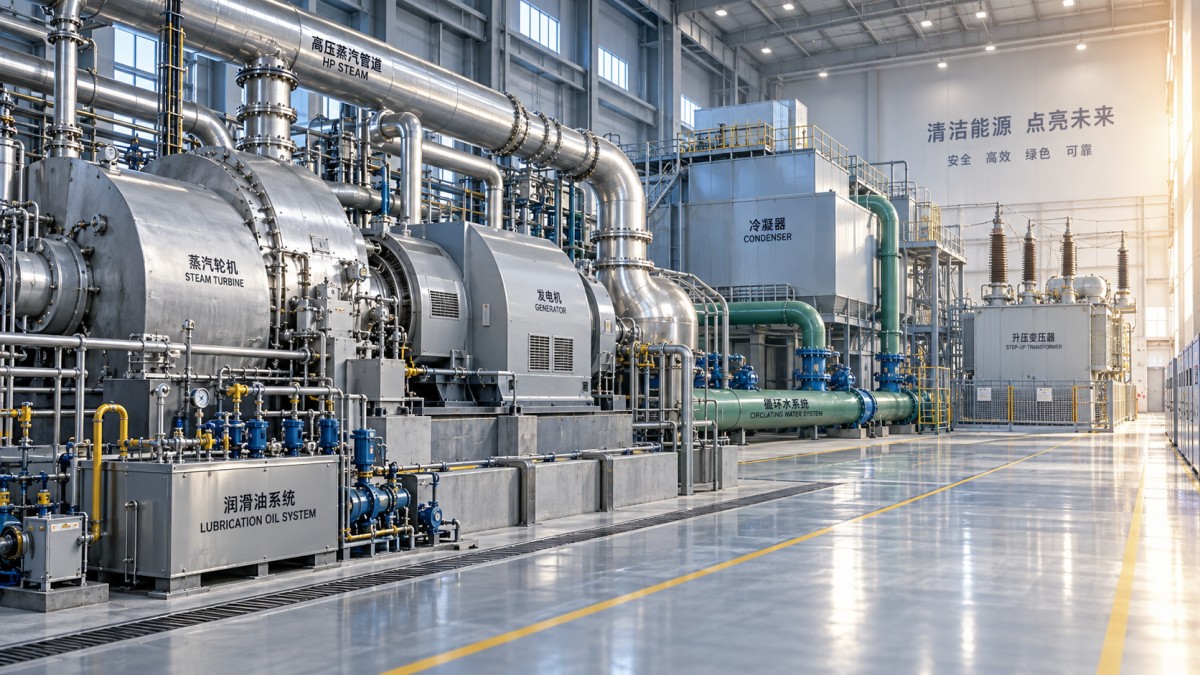
The core package commonly includes the steam turbine, generator, governing and protection systems, lubrication equipment, turning gear, local instruments, and selected skid-mounted auxiliaries. Yet the boundary between “included” and “required for operation” varies substantially. One supplier may include a lube oil console and turbine supervisory instrumentation, while another may price those items separately. Similarly, the generator may be supplied with basic accessories but exclude excitation interfaces, neutral grounding equipment, protection panels, or grid-side switchgear.
Review the package as an interface document rather than as a list of major machines. The approval team should ask which items are physically present, who supplies their cabling and piping, who controls their logic, and who accepts final performance responsibility. Missing interfaces are often more costly than visible equipment omissions because they emerge after civil, mechanical, and electrical contractors are already mobilized.
Balance-of-plant usually determines whether the estimate holds
For a condensing turbine, the heat-rejection system is a major installed-cost driver. A water-cooled condenser, cooling tower, circulating-water pumps, water treatment provisions, and associated civil works have different capital and operating implications from an air-cooled condenser. The selected arrangement depends on local water conditions, climate, plot space, parasitic power, and maintenance access. It should not be treated as a minor accessory decision.
Back-pressure and extraction-back-pressure configurations can reduce or eliminate some condensing-system requirements, but they place greater emphasis on reliable process steam demand. If the industrial host cannot absorb the steam at the required pressure and flow, electrical output may be constrained. The financial model should therefore test the relationship between electricity revenue, heat demand, turbine operating mode, and seasonal conditions rather than assuming a single continuous output level.
Other balance-of-plant areas that frequently expand after initial budgeting include boiler-turbine steam piping, pressure-reducing and bypass stations, condensate handling, gland steam systems, drain recovery, fire protection, compressed air, HVAC for electrical rooms, plant control integration, and wastewater handling. These are not optional details; they are the systems that allow the turbine island to start, run, and shut down safely.
Civil work and site conditions can change the economics quickly
A turbine is sensitive rotating equipment, so the foundation is not merely a concrete cost. Foundation design must consider machine loads, dynamic behavior, alignment, access for installation, and the surrounding building structure. Soil conditions, seismic requirements, groundwater, elevation constraints, and brownfield tie-ins can alter civil scope even when the turbine itself remains unchanged.
In greenfield projects, the budget should include roads for heavy transport, lifting plans, temporary power, construction laydown area, drainage, and installation access. In retrofit or expansion work, the main risks are often more complicated: removal of existing equipment, limited crane access, outage coordination, unknown buried services, and the need to connect to live steam or electrical systems. A lower machine price does not offset a poorly planned installation sequence.
Define the EPC boundary before comparing quotations
Installed cost is often distorted because bidders use different commercial boundaries. One proposal may cover supply only, another may include supervision, while a third may include installation engineering and commissioning support. None is necessarily wrong, but they cannot be compared line by line without a common scope matrix.
A useful review divides each responsibility among equipment supplier, EPC contractor, and owner. It should cover engineering deliverables, procurement, freight, insurance, unloading, storage, installation labor, piping, wiring, insulation, testing, performance demonstration, and punch-list closure. It should also identify who carries schedule risk when a late civil handover or a delayed boiler prevents turbine commissioning.
Where the project calls for a tailored steam-cycle arrangement, the choice between impulse and reaction technology, and between condensing, extraction-condensing, back-pressure, or extraction-back-pressure configurations, should follow the duty rather than a generic preference. A Steam Turbine range covering industrial drive, waste-heat utilization, heat supply, combined-cycle, biomass, and thermal generation applications may offer relevant configuration options, but the capital estimate still depends on how the selected machine connects to the complete plant.
Grid connection is frequently underestimated
A generator cannot be treated as a standalone source of revenue until it can synchronize, export, protect itself, and comply with the connection requirements established for the project. Depending on the connection point, costs may include a step-up transformer, medium- or high-voltage switchgear, protection and metering panels, synchronization equipment, cables, control interfaces, substation modifications, and studies required to validate the electrical design.
The financial review should establish whether the turbine’s rated output is measured at generator terminals or at the grid delivery point. Auxiliary loads from pumps, fans, cooling equipment, and electrical losses reduce net export. That distinction affects both projected revenue and the sizing of electrical infrastructure. It also prevents a project team from presenting gross output as the amount available for sale or internal use.
Commissioning costs are driven by readiness, not just specialist days
Commissioning budgets should include more than a supplier engineer’s visit. Before first rolling, the plant may need piping cleanliness verification, oil flushing, electrical checks, instrument calibration, control-loop tests, protection testing, rotor alignment confirmation, steam blowing or equivalent preparation, and documented readiness of auxiliary systems. Delays in any one area can keep specialized personnel on site longer and push the commercial operation date.
Contract language should distinguish mechanical completion, first synchronization, performance testing, and final acceptance. Each milestone may trigger payment, warranty commencement, or risk transfer. Aligning these definitions early avoids a situation in which the owner believes the plant is ready for dependable operation while the supplier’s obligations have already been deemed complete.
Protect the budget with lifecycle provisions
The installed-cost decision should include the equipment needed to maintain availability after handover. Initial recommended spares, special tools, consumables, documentation, operator training, remote support arrangements where applicable, and planned inspection requirements deserve explicit treatment. Omitting them may reduce the initial approval amount but transfers predictable cost into early operation, often when shutdown windows are limited.
Warranty terms should be reviewed alongside performance guarantees and exclusions. A guarantee has limited value if site steam conditions, cooling conditions, fuel-side variability, or owner-supplied auxiliaries fall outside the stated test basis. The sounder approach is to trace each performance commitment back to measurable plant inputs and identify who is responsible for maintaining them.
For a 50 MW steam turbine project, the most reliable estimate is therefore not the lowest equipment figure. It is the estimate with a defined duty, transparent battery limits, realistic site work, complete electrical and mechanical interfaces, and clear commissioning and service responsibilities. That level of scope discipline gives an approval team a more defensible capital number and reduces the chance that essential costs appear only after the purchase order is issued.
- ▶ How to assess overload capability in a 50 MW steam turbine
- ▶ What foundation conditions are needed for a 50 MW steam turbine
- ▶ How condenser selection affects 50 MW steam turbine performance
- ▶ What drives the installed cost of a 50 MW steam turbine
- ▶ How grid connection requirements shape a 50 MW steam turbine project
- ▶ Which costs determine the payback of an extraction steam turbine
Search from here
Leave a message
