




















How Grid Connection Requirements Shape a 50 MW Steam Turbine Project
Grid connection requirements can determine the technical scope, schedule, and long-term value of a 50 MW steam turbine project.
For business leaders, early alignment on grid code obligations is often more valuable than late-stage equipment optimization.
Why Grid Requirements Should Influence the Investment Decision
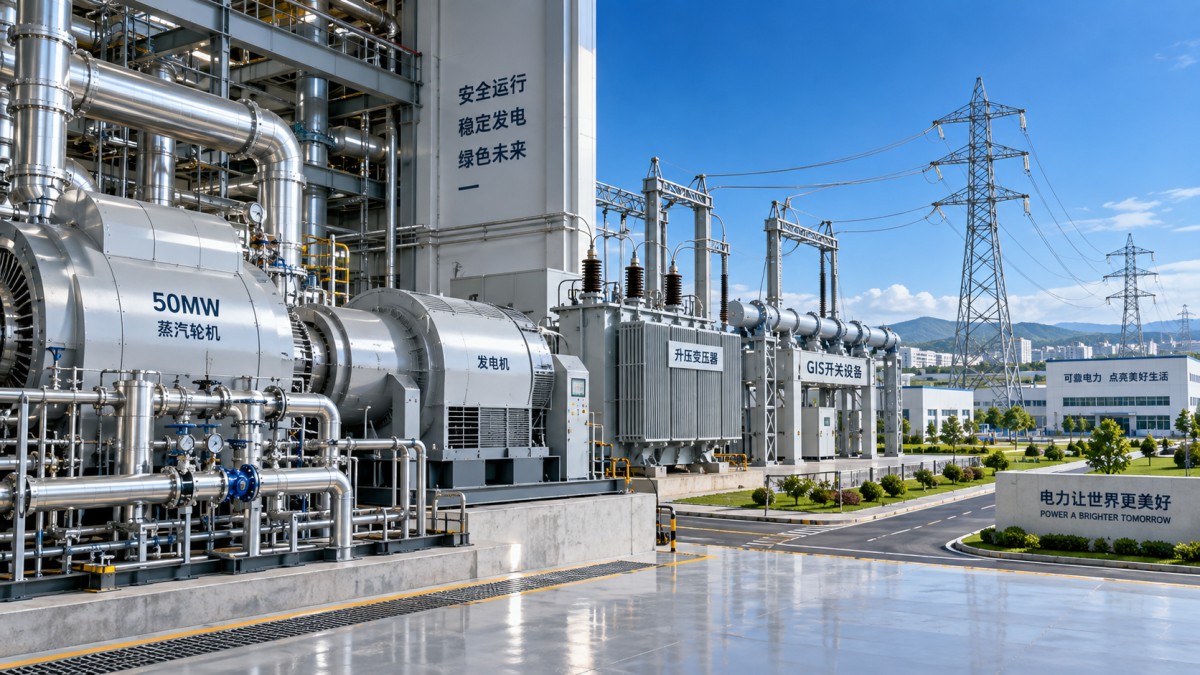
A 50 MW steam turbine project is not simply a generation asset purchase. It is a power system integration project with commercial consequences.
The turbine, generator, transformer, switchgear, controls, protection systems, and grid connection agreement must operate as one coordinated system.
When grid requirements are identified late, developers may face expensive redesigns, delayed commissioning, reduced export capacity, or avoidable performance penalties.
For decision makers, the key question is straightforward: can the proposed plant deliver dependable, compliant power under the actual conditions of its connection point?
This question should be answered before major procurement commitments, because electrical compliance can alter equipment selection, EPC scope, financing assumptions, and operating economics.
Grid operators generally assess how a generating plant behaves during normal operation, disturbances, voltage changes, frequency events, outages, and restoration activities.
A technically efficient 50 MW steam turbine can still become a weak investment if its supporting electrical systems cannot meet these obligations.
Start With the Point of Connection, Not the Turbine Nameplate
The point of connection defines the electrical environment that the project must satisfy. Its voltage level, short-circuit strength, network topology, and operating rules matter.
Developers should request a formal grid impact study or connection study as early as possible. Preliminary assumptions are useful, but they are not enough.
A weak grid may require additional reactive power equipment, faster controls, harmonic filtering, or a more conservative export strategy than initially expected.
A strong industrial grid may simplify some requirements, yet it can introduce demanding fault-level, protection coordination, and power quality obligations.
Management teams should confirm whether the 50 MW steam turbine will operate in base-load, load-following, captive-power, islanding, or combined export modes.
Each operating mode changes the required control philosophy and may affect availability guarantees, fuel planning, steam balance, and revenue expectations.
The connection agreement should clearly define maximum export, minimum technical output, reactive power range, outage notification duties, and curtailment rights.
Voltage Control Can Change the Electrical Scope and Budget
Grid operators commonly require generators to support voltage regulation through reactive power capability. This requirement directly affects generator sizing and excitation system design.
For a 50 MW steam turbine project, reactive power obligations may require a specified power factor range at the point of connection.
The required range cannot be evaluated only at the generator terminals. Transformer losses, cable impedance, and auxiliary loads affect delivered capability.
Business leaders should ask whether the proposed generator has adequate excitation margin across expected ambient conditions and operating load ranges.
They should also determine whether capacitor banks, reactors, STATCOM equipment, or synchronous condenser support are necessary for compliance.
These additions can materially affect capital expenditure, land requirements, installation time, and maintenance responsibilities throughout the project lifecycle.
Voltage compliance should therefore be modeled through credible load-flow studies rather than estimated through generic generator power-factor statements.
Frequency Response and Turbine Controls Affect Revenue Security
Frequency events test whether a power plant can remain stable when system demand and generation suddenly become unbalanced.
Depending on local rules, the project may need governor response, primary frequency control, automatic generation control compatibility, or defined ramp-rate performance.
Steam turbine response depends on the complete steam cycle, including boiler flexibility, steam pressure reserves, bypass arrangements, and control valve behavior.
A contractual promise of rapid megawatt response is not credible unless the heat source and balance-of-plant systems can support it.
Decision makers should distinguish between turbine ramp capability and plant-level ramp capability. The difference can affect ancillary-service revenue projections.
They should also review how frequency control priorities interact with process steam commitments, fuel costs, emissions limits, and equipment life.
A well-designed control strategy protects both grid compliance and commercial value by preventing unnecessary thermal stress during routine dispatch changes.
Fault Ride-Through Requirements Must Be Treated as Design Inputs
Modern grid codes may require generating units to remain connected during temporary voltage dips or frequency disturbances, rather than disconnecting immediately.
This capability is commonly described through low-voltage ride-through and high-voltage ride-through requirements, with voltage-time profiles defined by the grid operator.
For a 50 MW steam turbine, successful ride-through depends on generator excitation, protection settings, control logic, auxiliary system resilience, and transformer performance.
Protection systems that are set too conservatively can trip the unit during events where the grid operator expects continued operation.
Conversely, overly aggressive settings may expose valuable equipment to faults that should trigger isolation. Coordination requires detailed engineering, not generic templates.
Executives should require evidence that protection coordination studies consider generator, transformer, feeder, busbar, and utility protection schemes together.
This work reduces the risk of failed compliance tests, repeat outages, disputes with the utility, and unplanned revisions after construction.
Synchronization and Protection Design Determine Commissioning Risk
Synchronization is the controlled process of matching generator voltage, frequency, phase sequence, and phase angle before connecting to the grid.
Although routine in concept, synchronization errors can cause severe mechanical and electrical stress, creating risks for generators, couplings, transformers, and switchgear.
The project should include reliable automatic synchronization, manual synchronization capability where appropriate, interlocks, permissives, and documented operating procedures.
Protection design should cover common conditions such as reverse power, loss of excitation, overcurrent, earth faults, underfrequency, overfrequency, and out-of-step events.
Protection philosophy must also account for process needs. A captive industrial plant may require selective islanding rather than a full generation trip.
Early factory acceptance testing and site acceptance testing help identify wiring, logic, communications, and settings problems before commercial operation begins.
For lenders and boards, comprehensive test documentation provides stronger assurance than supplier declarations alone.
Reliability Expectations Should Shape the Equipment Package
Grid compliance is not a one-time commissioning event. The plant must sustain compliant behavior over years of changing grid conditions and operating demands.
Reliability depends on maintainable design, control system support, spare-parts availability, condition monitoring, operator training, and clear service responsibilities.
When evaluating a 50 MW steam turbine supplier, management should assess total system capability rather than compare only turbine efficiency or initial price.
A supplier with integrated turbine, generator, controls, EPC coordination, and service support can reduce interface risk across the project lifecycle.
For sites requiring operational flexibility or phased capacity development, complementary solutions such as a Gas Turbine package may also be assessed within a broader generation strategy.
Such comparisons should be based on site steam demand, fuel availability, emissions obligations, grid responsiveness, maintenance windows, and long-term energy economics.
The correct decision is not necessarily the lowest-cost configuration. It is the configuration that achieves reliable compliance with acceptable lifetime risk.
Questions Leaders Should Ask Before Approving the Project
Before approving procurement, leaders should ask whether the final grid code has been received, interpreted, and incorporated into the technical specification.
They should confirm that load-flow, short-circuit, harmonic, stability, protection coordination, and arc-flash studies have defined their assumptions and responsibilities.
It is also important to identify which party supplies reactive power equipment, communication gateways, revenue metering, protection panels, and grid dispatch interfaces.
Commercial teams should verify whether delays in utility approvals could affect project milestones, liquidated damages exposure, financing dates, or offtake commitments.
Operations leaders should review test requirements, including synchronization tests, load rejection tests, reactive power tests, ride-through demonstrations, and reliability runs.
Finally, the project should include a practical change-control process. Grid operator requirements can evolve between early design and final energization.
Clear ownership of changes prevents technical gaps from becoming commercial disputes among the owner, EPC contractor, equipment supplier, and utility.
Conclusion: Grid Compliance Is Part of Asset Value
For a 50 MW steam turbine project, grid connection requirements shape far more than the electrical connection. They influence scope, schedule, cost, operational flexibility, and revenue certainty.
The strongest projects treat grid studies and compliance obligations as early investment inputs, not late engineering checks after core equipment decisions are fixed.
Business leaders should select partners able to connect turbine performance with generator design, controls, protection, EPC execution, commissioning, and long-term service support.
That integrated approach helps ensure the plant delivers not only rated output, but dependable and compliant power when the grid requires it most.
