




















How to assess overload capability in a 50 MW steam turbine
How to Assess Overload Capability in a 50 MW Steam Turbine
Assessing the overload capability of a 50 MW steam turbine is not simply a question of whether the generator can deliver more than 50 MW. A turbine may briefly produce additional output under favorable conditions, yet that does not mean it can safely sustain that output, repeat it frequently, or do so while supplying process steam. For operating teams, the real task is to identify the permissible load envelope: how much additional load is available, for how long, under which steam and condenser conditions, and with which operating restrictions.
This distinction matters during grid demand peaks, seasonal ambient changes, process upsets, equipment outages, and proposed plant uprates. A decision based only on the nameplate rating can create hidden problems in the governing system, exhaust section, bearings, condenser, boiler, or connected generator. A sound assessment combines original design documentation with current operating data and a disciplined review of limiting components.
Start by defining what “overload” means at the site
Before reviewing limits, define the requested duty. There is a substantial difference between a short peak-load event, a one-hour dispatch request, and a continuous uprate. The operating objective should state the target electrical output, expected duration, frequency of occurrence, steam source, extraction or back-pressure requirements, and condenser condition. If the unit drives a compressor or pump rather than a generator, the driven-equipment power curve must also be included.
A 50 MW steam turbine in a condensing power plant may have more flexibility than one supplying a tightly controlled industrial steam header. Conversely, a turbine with extraction capability can be limited not by the first stages but by process demand, extraction pressure control, or the available steam flow through downstream sections. The equipment arrangement matters as much as the rated output.
The first documents to review are the turbine heat balance, performance curves, general arrangement, control narrative, allowable operating map, generator data sheet, and any original manufacturer limits. If these records are incomplete, an engineering review should reconstruct the operating case from measured steam conditions and a current inspection history rather than relying on assumptions made during commissioning.
Confirm the steam path has sufficient margin
Additional megawatts require additional useful enthalpy drop and, in most cases, higher steam flow. Operators should therefore compare the intended overload point with rated inlet pressure, inlet temperature, main steam flow, reheat conditions where applicable, and exhaust pressure. A unit may reach a higher output on a cold day with low condenser back pressure, while the same request becomes unsuitable in hot weather or when cooling-water performance deteriorates.
Do not treat favorable inlet pressure as a free reserve. Higher steam flow changes pressure distribution across the turbine stages and can raise loading on nozzles, diaphragms, blades, glands, and thrust components. For reaction designs, flow redistribution and internal leakage effects also deserve attention. For impulse designs, nozzle governing and admission pattern can become the practical constraint. The applicable limit is determined by the specific flow path, not by turbine type alone.
Exhaust conditions are often underestimated. In condensing service, excessive back pressure reduces output and can increase moisture-related risk in the low-pressure section. In back-pressure or extraction-back-pressure service, the receiving steam system may set a firm limit. Raising turbine load must not push process pressure outside its allowable range or upset downstream users.
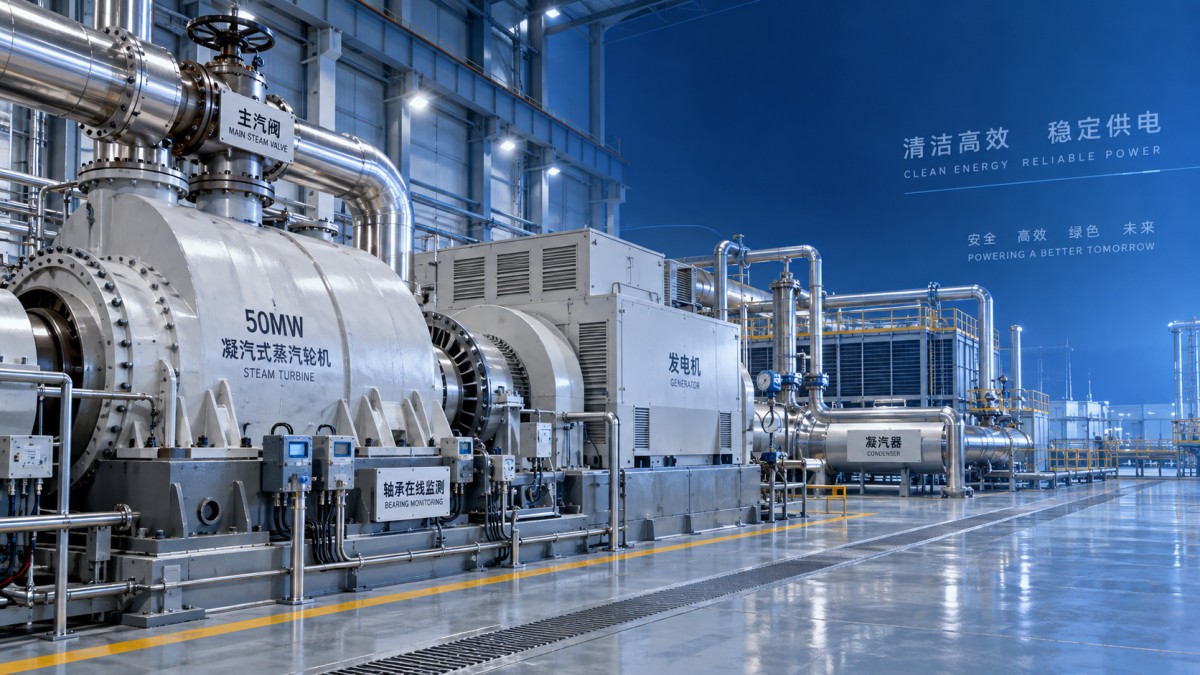
Check the mechanical limits, not only thermal performance
A turbine can appear thermodynamically capable of producing extra power while mechanical margins are already narrow. The assessment should review bearing metal temperatures, bearing drain temperatures, lube-oil supply pressure and temperature, shaft eccentricity, axial position, casing and rotor differential expansion, and vibration at each monitored bearing location. Trends are more useful than isolated readings. A vibration level that remains acceptable at rated load but rises sharply with a small load increase is a warning that the operating point needs investigation.
Axial thrust is especially important. Higher steam flow and altered pressure distribution can change the thrust balance across the rotor. The thrust bearing may be protected by alarms and trips, but operating near a protective setpoint is not a credible overload strategy. The same principle applies to coupling alignment, generator bearing performance, and foundation behavior. A full train review is required for a turbine-generator set.
Thermal expansion deserves equal attention when overload follows a rapid load increase. Rotor and casing temperatures do not move at the same rate. A load ramp that looks acceptable in electrical terms may create differential expansion or rub risk, particularly after a start, a prolonged low-load period, or a large steam-temperature change. The permitted ramp rate in the operating procedure should therefore be treated as part of overload capability.
Validate governing and protection response
Overload capability is only useful if the control system can reach and hold the requested point without unstable valve movement or excessive pressure swings. Review governor-valve position, control-valve travel, hydraulic or electrohydraulic system condition, load-control stability, overspeed protection status, and the relationship between turbine controls and boiler or heat-recovery steam generator controls.
If the control valves are already nearly wide open at normal peak load, further output may depend on steam conditions rather than control authority. Repeated valve hunting can also produce cyclic thermal and mechanical loading, even when average megawatts appear acceptable. For extraction units, verify that extraction-pressure control remains stable at the proposed higher flow. A temporary gain in electrical output is not worthwhile if it destabilizes the plant steam balance.
Use a controlled test instead of a single large step
Where design documents indicate possible margin, a staged test is generally more informative than an immediate jump above rating. Establish a stable baseline at current maximum normal load, then increase load in controlled increments while recording the relevant steam, mechanical, electrical, and condenser parameters. Hold each step long enough to identify developing temperature or vibration trends. The test plan should define stop criteria in advance, including abnormal vibration behavior, axial-position movement, bearing-temperature rise, exhaust-pressure deterioration, process-header deviation, or control instability.
The purpose is not to prove the highest possible number on one favorable day. It is to establish a repeatable and defensible operating limit. The final result may be expressed as a short-duration peak limit, a seasonal limit, a limit linked to condenser pressure, or a limit that applies only when extraction demand is below a defined level. These are far more useful to an operator than a broad statement that the machine “has overload capacity.”
Do not overlook the balance of plant
The turbine is rarely the sole constraint. Boiler firing capacity, superheater temperature control, feedwater flow, condenser cleanliness, circulating-water temperature, vacuum-system performance, transformer capacity, generator cooling, switchgear settings, and emissions-related operating constraints can all determine whether increased output is practical. For biomass, waste-to-energy, waste-heat, combined-cycle, and district-heating facilities, steam availability may vary significantly with fuel quality, process conditions, or heat demand.
Generator capability must be checked independently. Extra real power can affect stator current, rotor current, cooling margin, terminal voltage, and reactive-power obligations. The turbine may be able to admit more steam while the generator cannot safely carry the corresponding electrical load under site ambient conditions.
When an engineering review is the right next step
A formal review is advisable when a plant intends to make overload operation routine, extend its duration, change steam conditions, modify extraction service, or operate after major repairs. It is also appropriate where historical data show increased vibration, declining vacuum, higher bearing temperatures, or unexplained differences between expected and actual output.
The review should connect current field data with the original turbine design and maintenance condition. This is particularly valuable for older units whose operating duty has changed over time. SINO-QNP supports turbomachinery projects through design, manufacturing, EPC coordination, spare-parts supply, and service support; its Steam Turbine range covers industrial-drive and power-generation duties across a broad output range, including condensing, extraction, and back-pressure configurations. For an existing unit, however, the relevant question remains specific: what can this machine, in this installation, safely do today?
A credible overload decision should end with documented operating boundaries, required monitoring points, alarm-response actions, permissible duration, and clear conditions that cancel the higher-load allowance. That approach protects availability as well as equipment life—and gives operators a practical basis for responding when the next peak-load request arrives.
- ▶ How to assess overload capability in a 50 MW steam turbine
- ▶ What foundation conditions are needed for a 50 MW steam turbine
- ▶ How condenser selection affects 50 MW steam turbine performance
- ▶ What drives the installed cost of a 50 MW steam turbine
- ▶ How grid connection requirements shape a 50 MW steam turbine project
- ▶ Which costs determine the payback of an extraction steam turbine
Search from here
Leave a message
