




















What causes blade deposits in a WTE turbine?
Blade deposits in a WTE turbine usually originate from impurities in the steam: boiler-water droplets carried into the steam supply, silica transported in the vapor phase, or corrosion products released from the water and steam circuit. The corrective action depends on which material is present and how it reached the blades. Cleaning restores the flow path, but recurring deposits indicate that the contamination source or transport mechanism remains active.
In a waste-to-energy plant, combustion ash and flue gas remain outside the turbine’s normal steam path. Waste composition affects boiler operation and heat-transfer surfaces, but ash on the fireside does not establish the cause of turbine fouling. A diagnosis needs evidence connecting the blade deposit to steam chemistry, water treatment, equipment condition, or an operating event.
Boiler-water carryover introduces dissolved salts
Mechanical carryover occurs when water droplets escape the boiler’s steam-separation system. These droplets contain dissolved and suspended material from the boiler water. As they enter superheated steam and evaporate, they leave contaminants that can accumulate on valves, nozzles, and blades.
High drum level, foaming, damaged separator components, and operation outside the separator’s intended loading range all increase the likelihood of carryover. Rapid load changes deserve particular attention. Drum swell during a pressure reduction can raise the apparent water level and disturb separation even when the preceding steady-state readings looked acceptable.
Elevated boiler-water dissolved solids promote carryover under unfavorable conditions. Organic contamination, including oil entering the condensate system, can encourage foaming. Increasing blowdown may reduce dissolved-solids concentration, but it will not repair a damaged separator or eliminate an oil ingress source.
Sodium in a representative steam sample is a useful indicator of contamination because many boiler-water impurities contain sodium. However, a sodium excursion alone does not identify the entry point. Compare its timing with drum level, load ramps, boiler-water chemistry, and condensate quality. Brief contamination during startup or a load disturbance can leave deposits even though later samples return to normal.
Silica behaves differently from droplet carryover
Silica can enter steam through both mechanical carryover and vapor-phase transport. Its partitioning between boiler water and steam changes with pressure and water chemistry. Consequently, effective droplet separation does not by itself guarantee sufficiently low steam silica.
As steam expands through the turbine, its capacity to retain silica decreases, allowing silica to deposit on downstream surfaces. The affected stages depend on inlet conditions and the expansion path; assigning every silica deposit to a fixed turbine stage is unreliable. Silica-rich deposits are often hard and difficult to remove with water alone.
A low steam sodium reading therefore does not establish that silica control is satisfactory. Steam silica requires its own measurement, supported by boiler-water silica and makeup-water treatment records. Where a demineralization unit is used, exhausted media, breakthrough, or regeneration problems can raise the silica load entering the cycle.
Phosphate-containing deposits require a different interpretation. In a boiler using phosphate treatment, phosphate in a turbine deposit strongly supports transport of boiler water into the steam. Increasing chemical dosing without investigating carryover can increase the amount of material available for deposition.
Deposit composition narrows the investigation
Color and texture help document a deposit, but they cannot reliably identify it. A dark layer may contain iron oxides mixed with salts; a pale deposit may contain silica or several water-treatment compounds. Photograph the surfaces and collect samples before washing, blasting, or applying chemicals.
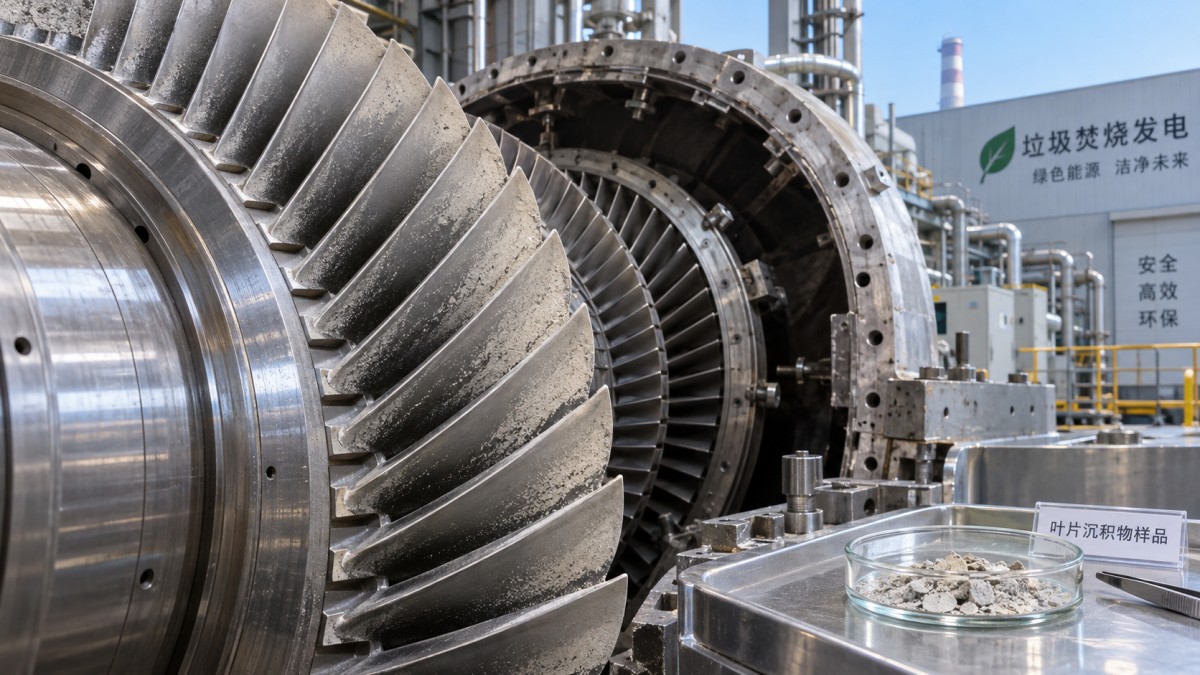
Keep samples from different stages and components separate. Record the stage, blade side, radial position, deposit thickness, and whether the material is loose or adherent. Combining everything into one sample removes location information that helps distinguish upstream contamination from deposition during expansion.
Elemental analysis identifies constituents; mineral-phase analysis helps establish the compounds present. Water-solubility testing also informs cleaning selection. Mixed deposits often need more than one analytical method, especially when soluble salts bind harder silica or oxide particles together.
Trace contamination through the water and steam circuit
A condenser leak can introduce cooling-water impurities into condensate. Contaminated process condensate returned to the cycle provides another route where heat is exported. The resulting turbine deposits depend on the contaminants, their concentration in the boiler, and how they transfer into steam.
Compare samples from makeup water, condensate, feedwater, boiler water, and turbine inlet steam. A deterioration appearing first in condensate points toward a different source than one confined to boiler water. Chemistry records should also include treatment changes, abnormal makeup demand, startup periods, and any isolation of condensate returns.
For iron-rich deposits, examine corrosion-product transport and recent operating history. Shutdown exposure, unsuitable preservation, and startup disturbances can release accumulated oxides. Larger oxide particles can also cause erosion, so a surface with both deposits and impact damage may reflect more than one mechanism.
Verify the sampling system before accepting an apparently clean steam result. Sample location, extraction arrangement, line condition, cooling, and analyzer response affect whether a short contamination event is captured. A delayed laboratory sample taken after stable operation resumes cannot reconstruct an earlier carryover excursion.
Separate fouling symptoms from other performance losses
Deposits alter blade profiles, increase surface roughness, and restrict nozzle passages. Depending on location and severity, the result is reduced efficiency, changed stage pressures, or reduced swallowing capacity. Compare stage pressure and steam flow at equivalent inlet conditions, exhaust pressure, and load; a single pressure reading is insufficient.
For a steam turbine driving a Generator, available in ratings from 1.5 MW to 400 MW, electrical output should be assessed alongside steam flow and thermodynamic conditions. Output loss alone cannot distinguish blade fouling from reduced inlet temperature, higher condenser pressure, or electrical limitations.
Vibration deserves the same discipline. Uneven deposition can disturb rotor balance, but alignment changes, bearing problems, rubbing, and blade damage also produce vibration. Correlate vibration trends with chemistry events and performance changes, then confirm the mechanical condition during inspection. Loose material can detach, so a sudden change in vibration is not proof that fouling has resolved.
Match removal and prevention to the confirmed mechanism
Choose cleaning methods from deposit analysis and the turbine manufacturer’s procedure. Water washing suits some soluble salts, while silica-rich or strongly adherent oxide deposits may require another approved method. Uncontrolled abrasive cleaning can change blade geometry or surface finish; unsuitable chemicals can attack materials or remain trapped in crevices.
Before cleaning, assess pitting, cracks, and erosion beneath the deposit. A blade that appears fouled may also have corrosion damage requiring repair or replacement. Online washing should only proceed where the turbine design and operating procedure explicitly permit it, with defined limits for water introduction and drainage.
Corrective work should follow the evidence: repair separation hardware for mechanical carryover, stabilize drum-level behavior during transients, restore silica removal where treatment breakthrough is confirmed, or isolate the contamination source in condensate. After restart, trend representative steam chemistry through startup and load changes as well as steady operation. Reinspect the previously affected stages at the next suitable outage to establish whether deposition has slowed or returned.
- ▶ What causes blade deposits in a WTE turbine?
- ▶ How boiler steam conditions determine the right WTE turbine size
- ▶ When is an extraction WTE turbine suitable for district heating?
- ▶ How waste heating value fluctuations affect WTE turbine output
- ▶ What causes mud pump bearings to overheat during continuous operation?
- ▶ Why mud pump discharge pressure drops during continuous operation
Search from here
Leave a message
