




















An extraction WTE turbine can support district heating when a waste-to-energy plant has reliable steam production and nearby heat demand that justifies the distribution infrastructure.
For project managers, suitability depends on more than turbine capacity: extraction pressure, seasonal heating loads, electricity revenue, and network return temperatures all influence performance and project economics.
Selecting the right configuration requires balancing heat delivery with power generation while maintaining operational flexibility across seasons, including periods when district heating demand falls significantly.
This article examines the key technical and commercial conditions that make an extraction turbine a practical choice for district heating—and the questions to resolve before specifying equipment.
Does the project have a dependable market for heat?
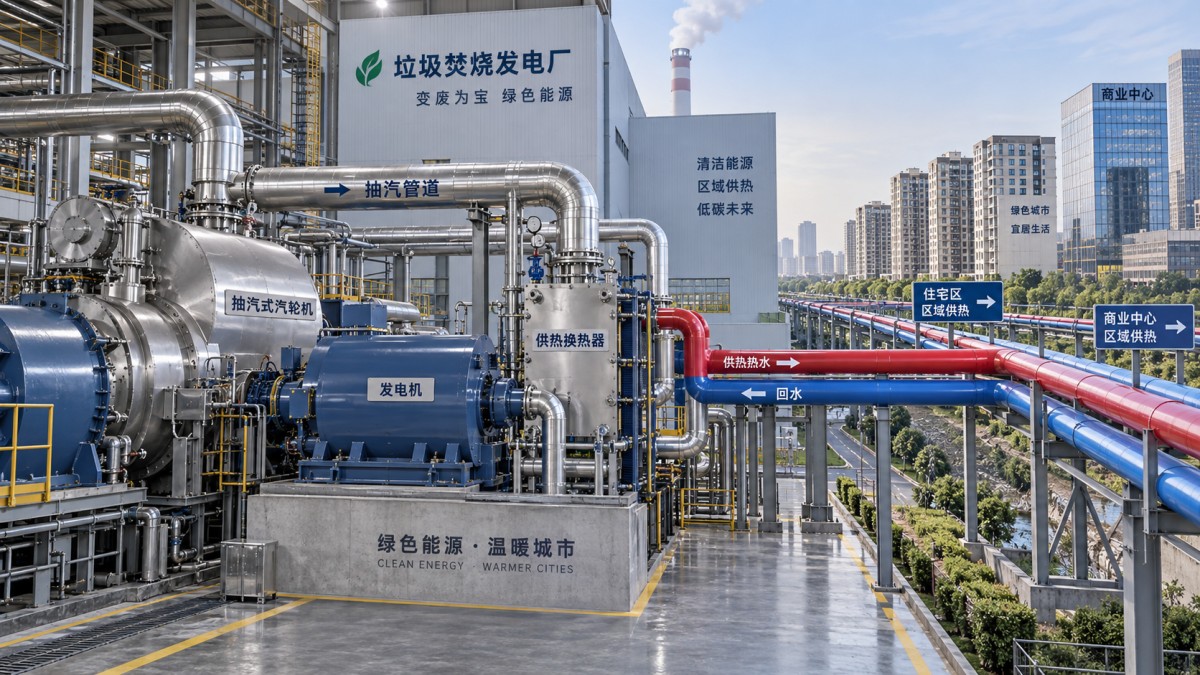
The strongest candidates combine predictable waste processing with an established heating network or committed customers, a manageable pipeline route, and heat demand extending beyond winter peaks.
Residential districts provide substantial winter demand, while hospitals, commercial buildings, and industrial consumers may strengthen year-round sales through domestic hot water or compatible process heating.
Assess an hourly heat-demand profile and load-duration curve. Annual consumption alone cannot reveal whether customers will buy heat when the plant can actually supply it.
Check network distance, connection density, route constraints, and construction permissions together. A large heat customer can still be commercially unattractive if connection costs are excessive.
Before equipment selection, distinguish signed demand from potential demand. Phased development should remain financially workable if later customers connect more slowly than originally forecast.
Can extraction steam meet the network’s temperature requirements?
An extraction WTE turbine supplies steam from an intermediate turbine stage to heat exchangers, where it heats district water without mixing the two fluid circuits.
Extraction pressure must provide a condensing temperature above the required network supply temperature, with sufficient allowance for heat-exchanger approach temperature and steam-side pressure losses.
Higher network temperatures generally require higher extraction pressure. This reduces the expansion available for electricity generation, increasing the opportunity cost of each unit of heat.
Evaluate supply and return temperatures across the operating year. Lower return temperatures can improve heat recovery and reduce water flow for a given temperature requirement.
Do not specify extraction pressure from a generic temperature rule. Request calculations using the actual network temperature schedule, exchanger design, pressure losses, and operating margins.
Confirm maximum extraction flow, pressure-control range, and permitted turbine operating conditions. The required thermal duty must remain achievable within the manufacturer’s validated operating envelope.
Will seasonal heat demand leave enough operating flexibility?
An extraction-condensing arrangement is often suitable when heating demand varies substantially, because steam can continue through the downstream turbine stages when extraction demand decreases.
That flexibility depends on condenser capacity, cooling conditions, and turbine limits. Confirm that low heating demand will not force unwanted reductions in waste-processing throughput.
A back-pressure arrangement may suit a strong, continuous heat sink. However, its dependence on useful exhaust heat demand requires careful assessment during low-load periods.
Waste composition, boiler fouling, maintenance, and ambient conditions can change available steam. Model these effects alongside heating demand instead of assuming constant nameplate production.
Ask the supplier to verify minimum downstream steam flow, extraction transitions, and load rejection. These conditions affect stable operation when customers rapidly reduce heat consumption.
Does heat revenue outweigh lost electricity and connection costs?
The business case should compare incremental heat revenue with reduced electricity income, additional operating costs, and the capital required to connect and serve customers.
Include heat exchangers, pipelines, pumping stations, metering, controls, backup capacity, and civil works. Network construction can determine viability even when turbine modifications appear affordable.
For illustration, 10 MW of delivered heat sold for 4,000 equivalent full-load hours represents 40,000 MWh annually, before accounting for outages or customer curtailment.
At an illustrative tariff of €35/MWh, that produces €1.4 million in gross annual heat revenue. It does not represent profit or establish project viability.
Calculate lost electricity from turbine performance at the relevant extraction conditions. Avoid applying a universal power-loss factor, because steam conditions and operating loads differ.
Test downside scenarios for electricity prices, heat tariffs, connection delays, pipeline costs, and warmer winters. Include pumping electricity and distribution losses in the financial model.
A credible investment case should remain acceptable under realistic downside assumptions and contracted heat volumes, with clearly allocated responsibility for network development and operating performance.
How will customers receive heat during plant outages?
District heating customers need dependable service, while a WTE plant requires planned maintenance and may experience unexpected shutdowns. Turbine selection cannot resolve this availability gap alone.
Define backup heat sources, thermal storage, and network interconnections according to customer requirements. Storage can smooth short fluctuations but needs explicit sizing for outage coverage.
Review the consequences of turbine trips and boiler outages separately. An engineered steam bypass may preserve some heating during turbine downtime when boiler steam remains available.
Agree on supply temperatures, availability commitments, outage notifications, and penalties before procurement. Heat contracts should reflect achievable performance and the responsibilities of each operating party.
Where separately justified, SINO-QNP’s Gas Turbine portfolio offers models rated approximately 2–114.5 MW; any cogeneration contribution requires separate fuel, heat-recovery, emissions, and economic assessment.
What should project managers request before specifying equipment?
Prepare a coordinated design basis covering boiler steam pressure and temperature, available flow, district heating temperatures, hourly demand, condenser conditions, and planned operating schedules.
Request performance maps for electricity-only operation, representative winter extraction, summer heating, and reduced boiler output. Each case should state net electricity and delivered thermal output.
Specify where performance is measured. Heat at the plant boundary differs from heat delivered to customers, while gross generation excludes the plant’s auxiliary electricity consumption.
For retrofits, require an engineering assessment of the existing turbine, extraction connections, controls, foundations, and outage requirements. Adding useful extraction is not always a straightforward modification.
SINO-QNP brings over 30 years of turbomachinery experience, with capabilities spanning design, manufacturing, EPC projects, and spare parts support across a global service network.
Use supplier discussions to establish project-specific guarantees, service arrangements, and interface responsibilities. General manufacturing experience should support, rather than replace, documented performance at your operating conditions.
When should you proceed, redesign, or defer?
Proceed when committed heat demand, compatible temperatures, sufficient steam availability, and acceptable connection costs align, supported by operating flexibility and a credible outage supply strategy.
Redesign when high network temperatures, weak summer demand, or costly routes undermine returns. Lower-temperature operation, phased connections, and storage may improve the overall project case.
Defer commitment when customer demand remains speculative, network permissions are unresolved, or revenues depend on optimistic assumptions. Resolve those uncertainties before fixing the turbine specification.
An extraction WTE turbine is suitable when the complete heat-and-power system works technically and commercially. Base procurement on validated operating cases and deliverable customer commitments.
