




















Does mud pump resale value justify buying for a short-term project?
Does mud pump resale value justify buying for a short-term project?
Resale value can make ownership look attractive, but does it outweigh the flexibility of leasing for a short-term project? For anyone asking “is it better to lease or buy a mud pump for short-term projects,” the answer depends on more than the purchase price. Rental rates, financing costs, maintenance exposure, transport expenses, and the timing of resale all affect the final return. Buying makes financial sense only when realistic net sale proceeds bring the total ownership cost below a comparable rental arrangement—with enough headroom to absorb uncertainty.
The distinction is between an asset that retains value and an asset you can sell, at the required price, when the project finishes. Those are not necessarily the same thing.
Compare the full project costs, not purchase price against rental fees
Start with the same equipment scope on both sides. A bare pump quotation cannot be compared directly with a rental package that includes a driver, controls, connections, commissioning, or maintenance support. Confirm the required flow, operating pressure, duty cycle, fluid characteristics, and site power arrangements before comparing prices. Otherwise, an apparently cheaper offer may simply exclude essential equipment.
A practical ownership calculation is:
Total ownership cost = purchase and preparation cost + project operating costs + financing or capital cost + post-project holding costs − net resale proceeds.
For leasing or rental, include the contracted charges, mobilization and return transport, insurance, consumables, maintenance obligations, and any extension or damage charges. Establish whether billing ends when operations stop, when equipment is collected, or when the supplier accepts its return. These dates can produce materially different costs.
Fuel, electricity, and routine operating labor may largely cancel out if both options use equivalent equipment. They should remain in the comparison when driver efficiency, staffing requirements, or package scope differs. Treat recoverable taxes consistently, and avoid counting both financing interest and an overlapping capital charge.
Resale proceeds need evidence—and deductions
An advertised used-equipment price is not proof of achievable resale value. Listings may remain unsold, include accessories your unit lacks, or reflect a different market. Seek completed-sale evidence where available, dealer purchase offers, or written buyback terms. Match the configuration, age, condition, location, and documentation rather than relying on the model designation alone.
Estimate net proceeds by deducting selling commissions, inspection, refurbishment, packing, loading, and any seller-paid freight from the expected sale price. Keep storage, insurance, and financing during the selling period in the holding-cost allowance, so they are not counted twice.
Physical condition deserves particular attention. Abrasive service can affect fluid-end components, liners, pistons, and valves; power-end condition requires its own assessment. Recorded operating hours help, but they do not explain loading, fluid properties, maintenance discipline, or previous repairs. A buyer may discount uncertain condition even when the equipment still operates.
Preserving resale value therefore starts during procurement. Specify the records you will retain: equipment identification, service history, replaced parts, inspection findings, and operating information. Documentation does not guarantee a sale, but it reduces the uncertainty a buyer must price into an offer.
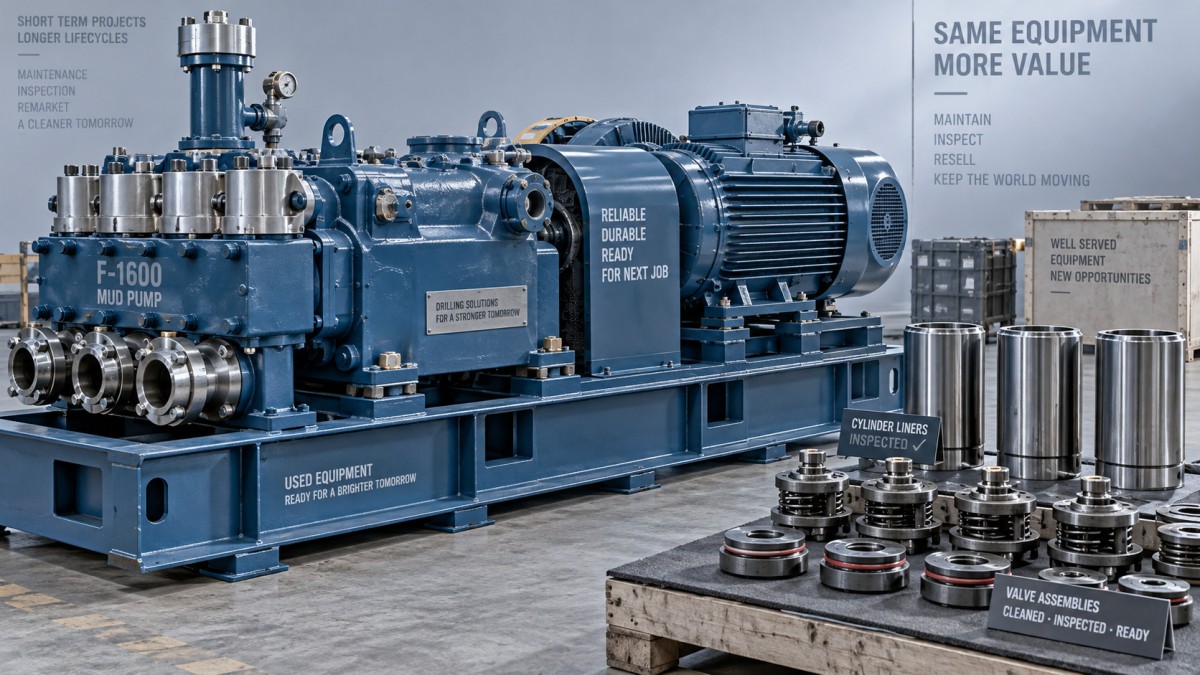
Find the resale threshold that makes buying worthwhile
Instead of debating whether residual value “looks strong,” calculate the minimum net proceeds required for ownership to break even:
Required net resale proceeds = total ownership outlay before resale − comparable total rental cost.
This turns a general purchasing discussion into a testable question: can the equipment realistically deliver those proceeds within the assumed selling period? If the threshold sits close to an optimistic asking price, the purchase case is fragile. A meaningful margin below a credible dealer offer is more defensible, subject to the offer’s conditions.
Run a downside scenario using a lower sale price, additional repairs, and a longer holding period. Also test a project extension: extra rental months may favor ownership, while additional operating wear may reduce its resale advantage. Use project-specific quotations and assumptions rather than a generic depreciation percentage.
Where cash-flow timing matters, compare discounted cash flows rather than nominal totals alone. Paying for equipment now and recovering money well after demobilization can create a funding burden even when the eventual accounting cost appears competitive.
Technical fit influences both operating cost and the exit market
A configuration selected solely for one project may have a narrow resale audience. Driver type, electrical requirements, package completeness, parts availability, and transport practicality can influence which buyers can use it without substantial modification. Check likely secondary-market demand before ordering, not after the equipment returns to storage.
The Mud pump range includes NF and PZ models and diesel-engine or electric-motor drive arrangements, with design and manufacture described as following an API standard. For evaluation, request the applicable standard and edition, model-specific documentation, and the complete package scope. That description should not be treated as independent certification or evidence of a particular resale premium.
SINO-QNP brings more than 30 years of turbomachinery experience across gas turbines, steam turbines, compressors, and generators, with capabilities spanning R&D, design, manufacturing, sales, EPC projects, and spare-parts supply. Its global marketing and service network provides context for discussing package integration and lifecycle support. However, the cost model should rely on written commitments for the specific equipment and destination: parts lead times, service coverage, commissioning responsibilities, and documentation deliverables.
Leasing transfers some risks, not all of them
Rental can protect against uncertain utilization and a difficult resale market. It does not automatically eliminate maintenance or downtime exposure. Read the allocation of wear-part replacement, misuse damage, standby charges, breakdown response, and replacement equipment. A low monthly rate is less useful if a failure leaves the project without a workable substitute.
Buying offers control over availability and maintenance scheduling, but ownership alone does not create service capability. The budget still needs technicians, spare parts, and a response plan. Count future redeployment as a benefit only when another project has credible timing and compatible requirements—not merely because another job might appear.
Make the decision around an executable exit
Resale value can justify buying for a short-term project when the equipment fits the duty, the purchase cost is competitive, and conservative sale proceeds leave a clear advantage after repairs, selling costs, and holding time. Leasing is usually the more defensible choice when utilization is uncertain or ownership only wins under an optimistic exit assumption.
Before approval, obtain a like-for-like rental quote, a complete purchase package, and a documented resale estimate. If a buyback is offered, check its condition limits, operating-hour restrictions, deductions, and payment timing. The deciding figure is not the equipment’s theoretical residual value; it is the cash you can reasonably recover after the project ends.
- ▶ How waste heating value fluctuations affect WTE turbine output
- ▶ What causes mud pump bearings to overheat during continuous operation?
- ▶ Why mud pump discharge pressure drops during continuous operation
- ▶ Should you lease or buy a mud pump for recurring short-term projects?
- ▶ Does mud pump resale value justify buying for a short-term project?
- ▶ How project extensions change the mud pump lease-or-buy decision
Search from here
Leave a message
