




















How waste heating value fluctuations affect WTE turbine output
How waste heating value fluctuations affect WTE turbine output
Waste-to-energy plants rarely receive fuel with a constant heating value. Changes in waste composition and moisture alter boiler heat input, steam production, and operating conditions, affecting WTE turbine output even when waste throughput remains unchanged. The relationship is not simply “more combustible waste equals more electricity.” Furnace capacity, steam conditions, heat extraction, and condenser performance determine how much additional energy reaches the generator.
In conventional combustion-based WTE plants, the turbine is normally a steam turbine. It responds to the steam delivered by the boiler, not directly to the waste. A useful assessment therefore follows the energy path from incoming waste to net exported power, identifying where fluctuations are absorbed, controlled, or constrained.
Heating value changes the boiler’s energy balance
The starting point is the waste’s lower heating value, or LHV, on an as-received basis. This basis matters: a dry-basis laboratory result cannot be applied directly to wet waste throughput. Higher moisture generally reduces available energy per tonne and increases the energy needed to evaporate water. Changes in plastics, paper, food waste, and inert material also shift the heating value.
For an initial calculation, waste thermal input is waste mass flow multiplied by as-received LHV. Heat transferred to steam then depends on boiler efficiency, auxiliary fuel input, and operating conditions. Steam production can be approximated by dividing useful boiler heat transfer by the enthalpy increase from feedwater to main steam.
This explains why unchanged tonnes per hour do not guarantee unchanged megawatts. If LHV falls while throughput remains fixed, less heat is available for steam generation. However, the response is delayed by waste-bed combustion, furnace conditions, and boiler thermal storage. A short disturbance may be buffered; a sustained change eventually affects the steam balance.
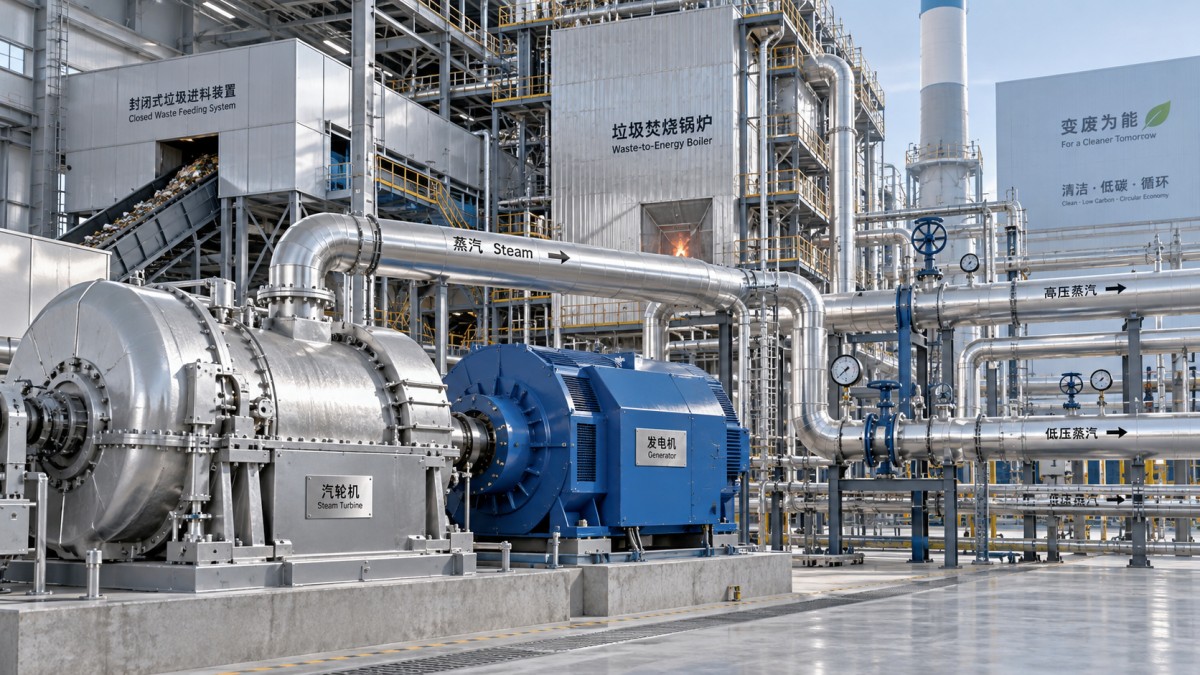
How the steam change reaches the generator
A simplified turbine power relationship is steam mass flow multiplied by the actual enthalpy drop through the turbine, with mechanical and generator losses deducted. For extraction or combined heat-and-power arrangements, the calculation must account for each steam path. Steam diverted to district heating or industrial users cannot contribute the same electrical work as steam expanding through the remaining stages.
When lower LHV reduces steam availability, the turbine governor adjusts admission to maintain the selected operating target within available capacity. Main steam pressure may fall if demand exceeds production. Where boiler controls hold pressure and temperature reasonably steady, reduced steam flow becomes the main cause of lower output.
Part-load efficiency adds another effect. Valve throttling, off-design stage operation, and losses that do not decrease proportionally with output can reduce conversion efficiency. The magnitude depends on turbine configuration and control strategy; it should come from the supplier’s performance curves, not a generic percentage.
Net export can decline more sharply than gross generation because fans, pumps, flue-gas treatment equipment, and other auxiliaries still consume power. Some loads vary with operating conditions, while others remain relatively steady. A turbine-only calculation therefore misses part of the commercial exposure.
Why higher LHV may not increase output
A plant can be limited by waste mass throughput or by thermal input. Once the furnace reaches its allowable thermal load, higher-LHV waste may require a lower feed rate. The boiler’s combustion diagram, showing permissible throughput against heating value, is more informative than a single nominal waste-processing figure.
Several downstream constraints can also flatten the output response:
- Boiler and superheater limits: Steam-generation capacity, metal temperatures, fouling, and corrosion exposure restrict usable heat input.
- Turbine admission capacity: Maximum steam flow and valve capacity limit how much additional steam can be accepted.
- Generator rating: Electrical and cooling limits may cap output before the boiler reaches maximum production.
- Condenser conditions: Higher exhaust pressure reduces available expansion work, particularly during unfavorable cooling conditions.
- Heat-delivery obligations: Required extraction flow can take priority over additional electricity generation.
Higher heating value also says little about fuel chemistry. A waste stream with more combustible material may carry different chlorine, alkali, or metal content. These characteristics need separate assessment; increasing steam temperature to exploit extra heat is not automatically an acceptable response.
Controls should stabilize steam, not chase every fluctuation
Bunker mixing and controlled feeding can reduce fuel variability before it reaches the grate. Combustion control then coordinates feed rate, grate movement, combustion air, and furnace draft. Steam pressure is a useful feedback signal, but its delayed response means aggressive corrections can produce oscillations rather than stability.
Boiler and turbine controls need an agreed operating philosophy. A turbine attempting to hold electrical load while boiler heat input falls may accelerate pressure loss. Conversely, a pressure-following strategy can protect steam conditions while allowing power to vary. The preferred approach depends on grid commitments, heat demand, and equipment limits.
Auxiliary firing may support combustion or steam production where the plant design and permit allow it, but the added fuel must be included in efficiency and operating-cost calculations. Turbine bypass systems can manage certain transients, yet bypassed steam sacrifices generation. Neither measure creates additional waste-derived energy.
Evaluate an operating envelope, not just rated power
A credible WTE turbine specification should connect the expected LHV range to minimum, normal, and maximum steam conditions. Request performance predictions across relevant steam flows, inlet pressures and temperatures, condenser pressures, and extraction demands. Include allowable ramp rates, minimum continuous load, and restrictions during temperature excursions.
For contractual testing, define measurement boundaries and correction methods explicitly. IEC 60953 provides methods for steam turbine thermal acceptance testing, where applicable to the agreed test scope. A turbine acceptance result at specified steam conditions does not by itself demonstrate plant output across variable waste quality. Fuel sampling, boiler performance, and auxiliary consumption require their own agreed treatment.
SINO-QNP’s more than 30 years in turbomachinery, covering steam turbines, compressors, generators, design, manufacturing, EPC support, and spare parts, provides a relevant basis for discussing these interfaces. The useful deliverable is a coordinated boiler–turbine–generator operating envelope, supported by control responsibilities and service provisions, rather than an isolated nameplate rating.
If a project also considers separately fueled generation, SINO-QNP’s Gas Turbine range includes listed models from 2 to 114.5 MW, with fuel options varying by model. That is a separate system decision, not a direct substitute for the steam turbine in a conventional WTE cycle. Any proposed integration needs its own fuel, heat-recovery, emissions, and net-power assessment.
The decisive question is how much power the plant can sustain across its actual waste and cooling conditions. Before accepting an output guarantee, confirm the as-received LHV basis, combustion limits, steam envelope, extraction schedule, and auxiliary-load boundary. Those assumptions determine whether the promised megawatts represent a repeatable operating condition or only a favorable design point.
- ▶ How waste heating value fluctuations affect WTE turbine output
- ▶ What causes mud pump bearings to overheat during continuous operation?
- ▶ Why mud pump discharge pressure drops during continuous operation
- ▶ Should you lease or buy a mud pump for recurring short-term projects?
- ▶ Does mud pump resale value justify buying for a short-term project?
- ▶ How project extensions change the mud pump lease-or-buy decision
Search from here
Leave a message
