




















How extraction steam turbine control valves affect operating stability
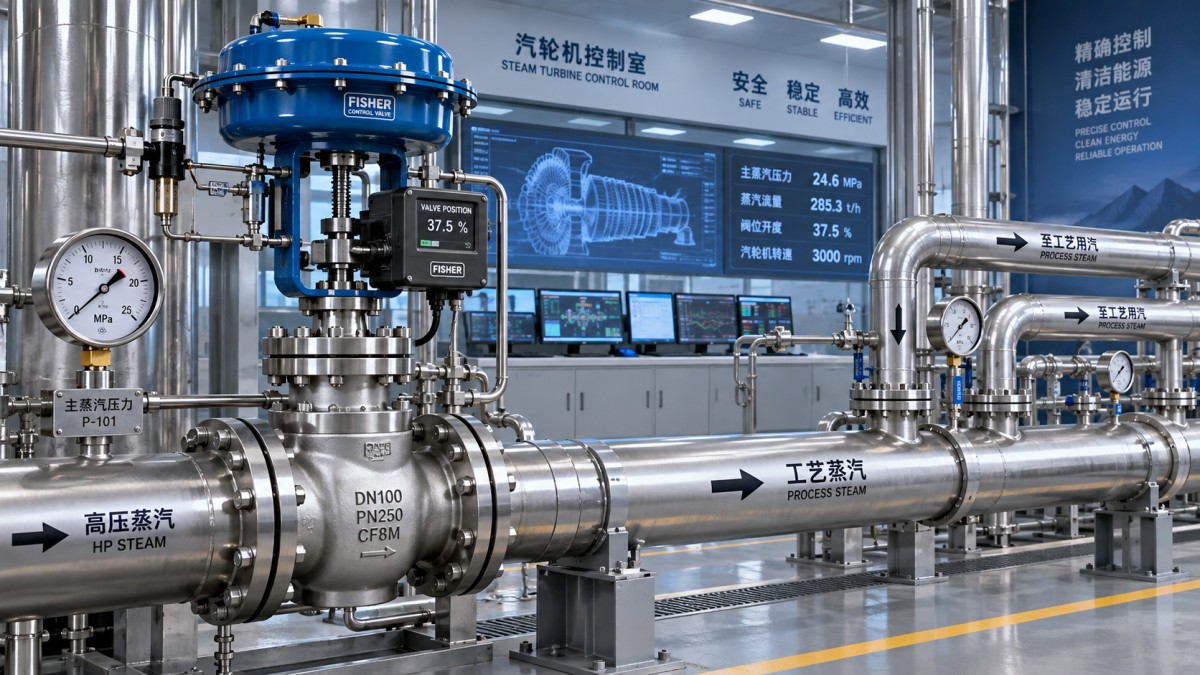
An extraction steam turbine can remain mechanically healthy yet operate unstably when its control valves do not manage steam flow with sufficient accuracy. The reason is simple: the valves regulate two demands that can conflict. The turbine needs stable steam admission to hold speed or electrical load, while the extraction system must maintain usable pressure and flow for process equipment. A small valve error can therefore become a pressure swing, a load disturbance, or a protection trip.
For quality and safety control, the practical issue is not whether a valve opens and closes. It is whether the complete valve loop responds predictably across normal load changes, extraction-demand changes, startup, and upset conditions. Valve stroke, actuator force, position feedback, steam leakage, control logic, and downstream piping conditions all affect that outcome.
Why valve behavior has such a strong effect on stability
In an extraction steam turbine, main steam admission valves control the energy entering the turbine. Extraction control valves, or extraction regulating arrangements, influence how much steam remains available at an intermediate stage for process use. Changes on either side affect the pressure distribution through the turbine.
If a process user suddenly takes more extraction steam, extraction pressure tends to fall. The control system must recognize the change and move the relevant valve in a controlled way. If the response is too slow, the process header pressure may fall below its acceptable operating band. If the valve reacts too aggressively, it can overshoot, causing pressure cycling and repeated corrective movements. That cycling may propagate into turbine load, condenser conditions, boiler controls, or connected process equipment.
The reverse situation is equally important. A sharp reduction in process steam demand can raise extraction pressure. If the control valve cannot reduce flow or redirect steam as intended, the turbine may experience abnormal stage conditions or force the process header toward a high-pressure alarm. Stability is therefore a system outcome, not a valve-only characteristic.
Three valve conditions that create most operating problems
1. Dead band, stiction, and poor low-stroke control
A valve with excessive friction may not move when the controller requests a small correction. The output signal changes, but the stem remains still until the actuator force overcomes friction. It then moves too far at once. This stick-slip behavior creates a recognizable pattern: extraction pressure oscillates while valve position changes in steps rather than smoothly.
This is especially risky where process steam demand changes gradually. Operators may compensate by placing the loop in manual control or reducing controller sensitivity. Those actions can hide the symptom, but they do not remove the mechanical cause. Packing friction, inadequate actuator sizing, damaged stem surfaces, poor linkage condition, and unsuitable positioner tuning should all be examined.
2. Internal leakage and inadequate shutoff
Leakage across a control valve changes the steam balance even when the valve is commanded closed or near closed. In an extraction service, that can make it difficult to stabilize header pressure at low demand. It can also create an unexpected steam path during startup, shutdown, or isolation work.
Leakage is not merely an efficiency concern. For safety managers, it affects isolation assumptions. A valve position indication showing “closed” does not prove that the steam path is isolated. Valve seat condition, trim wear, deposits, thermal distortion, and the actual pressure differential across the valve determine whether shutoff performance remains adequate for the duty.
3. Inaccurate position feedback or actuator failure mode
The controller can only regulate what it can measure. If the position transmitter is miscalibrated, has intermittent signal loss, or does not reflect actual stem travel, the loop may appear healthy while the valve is not following the command. A comparison between controller output, indicated valve position, and process response is more informative than reviewing any one signal alone.
Actuator action must also match the process hazard. Whether a valve should fail open, fail closed, or remain in place depends on the turbine design, extraction header arrangement, bypass capacity, and the consequences of lost instrument air or electrical power. Treating “fail closed” as automatically safer is a common mistake. In some arrangements, abruptly removing extraction steam can damage downstream process stability; in others, continued admission may create an overpressure risk. The required safe state must be defined from the full steam-and-energy balance.
Valve sizing is not the same as stable controllability
A valve may have enough maximum flow capacity and still perform poorly in normal operation. Oversized valves often spend routine operation near the low end of travel, where small stem movements produce disproportionately large flow changes or where controllability is weak. An undersized valve may remain nearly fully open during peak extraction demand, leaving little authority to correct a disturbance.
Quality review should therefore consider the expected operating envelope, not only the design maximum. The valve characteristic, available pressure drop, steam conditions, minimum and maximum extraction demand, and expected rate of demand change should be assessed together. Equal-percentage trim is often selected where the process sees a wide range of load, but the correct choice still depends on the installed pressure-drop behavior and control objective.
Assess the complete control loop, not the valve in isolation
Valve maintenance alone cannot resolve a poorly coordinated turbine and process control scheme. Extraction pressure control may interact with turbine speed/load control, inlet pressure control, boiler firing, pressure-reducing stations, and process-header bypasses. When two controllers attempt to correct the same pressure disturbance through different steam paths, cycling can result even when each loop appears properly tuned on its own.
A useful investigation sequence begins with operating trends. Review extraction pressure, turbine load, valve demand, actual valve position, upstream and downstream pressure, and the status of bypass or pressure-reducing equipment during a disturbance. The timing matters. If valve command changes before pressure moves but the indicated position does not follow, the issue is likely in the valve, actuator, or positioner. If position follows correctly but pressure responds unexpectedly, look at steam demand, piping restrictions, bypass paths, moisture carryover, or interactions with other loops.
Commissioning and major modifications require the same integrated view. In power generation and industrial steam systems, scope definition should include the turbine, steam headers, controls, protection logic, auxiliary systems, commissioning tests, and operator training. For projects that require this broader coordination, an EPC approach can incorporate engineering, equipment interfaces, safety evaluation, installation, and commissioning into one delivery plan rather than treating the extraction valve as a stand-alone procurement item.
What should be verified during inspection and acceptance
For a stable extraction steam turbine, inspection should focus on evidence of controllability under realistic conditions. A static stroke test is necessary, but it is not sufficient. The following checks provide a more meaningful basis for acceptance and ongoing quality control:
- Confirm that commanded travel and actual stem travel agree throughout the operating range, including low-stroke positions.
- Check for smooth bidirectional movement, unexpected reversals, hesitation, and excessive response delay.
- Verify position feedback calibration independently from the control command.
- Evaluate shutoff and internal leakage according to the site’s required isolation and process-control duty.
- Confirm actuator air supply quality, pressure stability, tubing condition, and the response to loss of utility supply.
- Review valve, bypass, trip, and alarm actions against the documented operating philosophy for startup, normal operation, and emergency conditions.
- Trend valve travel and pressure behavior over time; increasing travel activity for the same process demand can indicate emerging friction or trim degradation.
It is also important to distinguish a regulating valve from a protective isolation device. A valve selected for fine control may not provide the isolation integrity needed for maintenance boundaries, and a tight shutoff valve may not have the resolution needed for stable throttling. Where both duties are required, the design should state how each function is achieved instead of assuming one valve can reliably do both.
The most useful next step after an instability event
Do not begin by retuning the controller. First establish whether the valve physically follows its command and whether the measured position is credible. Retuning around stiction, leakage, or incorrect valve action can reduce visible oscillation temporarily while allowing the underlying fault to worsen.
Once mechanical condition and signal integrity are confirmed, assess the event against the full operating state: turbine load, extraction flow demand, inlet steam conditions, header pressure, bypass status, and protective actions. This approach helps quality and safety teams separate a valve defect from a control interaction or process-side disturbance, and it produces a corrective action that improves operating stability rather than only resetting the alarm.
- ▶ How extraction steam turbine control valves affect operating stability
- ▶ When an extraction steam turbine improves combined heat and power output
- ▶ What happens when process steam demand changes on an extraction steam turbine
- ▶ How to match extraction steam turbine pressure to process demand
- ▶ When local service coverage matters for a gas turbine generator manufacturer
- ▶ How manufacturer lead times can alter a gas turbine generator project
Search from here
Leave a message
