




















When an extraction steam turbine improves combined heat and power output
An extraction steam turbine improves combined heat and power (CHP) output when a facility needs electricity and process steam at more than one useful pressure level, and when those demands do not move in perfect lockstep. Its value is not simply that it generates more electricity. The stronger case is that it converts part of the steam’s pressure drop into power before delivering steam to the process at the condition the process actually requires.
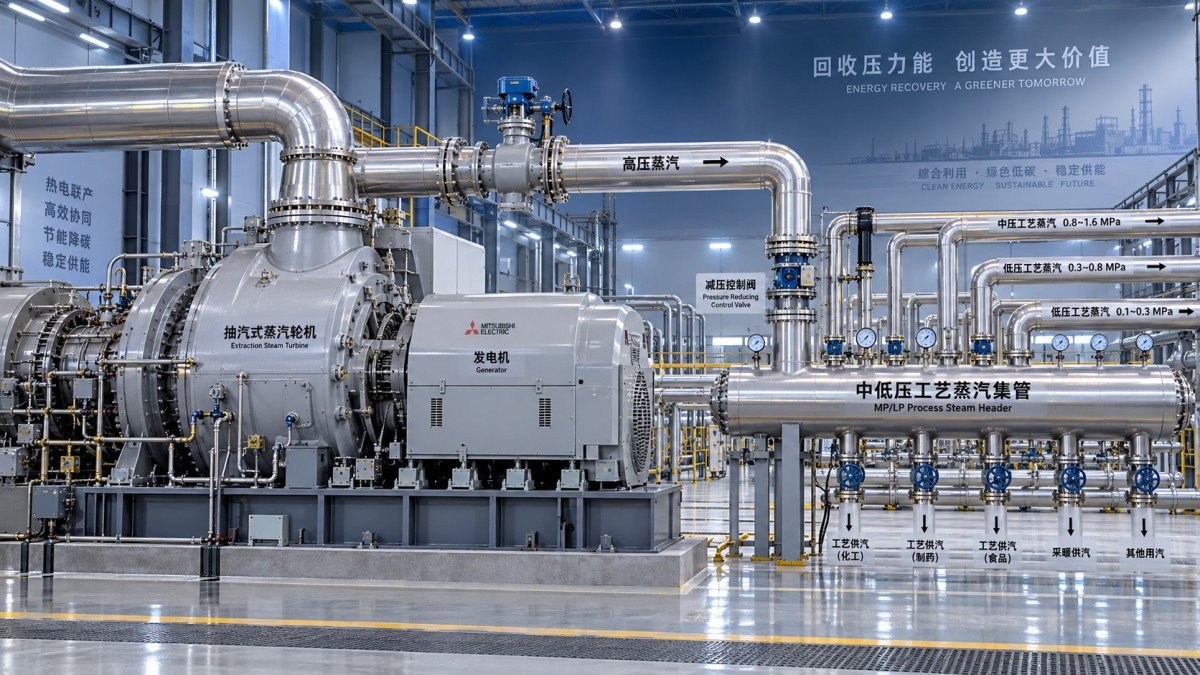
That distinction matters. A plant that produces high-pressure steam in a boiler and reduces it through pressure-reducing valves can meet its heat demand, but the pressure energy is dissipated rather than recovered. An extraction steam turbine places controlled expansion between steam generation and steam use. Electricity is produced during that expansion, while extracted steam is routed to headers serving heaters, evaporators, reboilers, dryers, distillation systems, deaerators, or other thermal loads.
The result can be a more productive use of the same fuel input, provided the turbine, boiler, steam network, and production schedule are designed as one operating system. Where that integration is absent, an extraction turbine can add capital cost and operating complexity without delivering the expected CHP benefit.
The operating condition that creates value
The most suitable facilities have a sustained need for both power and steam, rather than a high demand for only one of them. Chemical processing, refining-related operations, pulp and paper production, food processing, textile finishing, metallurgy, district energy systems, and many light-industrial plants can fit this profile, but the industry label alone is not enough. The deciding factor is the site’s steam-and-power balance.
An extraction turbine is particularly relevant when the site has:
- high-pressure steam available from a boiler, waste-heat source, or recovery system;
- process steam demand at intermediate and/or low pressure;
- an electrical load that can use on-site generation or offset purchased electricity;
- enough operating hours for fuel savings and avoided grid purchases to justify the investment; and
- steam demand that remains reasonably predictable over the turbine’s operating range.
Consider a plant that generates steam at a pressure required by a boiler or heat-recovery source, while major process users need lower-pressure steam. If the plant relies on letdown stations, it pays for the fuel needed to create high-pressure steam but captures no electrical work from the pressure reduction. With an extraction steam turbine, steam expands through selected turbine stages and is extracted at the required header pressure. Remaining steam may continue to a lower-pressure extraction point, to a condenser, or to another end use depending on turbine configuration.
This arrangement can improve the useful energy recovered from fuel, but it does not remove the physical link between heat and power. Every tonne of steam extracted for process use changes the steam flow available for further expansion. The facility therefore needs to evaluate the combined value of electricity and thermal energy, not treat turbine output as an isolated generation figure.
Why extraction is more flexible than a simple back-pressure arrangement
A back-pressure turbine exhausts all steam at a defined process pressure. It can be efficient and mechanically straightforward where one large, stable steam header dominates the site. Its power output, however, is tightly tied to process steam flow. When the process reduces steam demand, turbine throughput and generation decline as well.
An extraction design introduces a controlled withdrawal point within the expansion path. In a controlled-extraction turbine, valves regulate extraction flow and help maintain the required header pressure over a defined operating range. This is useful where a plant must protect process conditions despite changes in electrical load, boiler output, or downstream steam consumption.
For a site with two or more steam headers, extraction can also reduce reliance on multiple pressure-reducing stations. High-pressure steam can be expanded to an intermediate extraction header, while unextracted flow continues to a lower-pressure level. In the right steam balance, this produces more internal power than a single back-pressure exhaust arrangement while supplying steam closer to the conditions required by individual users.
The flexibility should not be overstated. Extraction valves are not a substitute for a sound steam system. If the process demand swings rapidly beyond the turbine’s control capability, the plant may still need pressure-reducing and desuperheating stations, bypass lines, accumulator capacity, or auxiliary steam sources. These are not signs of poor design; they are often necessary safeguards to maintain production during turbine trips, start-up, low-load operation, and abrupt process disturbances.
The central question is the steam balance, not turbine nameplate capacity
A common early-stage error is to start with a desired megawatt rating and select a turbine around it. In CHP, the turbine must be selected around the site’s steam conditions and operating envelope. Nameplate output can look attractive at a single design point yet provide limited value during the hours that dominate annual operation.
A credible assessment begins with time-based data rather than one “average” number. Steam header pressure, temperature, flow, electrical demand, boiler fuel use, imported power, vented steam, pressure-reducing valve duty, seasonal effects, and planned production changes all affect the result. The useful question is: how much steam can pass through the turbine at each operating state while meeting process requirements and equipment limits?
The following conditions deserve particular scrutiny:
- Pressure and temperature requirements. Process users may require saturated steam, controlled superheat, or tightly managed pressure. Extraction steam conditions must match real process needs after accounting for line losses, control margins, and desuperheating where necessary.
- Minimum process-steam demand. A turbine designed around a high steam flow can operate inefficiently or require alternative operating modes when the process is at low load.
- Electrical load profile. The value of generated power depends on whether it offsets imported electricity, supports isolated operation, or must be exported under local grid rules and commercial arrangements.
- Boiler operating limits. Additional turbine flow may require more boiler capacity, different firing behavior, upgraded feedwater systems, or changes to water-treatment capacity.
- Steam quality. Moisture risk in later turbine stages, carryover from boilers, and inadequate condensate management can undermine reliability and lifecycle performance.
These variables explain why two plants with similar boiler capacities can reach very different conclusions about the same extraction steam turbine concept.
Where CHP output improves—and where it does not
“Improved output” can mean several different things. It may mean more on-site electricity from an existing steam flow, more total useful energy from a given fuel input, lower purchased-power exposure, or a better match between utility production and manufacturing demand. A project should define which measure drives the investment decision.
The strongest efficiency gain often occurs when steam previously throttled across pressure-reducing valves is instead expanded through the turbine. The pressure drop already exists because the process needs lower-pressure steam. Recovering work from that drop can increase the site’s useful energy output without requiring process steam to be generated solely for power production.
The case weakens when the facility must raise steam production primarily to maximize electrical generation while there is insufficient thermal demand. In that situation, a condensing turbine, a gas-turbine-based CHP configuration, grid power, or another energy strategy may be more appropriate depending on fuel availability, operating profile, emissions requirements, and project economics. Extraction is most compelling when process heat is a genuine and continuing requirement, not an assumed outlet for surplus steam.
Similarly, a plant with highly intermittent batch loads may find that the turbine spends too much time at off-design conditions unless steam storage, supplementary controls, or flexible boiler operation are included. The appropriate answer is not automatically a larger turbine. It may be a smaller unit sized around the dependable base load, with bypass capacity handling peaks.
Reliability depends on preserving process steam during every operating mode
CHP projects can fail operationally when power-generation objectives are allowed to compromise steam security. For many industrial facilities, loss of steam pressure can stop production, damage product quality, or create safety concerns. The steam network must therefore be designed so that process users remain protected during turbine outages, load rejection, start-up, maintenance, and abnormal boiler conditions.
A robust arrangement typically considers turbine bypass capability, pressure-reducing stations sized for critical demand, isolation philosophy, control-valve response, emergency trip logic, condensate routing, and adequate instrumentation at each steam header. The exact configuration depends on process criticality, but the principle is consistent: the turbine should recover energy from the steam system, not become a single point of failure for it.
Control integration is equally important. Boiler master control, turbine governing, extraction-pressure control, electrical load control, and steam-header pressure control can conflict if they are tuned independently. For example, a sudden reduction in process steam demand can raise header pressure while also changing turbine generation. The control strategy must establish which variable has priority and how bypass systems respond. In most process plants, stable steam delivery takes precedence over maximizing short-term electrical output.
Investment evaluation should use marginal energy value
The business case is often distorted by valuing every kilowatt-hour at a single assumed electricity price and every unit of steam at a simple fuel-cost equivalent. A more useful approach compares the incremental value of power recovered through expansion with the incremental costs and constraints required to deliver the needed steam.
Relevant cost elements include turbine-generator equipment, foundations, piping changes, electrical interconnection, switchgear, controls, water-system upgrades, emissions-control implications, civil work, commissioning, spares, and the cost of maintaining steam backup. Fuel economics should reflect the boiler’s real efficiency at expected loads, not only its rated condition. Electricity savings should reflect tariff structure, demand charges where applicable, reliability value, and any restrictions on parallel operation or export.
Lifecycle analysis also needs to include planned outages. A turbine with a favorable design-point heat rate is not necessarily the better asset if service support, spare-part availability, inspection access, or outage coordination creates disproportionate production risk. For projects involving substantial utility-system modifications, a coordinated engineering scope can be more important than a narrowly priced turbine package. Services such as feasibility work, energy assessment, design of boiler and auxiliary interfaces, electrical systems, commissioning, and operator preparation are often part of the same decision. In that context, an integrated EPC approach may help keep responsibility for the steam cycle, balance-of-plant systems, and performance interfaces aligned.
Design choices that change the practical result
Extraction turbines are not a single configuration. A non-condensing extraction turbine is suited to sites where nearly all inlet steam has a useful process destination. An extraction-condensing turbine provides another degree of freedom: steam not required by the process can continue to a condenser, allowing additional power generation within condenser, cooling, and operating limits. That flexibility can be valuable when process steam demand varies, but it introduces condenser duty, cooling-water or air-cooling requirements, and a different capital and maintenance profile.
Controlled extraction is generally preferable where header pressure must be maintained within a defined range. Uncontrolled extraction may be acceptable in narrower applications, but the steam flow and pressure relationship must be understood carefully. Decisions on inlet pressure, extraction pressure, exhaust pressure, speed, generator arrangement, and auxiliary systems should be based on the annual operating envelope rather than only the maximum case.
There is also a practical limit to how much efficiency can be captured. Steam piping losses, desuperheating requirements, turbine internal efficiency, minimum flow constraints, auxiliary power consumption, and part-load operation all reduce theoretical gains. A feasibility model that ignores these factors may overstate recoverable power and understate the size of supporting systems.
A sound decision begins with the conditions the plant cannot compromise
An extraction steam turbine is a strong CHP solution when it sits between an available high-pressure steam source and a durable process demand for lower-pressure steam, while the generated electricity has meaningful on-site value. It is less suitable when thermal demand is weak, highly erratic without mitigation, or disconnected from the electrical objective.
The most reliable investment decisions define non-negotiable process steam requirements first, map hourly or representative operating states, quantify bypass and backup needs, and then determine how much pressure energy can be recovered without reducing production resilience. When that sequence is followed, the extraction turbine becomes more than a generator: it becomes a controlled energy-recovery element that can improve the economics and operational usefulness of the entire steam system.
- ▶ When an extraction steam turbine improves combined heat and power output
- ▶ What happens when process steam demand changes on an extraction steam turbine
- ▶ How to match extraction steam turbine pressure to process demand
- ▶ When local service coverage matters for a gas turbine generator manufacturer
- ▶ How manufacturer lead times can alter a gas turbine generator project
- ▶ Which certifications matter when choosing a gas turbine generator manufacturer
Search from here
Leave a message
