




















What happens when process steam demand changes on an extraction steam turbine
A change in process steam demand does not stay isolated at the extraction point. On an extraction steam turbine, it changes the balance between steam sent to the process, steam expanded through the lower-pressure turbine stages, and electrical or mechanical power delivered by the shaft. A sudden increase in process demand may reduce the steam available for further expansion, while a rapid reduction can raise extraction pressure unless the control system responds correctly.
For operators, the immediate priority is not simply to match the requested process flow. The turbine must maintain extraction pressure within the process requirement, avoid unstable governor action, preserve acceptable condenser conditions, and keep the machine within its approved operating limits. The correct response depends on whether the turbine is operating in extraction-pressure control, load control, inlet-pressure control, or a coordinated mode.
The basic flow balance changes with process demand
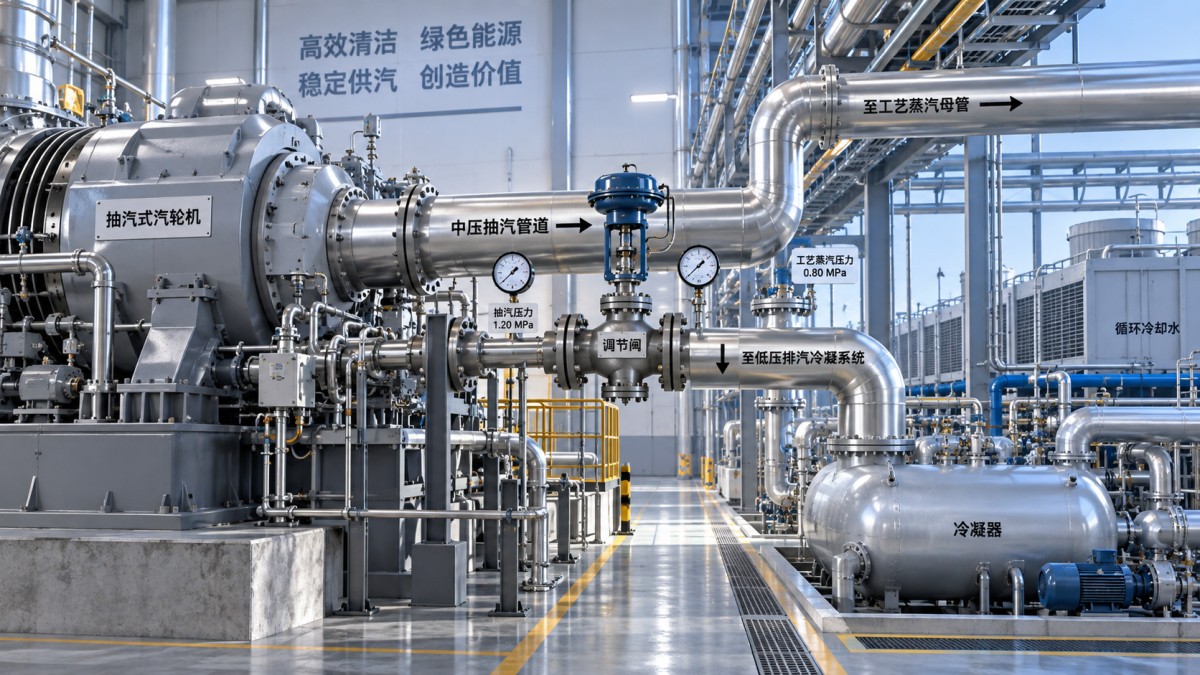
An extraction turbine receives high-pressure steam at the inlet, expands part of it through the early stages, and removes a controlled quantity at an intermediate pressure for process use. The remaining steam continues through later stages toward the exhaust or condenser. When process steam demand changes, the split between extracted steam and exhaust steam changes as well.
When process demand rises, the extraction control valve normally opens further to supply more steam. If inlet steam flow remains unchanged, less steam continues through the low-pressure stages. Shaft power may therefore fall, especially on a condensing extraction unit where the remaining steam would otherwise produce additional work during expansion. If the turbine is required to hold generator output, the governor may increase inlet steam flow to compensate.
When process demand falls, the extraction valve closes to restrict process flow. More steam then tends to continue to the downstream turbine stages. Depending on the governing arrangement, this can increase power output, lower extraction pressure, or both. A rapid process load rejection can be particularly demanding because the process side stops accepting steam before the turbine and governor have fully stabilized.
What operators may see during a demand increase
A gradual increase in process steam use is usually manageable when the extraction-pressure controller, inlet governor, and process pressure-control system are all correctly tuned. The common operating pattern is an opening extraction valve, higher extracted flow, a change in inlet valve position, and a shift in turbine load.
The exact result depends on the turbine’s control philosophy:
- Extraction pressure held, turbine load allowed to move: the turbine supplies the additional process steam, and shaft power may decrease as less steam reaches the later stages.
- Generator load held, extraction pressure held: inlet steam flow generally has to increase so that both process demand and power demand can be met.
- Inlet steam flow limited: process steam demand may not be fully satisfied. Extraction pressure can sag, and the process header may need support from a pressure-reducing station or another steam source.
Low extraction pressure is often the first visible symptom when process demand rises faster than the turbine can admit and distribute additional steam. Do not assume the extraction valve alone is the cause. The valve may already be near its travel limit, the inlet governor valves may be restricted, boiler pressure may be declining, or the process header may be consuming steam faster than indicated by the extraction-flow measurement.
Why power output often drops
Steam extracted at an intermediate pressure has not completed its available expansion through the turbine. A larger proportion of steam leaving at the extraction point means less mass flow through the downstream blading. The reduction in low-pressure-stage flow reduces the work produced in those stages. This is a normal thermodynamic effect, not automatically a sign of poor turbine performance.
Problems arise when the operating team treats every power reduction as a governor fault and forces inlet flow upward without checking steam conditions and operating limits. More inlet flow can restore load, but it may also push extraction flow, exhaust flow, valve travel, or boiler demand beyond the intended range. The turbine should be operated against its approved extraction and load map rather than by a single parameter alone.
A process demand decrease can create faster pressure disturbances
When a process user suddenly closes a major steam consumer, the extraction header pressure can rise quickly. The extraction valve should close in response, while the governor adjusts inlet steam flow as required by the selected load or pressure-control mode. Before that response is complete, the turbine may experience a temporary redistribution of flow toward the exhaust end.
On a condensing extraction machine, higher exhaust steam flow can affect condenser pressure and hotwell conditions. A deteriorating vacuum reduces the turbine’s expansion ratio and may trigger load limitations or protective action. On a back-pressure arrangement, downstream steam-system pressure can rise instead, so the receiving header and associated control valves become just as important as the turbine itself.
Watch for a combination of rapidly rising extraction pressure, changing valve positions, generator load movement, exhaust pressure changes, and oscillating process-header pressure. These variables tell more than any single alarm. For example, rising extraction pressure with a nearly closed extraction valve may point to a process-side isolation issue or a pressure-control valve that is passing. Rising pressure with an extraction valve that remains open may indicate a controller signal problem, poor valve response, or incorrect pressure feedback.
Separate a real steam imbalance from an instrument problem
Not every apparent demand change is a true process event. Extraction pressure transmitters, flow elements, valve-position feedback, and load signals can all introduce misleading information. Before making a large manual correction, compare the control-room trend with independent indications where available.
Valve stiction deserves attention because it can look like an unstable process. The controller sends small corrections, but the extraction valve does not move until the force becomes large enough to overcome friction. Pressure then overshoots, the controller reverses, and the cycle repeats. A trend showing smooth valve command with stepped or delayed position feedback is a useful warning sign.
Control interactions that can make a small change unstable
Extraction turbines often have multiple loops acting on related variables. An extraction-pressure controller may modulate an extraction valve, while the governor controls speed or generator load through inlet valves. A boiler master, header-pressure controller, bypass station, or import-steam valve may also respond to the same pressure disturbance. Poor coordination can lead to competing actions.
For example, a falling process header pressure may cause the extraction turbine to increase extraction flow while a pressure-reducing station opens at the same time. If both systems overreact, header pressure may overshoot. The turbine then reduces extraction, the reducing station closes, and pressure may fall again. The issue is not always a defective component; dead bands, response speeds, pressure setpoints, and controller tuning may simply be mismatched.
During stable operation, trend the process header pressure, extraction pressure, extraction valve command and feedback, inlet governor position, main steam pressure and temperature, turbine load, exhaust pressure, and condenser vacuum where applicable. A short, well-timed trend around the disturbance is more useful than reviewing isolated values after the system has recovered.
Operator response during a changing steam requirement
Large manual valve movements can create a second disturbance while the automatic controls are already responding. Unless site procedures require manual intervention, first allow the designated control mode to act and verify that the response is moving in the expected direction. Then determine whether the machine has reached a limit or whether the controls are failing to follow the demand.
- Confirm whether the process header pressure is genuinely moving and whether the demand change is gradual or abrupt.
- Check the active control mode and setpoints. A turbine in load control will react differently from one in extraction-pressure control.
- Compare extraction valve demand with actual position. A mismatch can indicate actuator, positioner, air-supply, or mechanical travel issues.
- Check available inlet steam pressure and temperature. Inadequate inlet conditions may prevent the turbine from sustaining both process flow and power.
- Review exhaust or condenser conditions before increasing inlet steam substantially. A downstream restriction can limit safe operation.
- Verify supporting steam-system equipment, including bypass valves and pressure-reducing stations, so that multiple controllers are not driving the header in opposite directions.
Where plant arrangements include compressor drives, changes in turbine power can also affect connected rotating equipment. A compressor train may have its own anti-surge controls, load limits, or process constraints. Coordination between turbine load changes and the driven machine’s control system helps avoid treating a steam-side disturbance and a compression-side response as unrelated events. For integrated turbomachinery applications, a properly matched Compressor unit and control interface can make these operating interactions easier to manage, but the steam balance and protection logic still need to be validated for the actual installation.
Operating limits should guide the final decision
An extraction steam turbine cannot supply unlimited process steam at every electrical load. Its allowable operating range is shaped by inlet steam conditions, extraction pressure, exhaust pressure, blade-path flow requirements, valve capacity, generator or driven-equipment demand, and mechanical protection settings. Low-flow operation through certain turbine sections, excessive exhaust pressure, high moisture conditions, or abnormal differential expansion can limit the response even when the process requests more steam.
When extraction pressure cannot be maintained, the right action may be to reduce process demand, bring an auxiliary steam source online, adjust a bypass arrangement, or revise the turbine load target within approved limits. When pressure rises following a demand reduction, confirm that excess steam has a controlled path and that the turbine is not being forced into an unstable low-load or high-exhaust-flow condition.
The key operating habit is to view extraction pressure, inlet flow, shaft load, and exhaust conditions as one connected system. A demand change is successfully handled only when the process receives stable steam and the turbine settles at a safe, controllable point rather than merely reaching the requested pressure for a few moments.
- ▶ When an extraction steam turbine improves combined heat and power output
- ▶ What happens when process steam demand changes on an extraction steam turbine
- ▶ How to match extraction steam turbine pressure to process demand
- ▶ When local service coverage matters for a gas turbine generator manufacturer
- ▶ How manufacturer lead times can alter a gas turbine generator project
- ▶ Which certifications matter when choosing a gas turbine generator manufacturer
Search from here
Leave a message
