




















How to match extraction steam turbine pressure to process demand
The correct extraction pressure is not simply the pressure written on a process steam specification. It is the pressure that must be available at the process header under the lowest credible supply condition, after allowing for pipe losses, control-valve pressure drop, measurement uncertainty, and changes in steam demand. Setting an extraction steam turbine too close to the nominal process requirement may appear efficient on paper but can leave the plant unable to hold header pressure during load swings. Setting it unnecessarily high can force downstream throttling and destroy recoverable energy.
For an extraction steam turbine, pressure matching is therefore a system decision rather than a turbine-only decision. The turbine, process header, boiler, pressure-reducing stations, condensate return system, and electrical load all influence whether the selected extraction condition is stable and useful.
Start with the pressure needed at the point of use
Process demand should be defined at the consuming equipment, not at the turbine extraction flange. A reactor jacket, dryer, evaporator, stripping column, tracing system, or deaerator may each require a different pressure for a different reason. Some need saturated steam at a defined temperature. Others need a minimum pressure to maintain control-valve authority or to prevent flashing in the distribution system. A header can also contain users with significantly different sensitivity to pressure variation.
The operating requirement should be expressed as a pressure envelope:
- minimum allowable pressure at the most critical user;
- normal operating pressure at the process header;
- maximum pressure that process equipment and control valves can accept;
- minimum, normal, and peak steam flow;
- expected duration and frequency of demand peaks;
- steam condition required by the process, including saturation, superheat, moisture tolerance, and condensate behavior.
From this envelope, calculate backward to the turbine extraction connection. Distribution losses are not fixed. A long header experiences greater pressure loss when flow increases, while a partially closed isolation valve, undersized separator, fouled strainer, or restrictive control valve can create an additional local loss. The extraction setpoint must cover these losses at the flow condition that matters most, rather than at average steam consumption.
A process needing 10 barg at its most remote consumer does not automatically imply a 10 barg extraction setting. The turbine may need to deliver a higher pressure to the header so that the required pressure remains available after the distribution network takes its share. The necessary margin should be calculated from the actual piping arrangement and flow cases, not added as an arbitrary percentage.
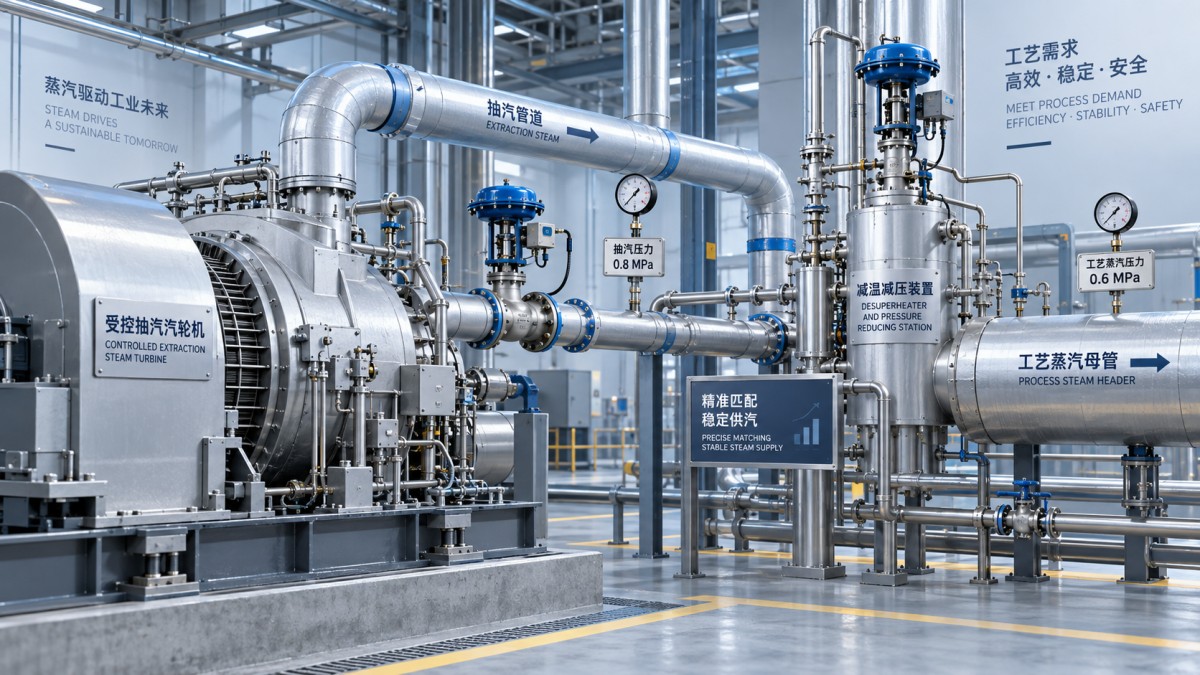
Distinguish controlled extraction from pressure that follows turbine load
This distinction determines whether the turbine can genuinely support a process steam header.
In a controlled-extraction turbine, an extraction control system regulates steam admission to the downstream turbine sections so that extraction pressure is held near its setpoint within the machine’s permissible operating range. The turbine can then respond to changes in process extraction flow by adjusting internal steam distribution, provided sufficient inlet steam, available expansion range, and control-valve capacity exist.
In a non-controlled extraction arrangement, extraction pressure is largely determined by steam flow through the turbine and the pressure profile across its stages. When electrical load, inlet flow, condenser condition, or downstream flow changes, the extraction pressure changes with them. Such an arrangement may be suitable where the extracted steam serves a tolerant user or where another pressure-control device protects the process header. It is not a substitute for a regulated process steam supply when the process requires a narrow pressure band.
This is one of the most consequential selection errors: treating an extraction point as though it were a guaranteed-pressure steam source. A turbine vendor’s extraction pressure rating must be read together with the extraction flow range, inlet condition, exhaust condition, generator load range, and governing arrangement. A stated design pressure alone says little about pressure stability across real operating conditions.
Build the steam balance around operating cases, not averages
Average annual steam consumption is useful for energy studies but insufficient for pressure matching. The relevant question is whether the turbine can maintain the required extraction pressure at each credible combination of process demand and electrical demand.
A practical steam balance should include, at minimum, these conditions:
- normal process demand with normal generator load;
- maximum extraction demand;
- minimum extraction demand;
- high electrical demand with reduced process demand;
- low electrical demand with high process demand;
- start-up, warm-up, and process ramp conditions;
- loss of a parallel steam source, pressure-reducing station, or major process user.
The difficult cases are usually the mismatched ones. High process steam demand may leave less steam available to expand through the low-pressure section, reducing electrical output. Conversely, low process demand can force more steam through lower-pressure stages or require bypassing, condensing, or reducing inlet flow. The operating philosophy must decide which demand has priority when the two conflict: process header pressure, electric output, boiler stability, or minimum turbine flow.
There is no universal answer. In a process plant, loss of steam pressure may directly disturb production or equipment temperature control, so header stability may take precedence. In another installation, grid or site electrical requirements may constrain turbine loading. The turbine’s rated extraction range must support the chosen priority without relying on an operating condition that is only briefly permissible.
Check steam quality, not pressure alone
Pressure determines saturation temperature, but process suitability also depends on steam quality. If the process requires saturated steam for predictable heat transfer, excessive superheat can reduce control responsiveness and complicate condensate formation. If wet steam reaches equipment that requires dry steam, erosion, poor heat transfer, and water hammer risk can increase.
Extraction steam may need desuperheating, moisture separation, or header conditioning depending on the turbine exhaust condition and process requirement. These devices impose pressure losses and have their own operating limits, so they belong in the pressure calculation. A desuperheater also needs adequate pressure differential and suitable spray-water conditions to control temperature effectively.
Condensate return deserves the same attention. If the selected process pressure produces condensate at a pressure incompatible with the return system, flash steam, backpressure, pumping limitations, or unstable trap performance can affect the steam balance. A pressure selection that looks efficient at the turbine can create operating problems downstream if the condensate network was designed around another pressure level.
Allow pressure-control margin without turning the turbine into a throttling station
A controlled extraction valve requires a usable pressure differential to regulate flow. If the turbine extraction setpoint is only marginally above the header requirement, the valve may reach a wide-open position during peak demand and lose its ability to hold pressure. If the setpoint is much higher than required, the valve continually throttles steam, converting a potentially useful pressure drop into an avoidable loss.
The best setpoint is generally the lowest extraction pressure that still maintains required process pressure at the critical user under the defined maximum-flow condition, while retaining enough control margin for normal disturbances. That conclusion must be checked against the turbine performance map. Lower extraction pressure may increase the available expansion work, but only if it remains compatible with process temperature needs, downstream equipment, and stable turbine operation.
Where a plant serves multiple pressure levels, it may be more effective to extract at the highest genuinely useful header pressure and use a controlled pressure-reducing/desuperheating station for a smaller lower-pressure header. This is not automatically the most efficient arrangement; it depends on the quantity and continuity of low-pressure demand. The key is to avoid creating a high-pressure extraction solely because a minor, intermittent user needs it.
The same principle applies to ancillary equipment. Hydraulic systems may use equipment such as an Mud pump, but its discharge-pressure selection is independent of steam-header control. Mixing pressure ratings from unrelated utility systems into a steam balance can lead to incorrect assumptions about available control margin.
Respect the turbine operating envelope
An extraction steam turbine cannot be selected only from desired extraction pressure and flow. Its limits may include maximum extraction flow, minimum flow through downstream stages, inlet valve capacity, exhaust pressure restrictions, casing temperature limits, rotor thrust limits, generator capability, and allowable rates of load change. The precise limits depend on the turbine design and control arrangement.
High extraction flow reduces the steam that continues to the lower-pressure section. At some point, low flow through those stages can impair cooling, increase ventilation losses, or move the turbine outside its approved operating region. At the opposite extreme, insufficient extraction demand can raise header pressure unless turbine admission, bypassing, condensing capacity, or another steam consumer absorbs the difference.
These constraints are especially important where the process header is expected to act as a buffer for rapidly changing demand. A steam header has some pressure-storage effect, but it is not a large energy store. Sudden extraction changes can be faster than boiler combustion control, turbine valve response, and desuperheater response can fully coordinate. The selected turbine and control scheme must be assessed for the expected rate of change, not only steady-state points.
Use control architecture that reflects the operating priority
Pressure control normally depends on coordination between the extraction pressure controller, turbine governor, inlet steam supply, generator load control, and any PRDS or bypass station. Poor coordination can produce oscillation: the extraction valve reacts to falling header pressure, generator load changes, boiler controls respond, and the header then overshoots.
The controlled variable should be clear. If process-header pressure is the priority, the extraction controller needs authority to protect it within turbine limits, while electrical output follows the remaining available steam expansion. If power output is held tightly instead, an independent pressure-control source such as a PRDS may be needed to protect process users during a disturbance.
Pressure sensing should represent the header condition that matters operationally. A transmitter mounted immediately at the turbine outlet may show acceptable pressure while a distant user experiences a shortage. Conversely, locating the only sensing point at the end of a fluctuating branch can make the turbine controller chase a local disturbance. Multiple measurements, properly selected control points, and comparison with remote header readings improve diagnosis.
Selection information that prevents later surprises
Before confirming an extraction condition, the turbine supplier and plant team should work from the same documented basis: inlet pressure and temperature range, extraction pressure range, extraction-flow envelope, exhaust destination and backpressure range, required electrical output range, process steam quality, header pressure-drop calculation, control philosophy, startup conditions, and fallback steam sources.
During commissioning, compare predicted and measured pressure drops at several flow levels, verify valve travel and controller response, and confirm that the process header remains within limits during realistic load changes. If pressure stability depends on a valve staying nearly fully open or nearly closed, the selected operating point has little resilience. Re-examining the extraction setpoint, piping restriction, control tuning, or backup-pressure arrangement is preferable to accepting chronic instability.
A properly matched extraction steam turbine supplies process steam at the lowest practical pressure that satisfies the real header requirement, while preserving control authority and remaining inside the turbine’s permitted flow-load envelope. That balance—not the nominal extraction rating—is what determines whether the installation delivers stable process operation and useful power recovery.
- ▶ When an extraction steam turbine improves combined heat and power output
- ▶ What happens when process steam demand changes on an extraction steam turbine
- ▶ How to match extraction steam turbine pressure to process demand
- ▶ When local service coverage matters for a gas turbine generator manufacturer
- ▶ How manufacturer lead times can alter a gas turbine generator project
- ▶ Which certifications matter when choosing a gas turbine generator manufacturer
Search from here
Leave a message
