




















Why an impulse steam turbine loses power when steam pressure drops
An impulse steam turbine loses power when falling inlet pressure reduces the steam flow, the energy available for expansion, or both. The result is less torque at the shaft. Speed may initially remain steady because the governor opens the control valve, a grid-connected generator remains at synchronous speed, or the rotating assembly briefly supplies energy as it slows.
A pressure drop therefore deserves attention even before speed changes. Its effect depends on where pressure is measured, steam temperature, exhaust pressure, and how much control-valve capacity remains. The first operating question is whether the turbine can still deliver the required load within its approved operating limits.
How lower pressure reduces shaft power
In an impulse stage, steam expands mainly through stationary nozzles, converting part of its available energy into velocity. The moving blades extract work by changing the direction and momentum of that steam. Lower pressure can weaken this process through two separate mechanisms: less steam passes through the nozzles, and each kilogram may have less energy available to convert into work.
Less steam reaches the blades
For a fixed nozzle area operating under choked-flow conditions, steam mass flow depends strongly on the absolute pressure immediately upstream of the nozzles, as well as temperature and steam properties. Choking means that downstream pressure changes no longer control mass flow in the same way; it does not make flow independent of upstream pressure.
If nozzle inlet pressure falls while temperature remains similar, mass flow generally falls. Even if the steam jet retains a relatively high velocity, less mass reaches the blades each second, reducing the momentum transfer that produces torque. A governor can compensate by opening the admission valve, but only while sufficient valve capacity and steam supply remain available.
Less expansion energy may be available
The energy available for expansion depends on both inlet conditions and outlet pressure. When inlet pressure falls while exhaust pressure stays unchanged, the available isentropic enthalpy drop generally decreases. The nozzles can then produce less jet velocity, and the blades have less energy to extract from each kilogram of steam.
The pressure ratio helps explain the direction of the change, but it cannot establish the power loss by itself. Steam temperature matters, and pressure readings alone do not define the inlet thermodynamic state. Pressure calculations also require absolute values; dividing gauge-pressure readings can give a misleading ratio.
A useful operating relationship is that shaft power depends on steam mass flow multiplied by the useful energy extracted per unit mass. If both decline, their effects combine. There is no reliable universal rule that a given percentage reduction in inlet pressure produces the same percentage reduction in power.
Blade efficiency can change as well. At constant rotor speed, a lower nozzle velocity changes the relationship between blade speed and steam speed. This moves the stage away from its design velocity relationship and can further reduce efficiency. The magnitude depends on the turbine design and operating point.
Why steady speed can hide falling output
On a generator connected to a stable electrical grid, turbine speed remains tied to grid frequency. Reduced steam torque normally appears as lower electrical output while speed stays essentially constant. Operators should therefore trend active power alongside inlet pressure and valve position. A steady speed indication does not establish that the turbine is maintaining its output.
For a turbine driving a pump or compressor, the governor may initially preserve speed by increasing steam admission. The useful warning is often a rising valve-position signal with little improvement in delivered load. Once the valve reaches its effective admission limit, further pressure loss leaves the turbine unable to sustain the same operating point.
Valve opening alone is not proof that enough steam is reaching the nozzles. The control system may command more opening while an actuator fault, restricted strainer, supply limitation, or partially closed upstream valve prevents the expected flow increase. Where instrumentation permits, compare commanded position, actual position, and pressures across the admission path.
Driven-equipment behavior also matters. A load reduction can allow speed to remain steady despite reduced turbine capability. Conversely, an increase in compressor or pump demand can produce a speed decline at the same time as a steam-pressure disturbance. Trend the driven process alongside the turbine to distinguish these effects.
Locate the pressure loss before changing settings
Start with a time-aligned record of supply-header pressure, turbine inlet pressure, steam temperature, exhaust pressure, steam flow, valve position, speed, and delivered load. Use existing instruments and approved operating procedures. Check sensor locations and whether the indicated pressure is upstream or downstream of the control valve; those readings answer different questions.
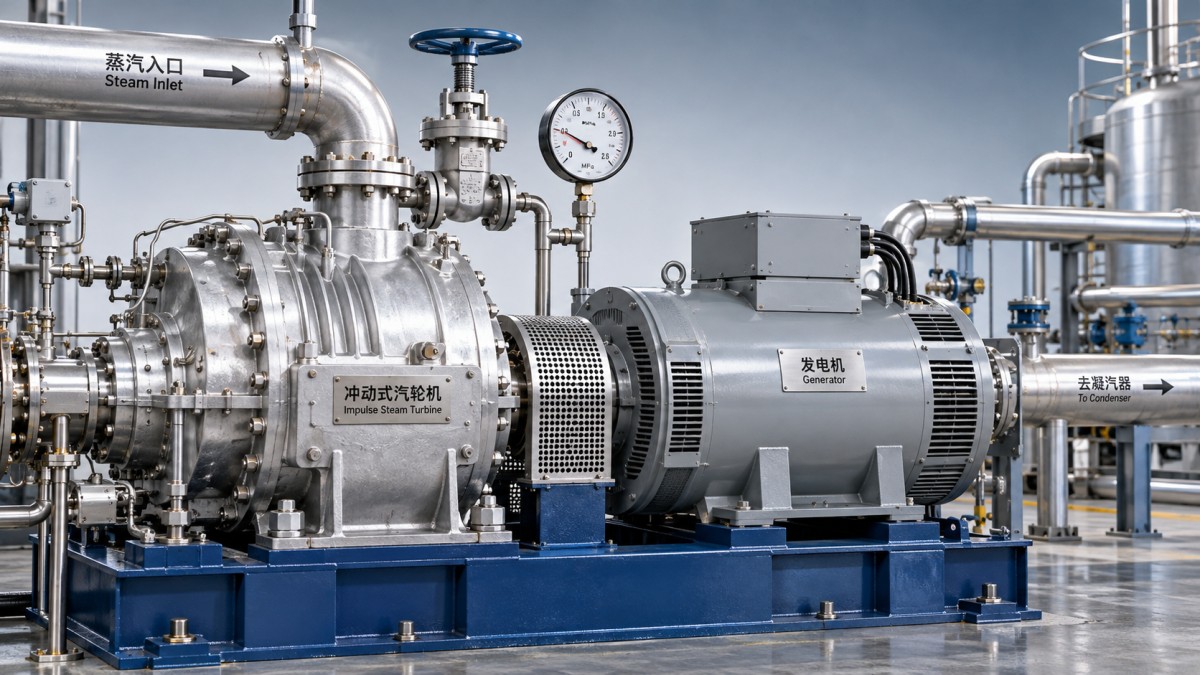
- Header and turbine inlet pressure fall together: investigate steam-generation capacity, competing steam demand, pressure-reducing equipment, and changes in the supply system. A common supply disturbance becomes more likely.
- Header pressure remains steady but turbine inlet pressure falls: examine the admission path. Check isolation-valve alignment, strainers, control-valve operation, and line pressure losses. Compare conditions at similar steam flows, since pressure loss through a restriction changes with flow.
- Inlet pressure remains steady while exhaust pressure rises: reduced expansion energy may explain the output loss. For a condensing turbine, examine condenser conditions and vacuum-system performance. For a backpressure turbine, examine the receiving steam header and downstream demand.
- Pressure and temperature appear stable while output falls: widen the investigation to actual steam flow, valve feedback, driven-equipment load, and turbine condition. Stable readings at one location do not rule out an admission or internal restriction.
The order of events helps narrow the cause. A header-pressure decline followed by increased valve opening and falling output supports a supply limitation. A valve-command change preceding the pressure decline may point toward a control response or load change. Allow for instrument response times before treating a small timing difference as conclusive.
If the disturbance followed maintenance or a lineup change, review the affected equipment first. Confirm valve positions and instrument availability through the site's procedures. Avoid opening drains, bypasses, or pressurized connections simply to test a theory.
Check temperature, exhaust conditions, and operating limits
A pressure drop accompanied by a temperature drop can reduce turbine capability more than pressure alone suggests. Evaluate both readings against the specified inlet steam conditions. Inlet pressure and temperature together can indicate whether superheat margin is being lost, but they do not by themselves establish the steam condition throughout the expansion path.
Suspected water carryover, abnormal vibration, unusual noise, or unstable operation requires attention under the turbine's operating instructions. Restoring header pressure does not resolve a steam-quality problem. Check relevant separators, drainage arrangements, and boiler or steam-conditioning conditions through established procedures.
Exhaust pressure deserves equal attention. Recovering inlet pressure may deliver little improvement if condenser vacuum remains poor or a backpressure header stays elevated. Compare the current inlet and outlet conditions with the manufacturer's performance curves or operating map. These provide a stronger basis for judging recoverable output than an assumed pressure-to-power conversion.
When admission capacity is exhausted, reduce load as permitted by the turbine and driven process, and address the identified supply or exhaust constraint. Repeatedly raising the speed or load demand cannot create additional steam energy. Increasing supply pressure beyond equipment limits is not an acceptable recovery measure.
After conditions stabilize, compare output at similar inlet temperature, exhaust pressure, speed, and load conditions. If performance returns, the evidence supports an operating-condition limitation. If a deficit remains, retain the trend record for a focused review of instrumentation, valve travel, restrictions, and internal condition. That comparison determines whether the next step belongs with steam-system operation, control maintenance, or turbine inspection.
- ▶ Why an impulse steam turbine loses power when steam pressure drops
- ▶ How does partial admission affect an impulse steam turbine?
- ▶ When should you choose an impulse steam turbine over a reaction design?
- ▶ How does an impulse steam turbine convert steam into shaft power?
- ▶ When a 50 MW steam turbine fits an industrial captive power plant
- ▶ How to assess overload capability in a 50 MW steam turbine
Search from here
Leave a message
