




















When a 50 MW steam turbine fits an industrial captive power plant
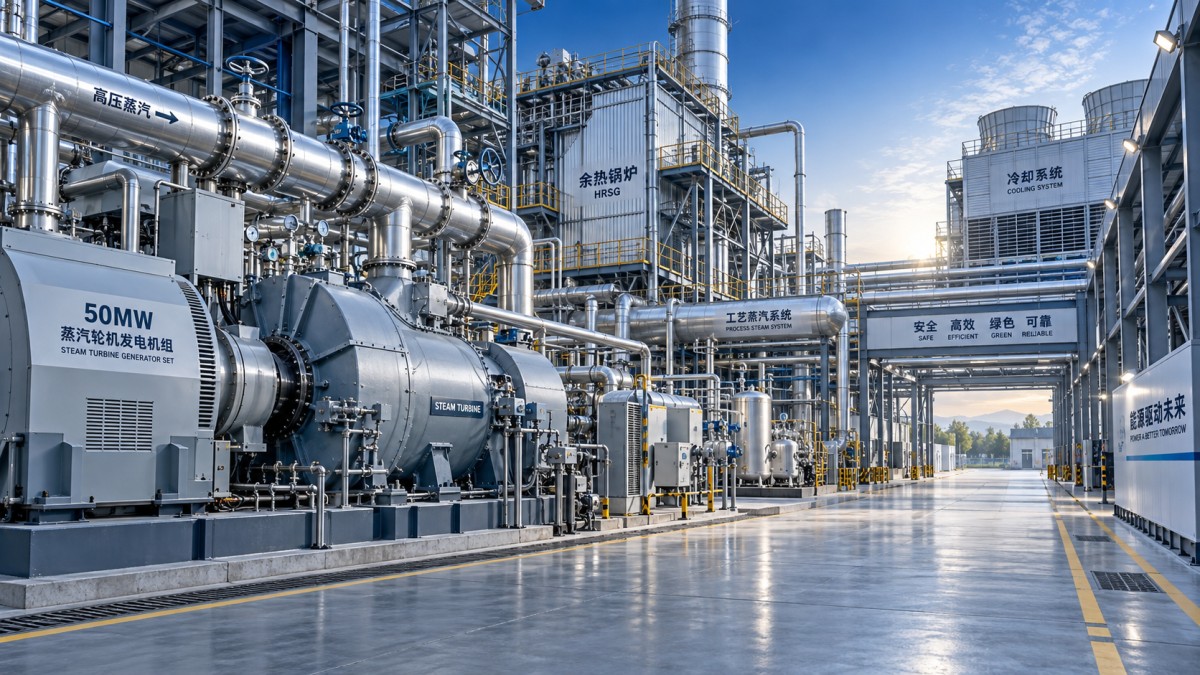
A 50 MW steam turbine fits an industrial captive power plant when the site has a sustained steam system to support it, a reliable source of boiler fuel or waste heat, and an electricity demand large enough to value on-site generation beyond simple backup power. For a business evaluator, 50 MW is substantial enough to affect plant economics, utility exposure, operating staffing, and project execution. It should therefore be assessed as part of an integrated steam-and-power system rather than as a standalone generator purchase.
The strongest fit is usually a continuous-process facility where steam is already a production utility: refineries, chemical complexes, fertilizer plants, pulp and paper mills, sugar operations, large food-processing sites, and certain metals or mining operations. In these settings, a turbine can convert pressure reduction that would otherwise occur across valves into useful electrical output. Where the plant only needs intermittent steam or has highly variable production schedules, the same rated capacity may create an underutilized and financially weak asset.
Start with the steam balance, not the 50 MW rating
A turbine nameplate says how much electric power the machine can produce under defined conditions. It does not establish whether that output is available under a site's normal operating conditions. The first commercial question is whether the plant can provide the required steam flow, pressure, temperature, and continuity without compromising process users.
For many industrial projects, a backpressure turbine is appropriate where high-pressure steam is generated for the boiler system and lower-pressure steam is needed continuously in production. Electricity is produced as steam expands to the process header pressure. This configuration can be attractive because the exhaust steam remains useful to the plant. Its limitation is equally important: power output is linked to process steam demand. If downstream steam consumption falls, turbine generation may also fall unless the steam system includes another credible operating path.
A condensing or extraction-condensing arrangement gives more flexibility. It can supply controlled extraction steam to process headers while sending surplus steam to a condenser for additional generation. That flexibility may support sites with seasonal steam demand, changing product mixes, or a need to maximize exportable electricity at certain times. It also brings higher capital cost, cooling-system requirements, water considerations, and a more demanding balance of plant.
Before deciding that 50 MW is the right size, the project team should model several operating cases rather than a single design-point heat balance:
- Normal production at expected steam and electricity demand.
- Reduced production, including low process-steam consumption.
- High ambient conditions that affect condenser performance where applicable.
- Startup, shutdown, and process upset conditions.
- Loss of one boiler, fuel interruption, or reduced waste-heat availability.
- Future operating cases if the site plans additional process trains or major debottlenecking.
The useful result is not only a theoretical maximum output. It is a view of how often the unit can operate near its economic range, when it will be constrained by steam demand, and whether imported power or supplementary generation is required during foreseeable plant states.
Load shape determines whether captive generation creates value
A 50 MW turbine is generally easier to justify when the plant has a high, stable electrical base load and meaningful exposure to grid supply cost, grid interruptions, or power-quality constraints. A site with a 60 MW to 70 MW continuous demand may use the turbine as a major part of its normal supply while retaining the grid for balancing, startup, and contingency support. A plant with a highly irregular 15 MW to 50 MW demand profile faces a different decision: the turbine may be technically feasible but operate far from the conditions assumed in its financial model.
Business cases often weaken when they credit every generated megawatt-hour at a retail grid tariff without considering the actual avoided-cost structure. The value of self-generation depends on the applicable tariff, demand charges, contracted capacity obligations, time-of-use pricing, export rules, taxes, and the cost of maintaining grid interconnection. In some jurisdictions, power exported from the captive plant may earn substantially less than power offset behind the meter. In others, export may be limited by the interconnection agreement.
The evaluation should separate three benefits that are sometimes blended together:
- Energy cost reduction: the difference between the cost of generating power and the cost of purchasing it from the grid.
- Steam-system efficiency: the value gained by producing electricity while meeting a required pressure reduction in the steam network.
- Reliability value: reduced exposure to production losses caused by grid disturbances, provided the turbine, boilers, switchgear, and controls are designed to ride through or recover from those events.
Reliability value deserves disciplined treatment. A steam turbine cannot keep a plant operating through every electrical event merely because it is installed on site. Island-mode capability, load-shedding logic, black-start arrangements, protection coordination, steam reserve, and operator procedures all influence the outcome. If uninterrupted process operation is a core investment driver, these elements should be specified early rather than left for late EPC integration.
Fuel and steam source can change the decision completely
The turbine itself does not create steam. A credible 50 MW captive-power plan needs a long-term basis for the energy entering the boiler or heat-recovery system. That may be coal, biomass, natural gas, refinery fuel, process off-gas, black liquor, bagasse, waste heat, or another site-specific source. Each option affects dispatchability, emissions controls, fuel handling, boiler availability, and operating cost risk.
Waste-heat-based steam generation can make the concept particularly compelling where a process already releases recoverable high-temperature energy. Yet waste heat may fluctuate with throughput, feed quality, furnace operation, or maintenance events. The steam turbine should be sized around dependable steam availability and a transparent dispatch philosophy, not around the highest momentary heat source. Oversizing the turbine against an uncertain steam source can produce a lower capacity factor and complicate debt-service assumptions.
Fuel flexibility also needs careful definition. A boiler advertised as capable of handling multiple fuels may still have different efficiency, fouling, corrosion, ash, or emissions characteristics across those fuels. The commercial model should reflect the fuel range that the plant will actually use, including expected quality variation. For steam systems coupled to compressors, refrigeration loads, or process-air demand, the electrical balance can also shift materially as throughput changes. An integrated review of the steam turbine, generators, motors, and major rotating equipment such as a Compressor package helps prevent a power island from being optimized in isolation while the wider process plant operates inefficiently.
Choose the turbine arrangement around operating constraints
There is no universal “50 MW configuration.” The practical choice depends on the pressure levels and control needs of the site.
Extraction control is especially relevant in an industrial plant. Process users require stable pressure, while the generator may be following electrical demand, grid conditions, or a site power-management system. The turbine and controls must handle these competing requirements without causing steam-header instability. This is a system-design issue involving boiler controls, pressure-reducing stations, bypass capacity, deaerator performance, condenser capability where installed, and the plant's electrical control philosophy.
Availability has to be evaluated at plant level
For a business case built around avoiding purchased power, planned and unplanned outages can have a larger financial effect than small differences in quoted turbine efficiency. Evaluators should ask how the plant will operate when the turbine is unavailable, when a boiler is offline, and when the steam demand changes faster than the machine can respond.
A sound scope defines the boundary between turbine supply, boiler island, generator, condenser or air-cooled condenser, electrical systems, controls, civil works, and process tie-ins. Gaps between these packages tend to surface during commissioning, when resolving them is costly. The EPC execution plan should make clear who owns heat-balance guarantees, performance testing conditions, protection studies, control integration, and the interfaces with the existing plant.
Maintenance planning should be tested against the facility's production calendar. Steam-path inspection, valves, lube-oil systems, governing equipment, generator maintenance, and auxiliary equipment all require access and outage windows. Spare-parts strategy is more than a procurement detail: it affects recovery time after a forced outage. Critical spares, repair capability, service access, and lead times should be evaluated alongside the initial equipment price.
A useful investment screen before committing to detailed engineering
A 50 MW steam turbine deserves further development when the preliminary review shows a stable steam source, a persistent electrical load, a realistic grid-value calculation, and a workable plan for abnormal operating conditions. It is less suitable when the turbine would be dependent on occasional surplus steam, when process steam demand is too volatile for the proposed configuration, or when the grid connection already provides reliable low-cost power without material production risk.
The most productive next step is a joint steam-and-power study that uses operating data from the actual site: hourly or representative load profiles, steam-header conditions, fuel assumptions, planned expansions, utility tariff structure, and outage history. That study should produce several operating cases and a lifecycle economic model, rather than one optimistic design-point calculation. When the 50 MW rating remains robust across those cases, the project moves from an appealing equipment concept to a credible captive-power investment.
- ▶ Sizing an Extraction Steam Turbine for Variable Process Steam Demand
- ▶ Overhaul | Our Company Completes Major Overhaul of a 160MW Steam Turbine Generator Set for a Paper Mill
- ▶ Controlled vs. Uncontrolled Extraction: Steam Turbine Design Differences
- ▶ SINO-QNP Concludes POWEREXPO Almaty with Great Success
- ▶ What Is an Extraction Steam Turbine and Where Is It Used?
- ▶ Deliveries Keep Projects Running: High-performance Heavy-Duty Equipment Rolls Out to Project Sites
Search from here
Leave a message
