




















Choose an impulse steam turbine when its stage arrangement, operating flexibility, and thrust characteristics fit your duty better than a reaction alternative at comparable lifecycle cost.
For technical evaluators, the decision requires more than comparing rated efficiency. Steam conditions, output requirements, load variation, sealing arrangements, and maintenance priorities all influence the result.
An impulse design concentrates stage pressure reduction in stationary nozzles, potentially simplifying rotor thrust management. Actual performance still depends on staging, clearances, controls, and operating conditions.
Drawing on SINO-QNP’s more than 30 years of turbomachinery experience, this article examines the engineering trade-offs and evidence needed to select a suitable turbine configuration.
What does the impulse-versus-reaction distinction actually change?
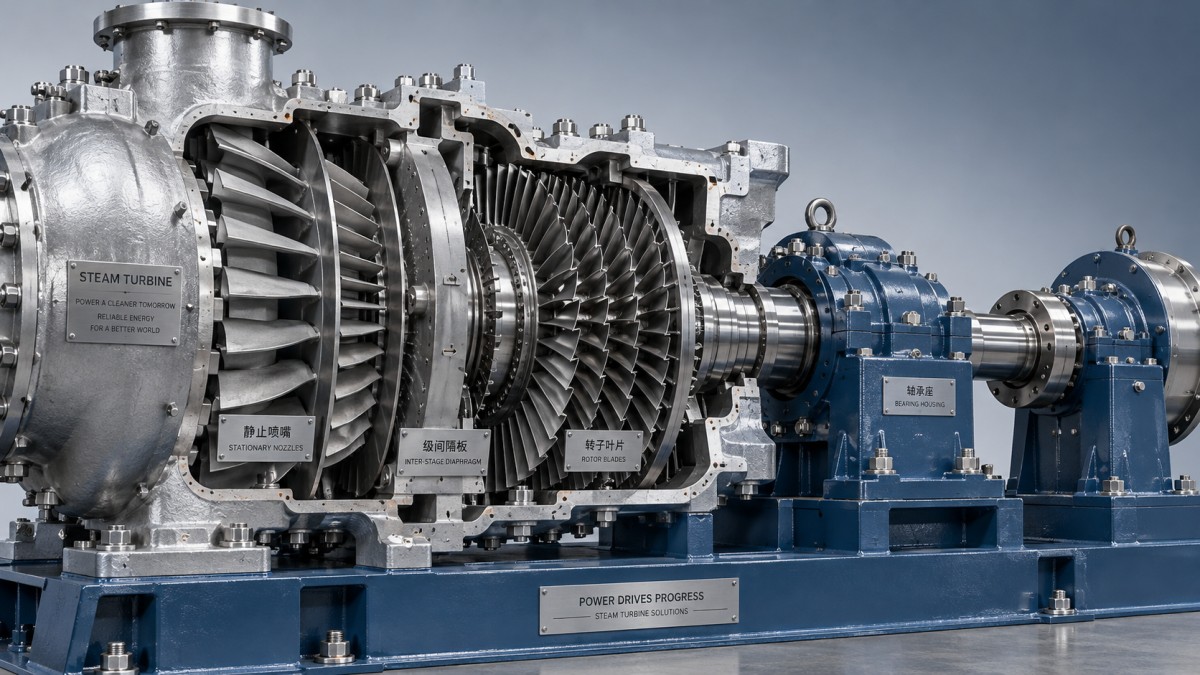
In an ideal impulse stage, steam expands through stationary nozzles, converting pressure energy into velocity. Moving blades extract work primarily by changing the steam’s momentum.
In a reaction stage, expansion occurs in both stationary and moving blade passages. That distribution changes blade loading, axial forces, and sensitivity to some internal leakage paths.
The distinction describes stage behavior, rather than an absolute classification of every machine. Commercial turbines can combine impulse governing stages with downstream stages having substantial reaction.
Ask suppliers to identify the proposed staging and degree of reaction. A product label alone cannot establish efficiency, thrust loading, reliability, or suitability for your process.
Both designs can serve industrial drives and power generation. Selection becomes meaningful only when competing proposals use the same steam boundaries, output definition, and operating profile.
When is an impulse design a strong candidate?
An impulse steam turbine deserves close consideration for industrial duties where a suitable stage arrangement delivers required power while meeting speed, package size, and maintenance constraints.
Pressure-compounded impulse arrangements distribute expansion across several stages. Velocity-compounded arrangements extract energy through successive moving blade rows, but can sacrifice efficiency compared with more extensive staging.
For lower-output applications, a compact impulse arrangement may offer attractive installed cost and accessibility. Verify the resulting steam consumption against annual operating hours before accepting that advantage.
For example, a continuously operated process drive may justify additional stages through lower steam consumption. An intermittently operated auxiliary drive may place greater value on simplicity.
Backpressure applications require particular attention to the process steam balance. Compare turbine output and exhaust conditions while preserving the downstream pressure and steam flow actually required.
High inlet pressure alone does not settle the choice. Evaluate the complete expansion ratio, steam temperature, mass flow, rotational speed, and proposed stage loading together.
Will it perform better across your actual load range?
Rated efficiency describes one operating point. A technically sound selection compares expected steam consumption across the load range, including minimum continuous load and frequently used intermediate loads.
Where offered, nozzle-group governing can support efficient operation at selected reduced loads by admitting steam through separate nozzle groups rather than throttling the entire flow continuously.
However, partial admission introduces its own losses and periodic blade excitation. Its value depends on admission geometry, valve sequencing, stage design, and the operating schedule.
Do not assume an impulse turbine automatically starts faster or follows load better. Thermal stress limits, rotor construction, casing design, and control logic govern those capabilities.
Request guaranteed performance at representative load points, with inlet conditions and exhaust pressure stated explicitly. Include expected seasonal cooling conditions for condensing turbines in the comparison.
Weight each operating point by annual hours to estimate steam consumption. For cogeneration, evaluate the combined electricity and useful heat balance before assigning savings to efficiency differences.
A turbine with a slightly weaker rated result can still deliver better annual economics. That conclusion requires a documented duty profile and comparable supplier performance data.
How much does lower axial thrust help your project?
Impulse staging can reduce the pressure-related contribution to rotor axial thrust because the intended pressure drop occurs mainly in stationary passages rather than moving blade rows.
This does not mean total axial thrust disappears. Steam momentum, pressure acting on rotor surfaces, leakage flows, and transient conditions still contribute to the bearing load.
Reaction configurations commonly require deliberate thrust-balancing provisions, which may include balance pistons and associated seals. Their practical implications depend on the complete rotor and casing arrangement.
Ask for calculated thrust across normal operation, startup, shutdown, and credible upset conditions. Review bearing capacity, operating margins, monitoring provisions, and the consequences of seal wear.
Lower thrust may simplify part of the mechanical design, but it does not independently prove greater reliability. Bearing design, lubrication quality, alignment, and protection systems remain essential.
Similarly, neither architecture has a universal clearance advantage. Compare nozzle, diaphragm, blade-tip, and balance-device leakage using the actual geometry and expected condition after service exposure.
Which maintenance and steam-quality risks should you compare?
Maintenance comparisons should begin with component access, inspection scope, repair methods, and outage duration. These practical details often matter more than the turbine’s architectural label.
For an impulse proposal, examine nozzle and diaphragm construction, erosion protection, blade attachment, and replacement procedures. Confirm whether repairs require rotor removal or specialized workshop equipment.
For either design, request recommended inspection intervals, critical spare parts, typical procurement lead times, and available field support. Relate these provisions to your site’s outage window.
Steam cleanliness matters in both architectures. Deposits can restrict flow and reduce efficiency, while solid particles and entrained droplets can damage stationary and rotating components.
An impulse design should not be treated as a remedy for contaminated steam. Specify filtration, drains, chemistry controls, and inlet steam quality appropriate to the application.
If expansion enters the wet region, review exhaust moisture and erosion exposure explicitly. The answer may involve revised steam conditions, staging, moisture management, or material selection.
When might a reaction or mixed-stage design be preferable?
A reaction or mixed-stage turbine may be preferable when the proposed configuration provides stronger guaranteed efficiency and lifecycle economics for sustained operation near its intended design conditions.
This consideration becomes particularly important when annual steam throughput is high. Small differences in consumption can outweigh initial savings, depending on the site’s marginal steam cost.
Large output and substantial expansion duties warrant comparison of multiple staging options. Neither machine rating nor industry convention should replace a project-specific assessment of competing designs.
Evaluate the entire train, including gearbox requirements, generator or driven equipment, condenser where applicable, lubrication systems, controls, and installation scope. Package differences can change the preferred option.
For grid projects, distinguish steam turbine selection from compressed air storage architecture. SINO-QNP’s Air Energy Storage uses surplus electricity to compress air for later electricity generation.
Compression heat can be captured in a thermal storage medium such as molten salt. During discharge, stored air is reheated and expanded to drive a generator.
That air expander requires its own working-fluid and duty assessment. Steam turbine comparison principles can inform evaluation, but steam performance guarantees do not establish storage-system performance.
What evidence should you require before selecting a supplier?
Build a common technical datasheet covering inlet pressure and temperature, exhaust conditions, steam flow, required output, speed, and operating hours at each significant load point.
Include startup frequency, ramp requirements, steam quality limits, ambient conditions, and expected process disturbances. These inputs allow suppliers to propose configurations against the same engineering basis.
Request comparable guarantees for steam consumption or heat rate, power output, and operating limits. Clarify measurement boundaries, correction methods, tolerances, and the agreed acceptance test procedure.
Evaluate lifecycle cost using installed price, steam or fuel economics, auxiliary power, maintenance expenditure, and expected availability. Test sensitivity to load changes and energy price assumptions.
SINO-QNP provides steam turbines, gas turbines, compressors, and generators, with capabilities spanning research and design, manufacturing, EPC projects, spare parts, and global service support for customers.
Use that integrated scope to request a coordinated equipment proposal, clearly defined interfaces, and documented service commitments. Confirm comparable application experience rather than relying solely on company history.
Choose the configuration that proves its value under your duty
Select an impulse steam turbine when verified performance, acceptable thrust loads, maintainable construction, and operating flexibility produce the strongest technical and economic result for your application.
Choose a reaction or mixed-stage alternative when its demonstrated advantages outweigh additional mechanical or maintenance considerations. Base the decision on matched guarantees and your actual operating profile.
