




















Which records should you verify before accepting a mud pump on site?
Before accepting a mud pump on site, verify that its records identify the delivered unit, demonstrate compliance with the purchase order, and support safe installation and commissioning. Missing evidence can turn an apparently complete delivery into additional testing, replacement parts, or delayed startup. Keep receipt of the shipment separate from technical acceptance, and follow the contract’s payment and acceptance conditions when recording unresolved items.
For anyone assessing how to inspect a mud pump before accepting delivery at site, the first document should be the contractual document register or agreed inspection and test plan. Use it to establish what evidence was required, which inspections needed witnessing, and what must be complete before acceptance.
Establish the identity and approved configuration
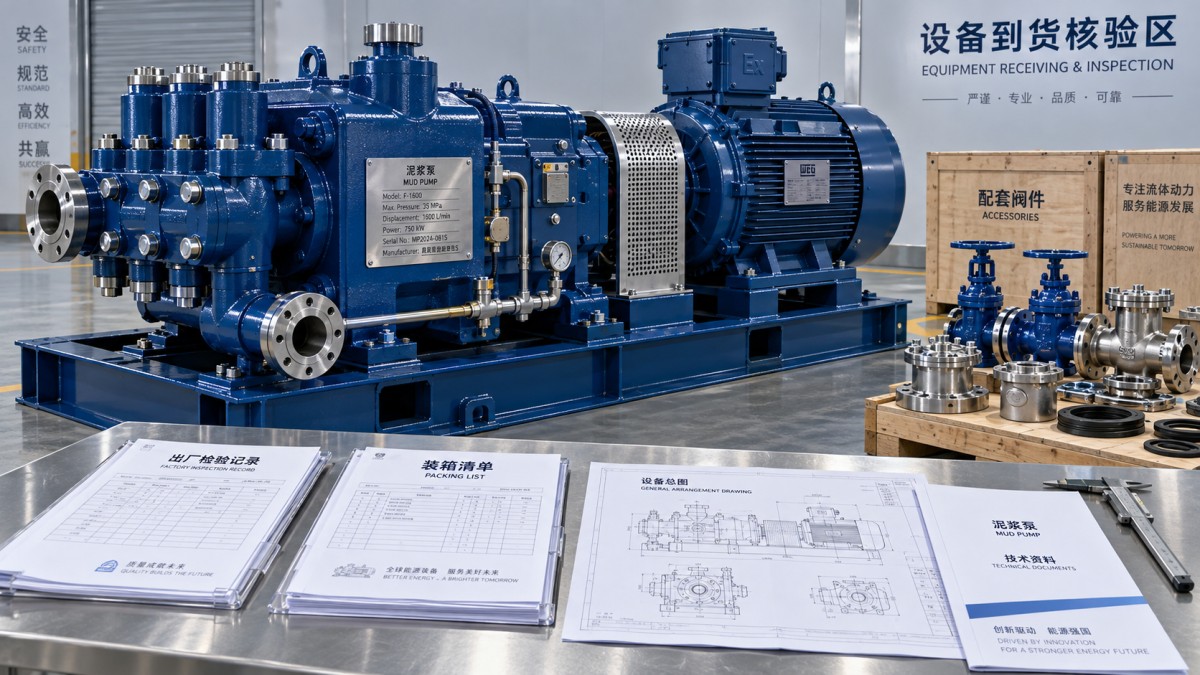
Match the purchase order, packing list, equipment nameplate, and factory records. The pump serial number should connect the delivered machine to its inspection reports and test results. For a packaged unit, identify the driver, gearbox where fitted, skid, and separately supplied pressure accessories. A report carrying only a model designation does not establish that the delivered pump was tested.
Compare the approved datasheet and final drawings with the actual configuration. Relevant details include pump type, liner diameter, stroke length, rated speed, pressure rating, driver power, suction and discharge connections, and supplied accessories. Record installed liner sizes: a pump model offered with several liner options does not have one universal pressure-and-flow capability.
Review approved deviations and substitutions alongside the purchase order. A different motor, connection arrangement, or fluid-end material requires evidence that the change was accepted through the agreed process. Resolve conflicts between document revisions before using a drawing for installation; an obsolete outline drawing can lead to foundation or piping rework.
Photograph nameplates, serial markings, and accessible component identifiers before packaging is discarded. These images provide a practical reference when certificates, loose accessories, or replacement documents arrive later.
Read factory test results against the purchased duty
A factory acceptance certificate is useful only when its supporting report states the test conditions, measured results, acceptance criteria, and equipment identity. Confirm that required witness signatures or inspection releases are present. Where witnessing was waived, retain the documented waiver instead of treating an unsigned witness field as automatically acceptable.
Separate pressure-containment testing from running or performance testing. A hydrostatic test of a fluid-end component demonstrates containment under the recorded conditions. It does not establish delivered flow, mechanical operation, or performance at the intended duty.
For a reciprocating mud pump, read flow, discharge pressure, speed, liner size, and power together. Maximum flow and maximum pressure shown in separate catalogue entries are not necessarily achievable simultaneously. The report should support the operating combination specified in the order, within the pump and driver limits.
Pay attention to the test medium and suction conditions. A water test provides evidence of operation under those conditions; it does not establish identical performance with drilling fluid containing solids or having different viscosity. Compare the test basis with the agreed specification, and identify any duty verification reserved for commissioning.
Useful supporting evidence includes:
- Pressure-test details: component identification, test pressure, holding period, test medium, and the recorded result against the specified acceptance criteria.
- Running-test observations covering leakage, lubrication, bearing temperature, and abnormal noise or vibration where these were included in the agreed procedure.
- Instrument traceability. Calibration records should identify the instruments used and establish their validity on the test date. An unrelated calibration certificate adds no confidence to the measurements.
If a report omits a required measurement, request the underlying data or an agreed supplementary test. Repeating a full factory test on site without first defining the evidence gap can create avoidable cost.
Confirm material and pressure-accessory traceability
Request material certificates for the components covered by the contract, such as fluid-end bodies, pressure manifolds, or specified critical fasteners. Match certificate heat or batch numbers to component markings or an approved manufacturing traceability record. A certificate for the correct material grade remains insufficient if it cannot be connected to the supplied component.
Review specified heat-treatment, dimensional, and nondestructive examination records where applicable. Their scope should identify the relevant parts and acceptance criteria. Avoid expanding the documentation requirement after delivery without a contractual or technical reason; unnecessary certificate requests can delay acceptance without resolving an actual uncertainty.
Pressure accessories deserve separate attention. Confirm the ratings and identification of supplied discharge hoses, manifolds, valves, and pulsation dampeners against the assembly’s intended service. The pump’s pressure rating does not establish the rating of everything attached to it.
For supplied overpressure protection, verify the documented setting or configuration, applicable test evidence, and installation instructions. A device present on the skid still requires confirmation that its arrangement protects the intended pressure boundary. Keep any specified dampener precharge requirements distinct from discharge pressure limits.
Use shipping and preservation records to interpret arrival condition
Compare the packing list with the received packages, including tools, loose fittings, guards, spare liners, pistons, seals, and commissioning consumables included in the order. Record shortages by item and quantity. “Accessories missing” is too vague to support replacement, scheduling, or cost recovery.
Preservation records should state the method, application date, storage conditions, and renewal requirements. Determine whether lubricating oil was retained, drained, or replaced with a preservative, and whether suction and discharge openings were sealed. These details affect what must happen before rotation or startup.
Inspect shipping restraints and lifting arrangements against the instructions. Transit damage, broken seals, standing water, or corrosion should be photographed and linked to the receipt record. Packaging damage alone does not prove internal damage, but it establishes a reason for targeted inspection. An expired preservation period similarly calls for assessment and corrective work rather than an assumption that the pump remains ready for service.
Verify the documents needed to install and start the supplied assembly
Confirm that operating and maintenance manuals cover the delivered configuration and include installation limits, lubrication requirements, startup procedures, maintenance intervals, and spare-part identification. Generic literature often omits the details that determine whether commissioning can proceed.
Final drawings should establish foundation interfaces, equipment weight and lifting points, connection locations, and alignment requirements. For an electrically driven package, verify motor nameplate data against the specified supply, together with wiring diagrams, control descriptions, and required protection settings. Record which alignment and functional checks remain to be completed after installation.
Maintain clear document boundaries when several equipment packages share a project. A grid-connected Air Energy Storage package stores compressed air and can retain compression heat in a medium such as molten salt before generating electricity through an expander. Its compressor, thermal-storage, and generator records belong to that package; they cannot substantiate the acceptance of a mud pump delivered under the same project.
Make the acceptance record explicit about unresolved evidence
Classify discrepancies by their effect on contract compliance, installation, and safe operation. The contract governs whether conditional acceptance is available. The acceptance record should identify each unresolved item, its required correction, the completion date, and any restriction on installation or commissioning.
Signatures should state exactly what has been accepted: shipment receipt, mechanical delivery, or completion of a defined acceptance stage. Attach the document register and discrepancy record so that an outstanding certificate, damaged component, or deferred test retains a clear status after the delivery paperwork is closed.
- ▶ What should a mud pump trial run confirm before site acceptance?
- ▶ Which records should you verify before accepting a mud pump on site?
- ▶ How to check a mud pump for shipping damage before site acceptance
- ▶ How to verify 100 MW steam turbine performance under IEC 60953
- ▶ Can a 100 MW steam turbine operate efficiently at half load?
- ▶ What drives the installed cost of a 100 MW steam turbine?
Search from here
Leave a message
