




















Can a 100 MW steam turbine operate efficiently at half load?
Yes—a 100 MW steam turbine can operate efficiently at half load, but “efficiently” needs a commercial definition. At around 50 MW, the unit may remain stable and mechanically suitable for continuous service while consuming more steam, and potentially more fuel, per unit of electricity than it does near rated output. The result depends on turbine design, steam conditions, governing strategy, and the surrounding plant.
For business evaluators, the important question is not whether the turbine can reach 50 MW. It is whether operating there for hundreds or thousands of hours makes financial sense. Drawing on SINO-QNP’s more than 30 years of turbomachinery experience, this assessment explains which technical differences matter—and what evidence buyers should request before committing to a machine.
“It can run at 50 MW” is not an efficiency guarantee
Three separate questions often get combined during equipment evaluation:
- Operating capability: Can the turbine sustain the required load within its permitted operating envelope?
- Energy performance: How much steam or fuel energy is required for each net megawatt-hour?
- Commercial performance: Does the value of electricity and useful process heat justify operating costs and capital expenditure?
A satisfactory answer to the first does not establish the other two. A supplier’s minimum-load statement confirms an operating limit under specified conditions; it does not necessarily guarantee acceptable heat rate, emissions performance of the steam source, or profitability.
Also establish what “100 MW” means. It may refer to rated generator output at defined inlet steam conditions, extraction flows, and exhaust pressure. If the rating is gross output, 50 MW at the generator terminals will deliver less than 50 MW for export after plant auxiliaries are deducted.
Why a 100 MW steam turbine loses efficiency at part load
Steam turbines are designed around particular flow, pressure, and temperature conditions. Reducing output changes those conditions, and the losses do not all shrink in proportion to power.
Steam admission and governing strategy
With throttle governing, control valves reduce the pressure available to the turbine. This introduces throttling losses and generally reduces the work obtainable from the supplied steam. Nozzle governing can limit some of these losses by controlling admission to groups of nozzles, although partial admission introduces its own aerodynamic penalties.
Sliding-pressure operation can improve part-load performance in a suitably designed plant by reducing steam pressure as load falls and avoiding excessive valve throttling. However, it must be coordinated with the boiler or heat-recovery steam generator. It is not a universal setting that can be applied to every turbine.
Off-design flow and losses that remain
At reduced steam flow, blade rows operate away from their design conditions. Stage efficiency, leakage behavior, and exhaust losses change. Mechanical losses and some auxiliary demands remain significant even though electrical output has fallen.
The plant can compound this effect. Feedwater pumps, cooling systems, fans, and other auxiliaries may not reduce their consumption proportionally. That is why net plant performance can deteriorate more than a turbine-only efficiency figure suggests.
Steam quality and exhaust conditions
Inlet temperature, pressure, and condenser backpressure strongly influence the result. Maintaining suitable superheat helps preserve performance, while poor condenser vacuum reduces the available expansion. Ambient conditions and cooling-system operation therefore belong in the assessment, not in a footnote.
For extraction and backpressure turbines, process steam requirements add another dimension. A machine producing 50 MW while delivering valuable heat cannot be evaluated fairly against a condensing turbine producing electricity alone.
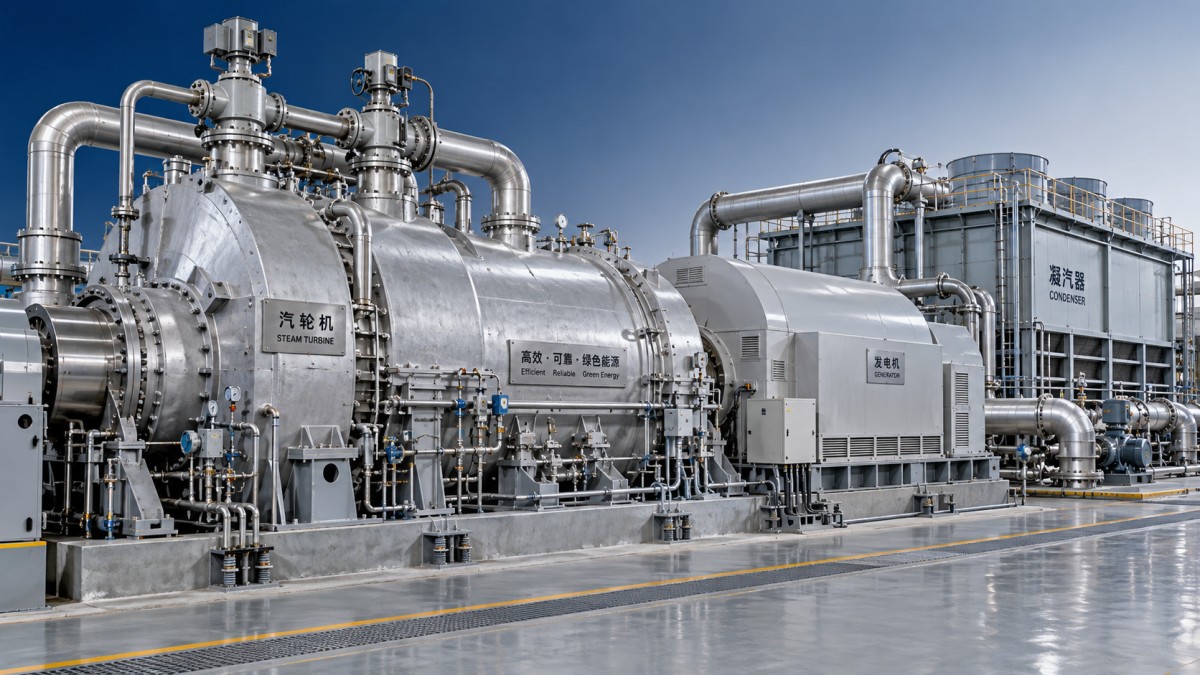
Translate the efficiency penalty into annual money
For electricity-focused projects, net plant heat rate is usually more useful than an isolated turbine efficiency percentage. It expresses the fuel energy required per unit of net electricity, using a clearly stated heating-value basis. Lower heat rate is better.
Consider an illustrative calculation—not a performance claim for any particular turbine. Assume a plant’s net heat rate rises from 9.0 GJ/MWh at rated conditions to 9.9 GJ/MWh at half load. The heat-rate increase is 10%. At a net output of 50 MW for 4,000 hours annually, electricity production would be 200,000 MWh.
The additional energy consumption relative to the 9.0 GJ/MWh benchmark would be:
200,000 MWh × 0.9 GJ/MWh = 180,000 GJ per year.
Multiplying that quantity by the applicable fuel cost reveals the annual fuel-cost exposure. The benchmark is useful for sensitivity analysis; it does not prove that another configuration can actually achieve 9.0 GJ/MWh at 50 MW.
In cogeneration, this calculation needs modification. Useful steam output, its pressure and temperature, and the agreed allocation of fuel cost between heat and electricity must be included. Ignoring heat value can make an economically attractive installation look inefficient.
The purchase decision changes with the load profile
A turbine that spends occasional afternoons at half load presents a different investment case from one expected to operate at 50 MW most of the year. Before comparing offers, build a load-duration profile showing annual hours at each output level, process steam demand, seasonal cooling conditions, and expected starts.
Two smaller machines can allow one unit to operate closer to its design point during low demand. They also introduce additional equipment, installation complexity, and maintenance obligations. The arrangement is worth modeling, not automatically assuming to be superior.
If the steam-generation concept is still open, a combined-cycle alternative may also deserve assessment. SINO-QNP’s Gas Turbine range includes models such as QGT-20 and QGT-50, with listed outputs of 20 MW and 52 MW respectively. These are options for a separate plant-level comparison, not direct substitutes selected solely by matching electrical capacity. Fuel availability, exhaust heat recovery, steam requirements, and integrated part-load performance must determine suitability.
What to request before accepting a supplier’s proposal
A rated-point specification is not enough for a variable-demand project. Ask for a performance package that makes competing offers comparable:
- Part-load curves: Output, steam consumption, and relevant heat-rate data at several loads, explicitly including 50%.
- Reference conditions: Inlet pressure and temperature, exhaust pressure, extraction flows, cooling conditions, and allowance for degradation.
- Measurement boundaries: Gross versus net output, included auxiliaries, and whether energy figures describe the turbine, steam cycle, or entire plant.
- Operating limits: Minimum continuous load, permissible extraction combinations, ramp rates, and any relevant low-load restrictions.
- Guarantee terms: Guaranteed points, correction methods, test procedures, tolerances, and contractual remedies where applicable.
- Lifecycle assumptions: Maintenance intervals, spare-parts requirements, service access, and the effects of frequent cycling.
Pay particular attention to whether 50 MW performance is guaranteed or merely predicted. A smooth curve in a presentation is not the same as a contractual commitment at your specified operating conditions.
A practical verdict for business evaluators
A 100 MW steam turbine can be a sound choice at half load when reduced output is temporary, capacity growth is credible, or useful process heat strengthens the economics. It is less convincing when 50 MW represents the normal operating point and excess capacity has no clear commercial purpose.
SINO-QNP’s integrated scope—from R&D and design through manufacturing, EPC projects, and spare-parts supply—provides a basis for discussing the turbine alongside the wider plant. The decision should still rest on project-specific data: a realistic load profile, comparable performance curves, defined guarantees, and lifecycle cost analysis.
Buy for the operating hours you expect, not just the maximum output you hope to need. That is the clearest way to distinguish a turbine that can run at half load from one that earns its place there.
- ▶ Can a 100 MW steam turbine operate efficiently at half load?
- ▶ What drives the installed cost of a 100 MW steam turbine?
- ▶ How condenser pressure affects a 100 MW steam turbine's output
- ▶ How much steam does a 100 MW steam turbine need at full load?
- ▶ Why an impulse steam turbine loses power when steam pressure drops
- ▶ How does partial admission affect an impulse steam turbine?
Search from here
Leave a message
