




















How condenser pressure affects a 100 MW steam turbine's output
How condenser pressure affects a 100 MW steam turbine's output
A rise in condenser pressure can reduce a 100 MW steam turbine’s output even when inlet steam conditions remain unchanged. For operators, understanding this relationship is essential to diagnosing lost megawatts, managing cooling-system performance, and maintaining efficient operation. Lower condenser pressure generally increases the energy available for expansion, but practical gains depend on turbine design, operating load, and exhaust conditions.
The useful question is not simply whether vacuum has deteriorated. It is whether the measured backpressure is reasonable for today’s cooling conditions, how much output it is costing, and whether the loss can be recovered without exceeding approved operating limits.
Why higher backpressure costs megawatts
A condensing turbine extracts work as steam expands through its stages toward the low pressure maintained at the exhaust. When condenser pressure rises, expansion ends at a higher pressure. The available enthalpy drop decreases, so the turbine generally produces less shaft power for the same steam flow and inlet conditions.
A simplified relationship is shaft power ≈ steam mass flow × actual enthalpy drop. With flow in kg/s and enthalpy drop in kJ/kg, the result is kW. This explains the direction of the change, but it is not a complete performance model: extraction flows, stage efficiency, exhaust losses, and mechanical losses also matter.
For a reheat or extraction-condensing unit, condenser pressure mainly affects the steam continuing through the low-pressure section. Applying the full inlet steam flow to a low-pressure enthalpy change can therefore overstate the output penalty. Use the unit heat balance and manufacturer’s correction curves rather than a generic percentage per unit of pressure.
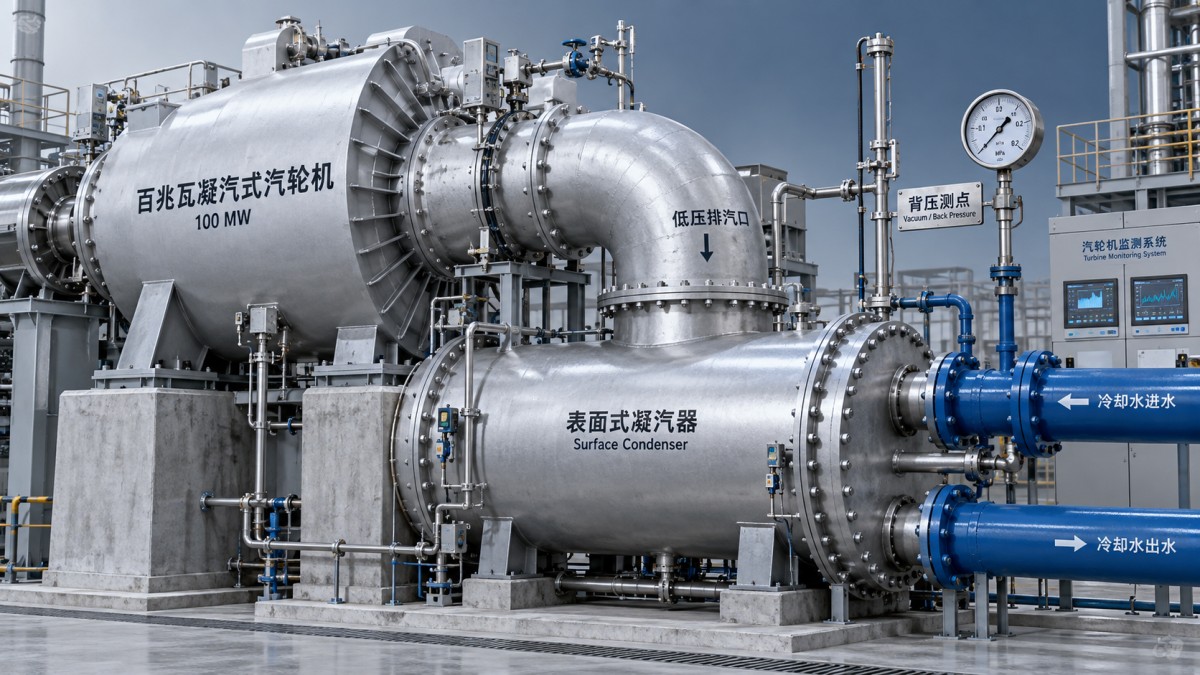
The “100 MW” rating does not establish a universal backpressure sensitivity. Two machines with the same rated output can respond differently because their exhaust areas, last-stage blades, extraction arrangements, and reference cooling conditions differ.
Read the pressure correctly before diagnosing the loss
Condenser performance should be assessed using absolute pressure. A vacuum indication referenced to atmospheric pressure can be misleading when barometric pressure changes. Check whether the control-system value is absolute pressure, gauge pressure, or a calculated vacuum signal, and confirm the units before comparing trends.
Steam saturation properties connect condensing temperature with pressure. Warmer cooling water usually requires a higher condensing temperature to reject the same heat load, raising backpressure. However, total condenser pressure also includes the partial pressure of non-condensable gases. A pressure-to-temperature mismatch can suggest air accumulation, but sensor location and measurement accuracy must be checked before drawing that conclusion.
Compare stable periods with similar load, steam conditions, extraction demand, and cooling-water inlet temperature. A summer afternoon and a winter night are not equivalent reference points. Likewise, unchanged inlet pressure and temperature do not prove unchanged steam flow: governing valves may admit more steam to hold the electrical load.
Separate cooling limitations from recoverable deterioration
A pressure increase caused by warmer cooling water is different from one caused by dirty tubes or air ingress. The first may be an expected environmental constraint; the others may represent maintenance opportunities. Several readings need to move together before the diagnosis becomes convincing.
- Cooling-water inlet temperature: If pressure follows a rising inlet temperature while other indicators remain stable, investigate cooling-tower or source-water conditions.
- Water flow and hydraulic condition: Review pump availability, valve positions, strainers, waterbox differential pressure, and measured flow where available. Pump running status alone does not establish adequate flow.
- Heat-transfer approach: Trend the difference between condensing steam temperature and cooling-water outlet temperature at comparable duty. A widening difference can indicate fouling, reduced effective surface, or air blanketing.
- Air-removal performance: Check ejector motive-steam conditions or vacuum-pump operating conditions against supplier requirements. Investigate gland seals, joints, and other potential leak paths through approved testing methods.
Cooling-water temperature rise also needs context. A larger rise may indicate reduced flow, but it can also reflect increased heat rejection. Tube plugging can reduce effective heat-transfer area even after cleaning restores the remaining tubes. No single temperature or differential-pressure reading establishes the cause by itself.
Estimate the output penalty on a defensible basis
Start with the OEM backpressure correction curve applicable to the operating load and turbine configuration. Confirm whether it describes output at constant steam flow, heat-rate change at constant load, or another basis. Those results are not interchangeable.
As a calculation illustration only, an actual enthalpy-drop reduction of 10 kJ/kg acting on 80 kg/s of affected steam corresponds to roughly 800 kW less shaft power before other changes are considered. These are assumed values, not a prediction for a particular 100 MW steam turbine. The actual penalty requires machine-specific flow and performance information.
Record gross generator output and net plant export separately. Additional cooling-water pumps or cooling-tower fans may lower condenser pressure and increase gross generation while consuming part of the gain. The operating decision should consider net megawatts, heat rate, equipment constraints, and water availability—not vacuum alone.
Where contractual performance verification is needed, ASME PTC 6 provides a framework for steam-turbine performance testing; ASME PTC 12.2 addresses steam surface condensers. The applicable edition, test boundary, instrumentation, corrections, and uncertainty requirements must be agreed for the project. An operating trend is useful evidence, but it is not automatically an acceptance test.
Lower pressure is not an unlimited operating target
Reducing backpressure generally increases expansion work, but the benefit eventually becomes constrained by exhaust geometry and last-stage performance. Lower pressure increases exhaust specific volume. Depending on the design and operating point, exhaust losses can offset some of the thermodynamic gain, and expansion conditions may increase moisture-related concerns.
At low load, last-stage flow conditions can also create ventilation heating and vibration concerns. Follow the manufacturer’s permitted pressure-load envelope, exhaust-temperature limits, and protection settings. Never change alarm or trip settings simply to recover output, and never assume the lowest achievable condenser pressure is the best operating point.
Make the next engineering review specific
A useful review package includes calibrated absolute-pressure readings, cooling-water temperatures and flow, steam conditions, extraction flows, valve positions, gross output, auxiliary power, and recent condenser maintenance records. Include the reference heat balance and correction curves. This allows an engineering team to separate expected seasonal losses from equipment deterioration.
SINO-QNP brings over 30 years of turbomachinery experience across steam turbines, gas turbines, compressors, and generators, with capabilities spanning R&D, design, manufacturing, EPC projects, and spare-parts supply, supported by a global marketing and service network. For this issue, the relevant scope is a coordinated turbine-and-cooling-system assessment rather than an isolated component recommendation.
Keep equipment specifications separate as well. A diesel-engine- or motor-driven Mud pump, described as designed and manufactured according to an API standard, has a different duty and standards basis; that specification does not establish suitability for condenser circulating-water service. Confirm the exact standard and operating requirements for each equipment package.
Before authorizing cleaning, leak repairs, or cooling-system changes, establish the expected backpressure at current conditions and estimate recoverable net output. After intervention, repeat the comparison on the same corrected basis. That is how a vacuum improvement becomes a measurable performance recovery.
- ▶ How condenser pressure affects a 100 MW steam turbine's output
- ▶ How much steam does a 100 MW steam turbine need at full load?
- ▶ Why an impulse steam turbine loses power when steam pressure drops
- ▶ How does partial admission affect an impulse steam turbine?
- ▶ When should you choose an impulse steam turbine over a reaction design?
- ▶ How does an impulse steam turbine convert steam into shaft power?
Search from here
Leave a message
