




















Why Steam Turbine Efficiency Drops: Common Causes and Practical Fixes
When efficiency starts slipping, what should maintenance teams look at first?
When a steam turbine loses efficiency, the problem rarely stays isolated. Load may hold for a while, but heat rate, steam consumption, vibration risk, and maintenance cost usually start moving in the wrong direction together. For after-sales maintenance teams, the fastest way to narrow the cause is to compare current operating data with the unit’s normal baseline rather than chasing one alarm at a time.
Start with the basics: inlet steam pressure and temperature, exhaust pressure, power output, extraction conditions if used, gland sealing performance, bearing temperatures, vibration trend, and valve position. A drop in efficiency often comes from a mismatch between steam conditions and the turbine’s design point, internal leakage, fouling, or mechanical wear. If those values changed gradually, think degradation. If they changed suddenly, think upset, leakage, or instrument error.
Can poor steam quality really cause a noticeable performance drop?
Yes, and it is one of the most common reasons. Wet steam, superheat loss, or contamination reduces the energy actually available at the blades. It also creates secondary damage. Moisture encourages erosion in later stages, while solids carried with steam can deposit on nozzles and blades, changing flow area and reducing efficiency even before obvious damage appears.
For maintenance teams, the practical check is not just “Is steam on spec?” but “Did steam conditions drift from what this machine was tuned to run on?” A turbine may continue operating under off-design steam, but it will do so less efficiently and with more internal stress. If the unit serves biomass power generation, waste heat utilization, or heat supply duty, steam quality can vary more than operators expect, so trend review matters.
How do blade deposits and erosion show up in real operation?
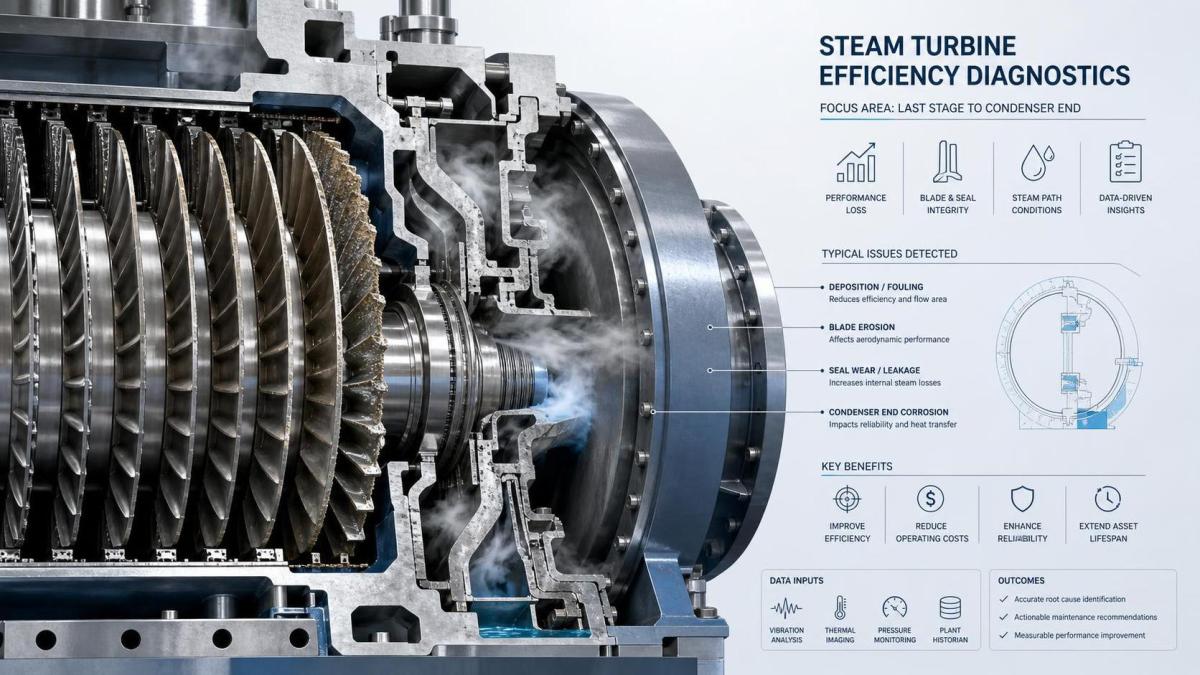
Usually as a slow loss of output or a need for more steam to hold the same load. Deposits narrow passages and disturb steam expansion. Erosion does the opposite in a different way: it damages the blade profile, reduces aerodynamic efficiency, and can upset stage balance. Neither issue always creates an immediate trip condition, which is why they are often missed early.
Typical field clues include:
- Higher steam rate at unchanged output
- Stage pressure pattern shifting away from historical values
- Gradual rise in vibration after long operation
- Reduced response during load changes
If an inspection window is available, look for scaling, roughened blade edges, or water-erosion marks in the low-pressure section. Waiting until overhaul to confirm what trend data already suggested usually costs more in lost efficiency than the inspection itself.
What about seals and clearances? Are they really that important?
Very important. Internal leakage through gland seals, labyrinth seals, and increased stage clearances can take a healthy-looking machine and quietly pull down its efficiency. The turbine may still run smoothly, but useful steam is bypassing the blade path instead of doing work.
This is especially relevant on units that have seen repeated startups, thermal cycling, or rotor and casing distortion events. Clearance growth is not always dramatic enough to trigger a mechanical alarm. It often appears first as poorer heat rate or lower output margin. If exhaust conditions, steam inlet conditions, and load demand all look normal but performance keeps slipping, leakage should move high on the list.
Could the condenser or backpressure side be the real problem?
Absolutely. Many teams focus on the turbine internals first, but poor vacuum or elevated backpressure can cut efficiency quickly, especially on condensing units. If the condenser is fouled, air ingress increases, or cooling performance drops, the exhaust end of the turbine loses its expansion advantage. The machine then needs more steam for the same output.
Check condenser vacuum trend, cooling water temperature rise, air removal performance, and any sign of leakage on the vacuum side. On back pressure or extraction-back pressure service, review whether downstream process demand has changed the operating point. A turbine can be mechanically sound and still look inefficient because the system around it is no longer giving it the same conditions.
How can you tell the difference between an instrumentation problem and a real efficiency loss?
Look for inconsistency between related measurements. A true efficiency drop usually leaves a pattern: more steam use, changed stage conditions, altered exhaust performance, or a shift in valve demand. A bad transmitter often creates a single strange number that does not match surrounding process behavior.
A quick data sanity check saves time. Maintenance teams lose a lot of hours when they open hardware before confirming the measurements are trustworthy.
Which fixes usually work fastest without waiting for a major overhaul?
Short-term gains usually come from operating corrections and system-side cleanup. That may include restoring steam conditions, fixing leaking valves, improving gland sealing, cleaning condenser surfaces, correcting vacuum problems, and verifying extraction settings. If the machine has been running off-design for process reasons, even a small correction in load point can recover noticeable efficiency.
For hardware-related loss, the practical fixes depend on what you confirm during inspection: blade cleaning, seal replacement, clearance restoration, valve repair, or rotor path maintenance. The key is to match the fix to the loss mechanism. Cleaning will not solve leakage, and seal work will not recover output lost to severe erosion.
When does it make sense to review turbine type or configuration instead of only repairing parts?
If the unit repeatedly runs far from its original duty, the issue may be application mismatch rather than wear alone. This comes up in plants with changing heat balance, steam extraction demand, or seasonal operating patterns. In those cases, maintenance data can help determine whether the current setup still fits the process.
That is where a broader equipment review matters. SINO-QNP supplies Steam Turbine solutions for industrial drive, combined cycle, thermal power generation, waste heat utilization, and heat supply applications, including impulse type and reaction type designs. Depending on process demand, condensing, extraction condensing, back pressure, or extraction back pressure arrangements may affect how efficiently the unit performs in actual service, not just on paper.
What mistakes make efficiency problems worse during troubleshooting?
Three mistakes show up often. One is focusing only on the turbine and ignoring the steam source or condenser. Another is comparing current readings to design data without checking whether the machine is running at the same duty point. The third is treating all efficiency loss as a maintenance issue when process conditions are actually driving it.
A more reliable approach is to move in order: confirm instruments, verify steam and exhaust conditions, compare trend data to a known good period, then inspect for leakage, deposits, erosion, or mechanical change. For larger units, especially in the 3 MW to 300 MW or broader 0.5 MW to 400 MW power range seen across different applications, that sequence reduces unnecessary disassembly and helps teams justify the right corrective scope.
If you need one rule to keep the diagnosis on track, use this: do not judge a steam turbine by output alone. Judge it by output, steam conditions, exhaust side performance, and how far the current operating point has drifted from the machine’s normal pattern. That is usually where the real answer shows up first.
- ▶ When an extraction steam turbine improves combined heat and power output
- ▶ What happens when process steam demand changes on an extraction steam turbine
- ▶ How to match extraction steam turbine pressure to process demand
- ▶ When local service coverage matters for a gas turbine generator manufacturer
- ▶ How manufacturer lead times can alter a gas turbine generator project
- ▶ Which certifications matter when choosing a gas turbine generator manufacturer
Search from here
Leave a message
