




















Understanding Steam Turbine Inlet Pressure, Exhaust Pressure, and Output
Why these three numbers are judged together
A steam turbine is often discussed in terms of output, but output on its own says very little. Two turbines can both be rated at the same megawatt level and still behave very differently in fuel use, controllability, condenser demand, and long-term operating margin. That difference usually starts with three linked parameters: inlet pressure, exhaust pressure, and output. If one of them is read in isolation, the technical picture becomes distorted.
For a technical evaluation, the practical question is not “which number is higher,” but “under what steam conditions is this output achieved, and what exhaust condition does the machine require to get there?” In industrial power projects, that is where efficiency, turbine sizing, auxiliary load, and downstream equipment selection begin to separate strong proposals from weak ones.
In simple thermodynamic terms, a steam turbine converts the enthalpy drop of steam into shaft power. Inlet pressure affects how much usable energy the steam carries into the machine. Exhaust pressure affects how much energy remains unused when the steam leaves. Output reflects how much of that available energy is converted into mechanical work after internal losses, leakage, blade-path behavior, and operating constraints are accounted for.
Inlet pressure is not just a “higher is better” parameter
A common misunderstanding is that higher inlet pressure automatically means a better turbine. It can improve the available energy drop, but only within the design limits of the steam path, valve system, casing strength, rotor design, and the broader heat balance of the plant. A turbine built for one inlet pressure range is not simply “upgraded” by feeding it higher-pressure steam. Doing so may shift expansion behavior, stress levels, moisture distribution, and control response in ways that reduce reliability or force derating.
In project evaluation, inlet pressure should be checked together with inlet temperature, steam flow, throttle governing philosophy, and expected load profile. A unit serving a process plant with variable demand may need different margin assumptions than a base-load condensing machine in a utility setting. The same nominal pressure can therefore represent very different design intent.
This is one reason experienced manufacturers focus on the complete turbomachinery train rather than a single equipment rating. Companies such as SINO-QNP, with long-term experience across steam turbines, gas turbines, compressors, generators, EPC execution, and spare-parts support, typically evaluate these conditions as part of an integrated operating envelope rather than as standalone catalogue values.
Exhaust pressure often decides whether a good paper rating survives real operation
Exhaust pressure is where many comparisons become misleading. Lower exhaust pressure generally allows greater expansion through the turbine and can increase output and cycle efficiency. On paper, that looks attractive. In reality, the turbine only sees that benefit if the condenser, cooling system, ambient conditions, and backpressure stability can actually sustain it.
If a proposal is based on an aggressive exhaust pressure that the site cannot maintain in summer conditions, fouled heat-exchange conditions, or reduced cooling-water availability, the promised output may exist only at design-point conditions. For evaluators, this is not a minor detail. It affects guaranteed performance, part-load behavior, and whether the owner ends up paying for capacity that is difficult to realize in daily operation.
Backpressure and condensing turbines should also be judged differently. In a backpressure machine, exhaust pressure is often dictated by process steam needs, so the “loss” of remaining energy is not necessarily a penalty; it may be a deliberate part of cogeneration value. In a condensing turbine, however, exhaust pressure is more directly tied to the condenser vacuum and therefore to the net power that can be extracted from the steam.
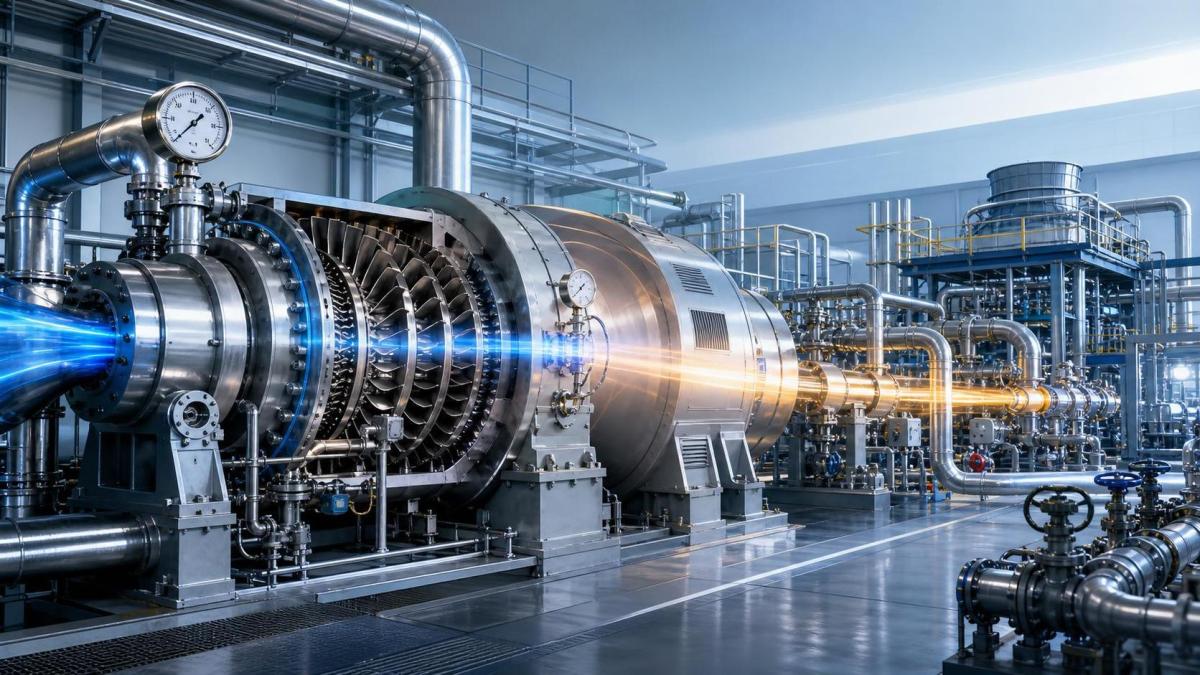
Output only makes sense when the steam conditions are explicit
When suppliers state turbine output, the evaluator should immediately ask: at what inlet pressure, inlet temperature, exhaust pressure, and flow condition? Without that context, output is just a headline number. The same machine family may show different outputs under different steam maps, extraction arrangements, or seasonal assumptions.
This matters especially in industrial self-generation and combined-cycle applications, where the turbine does not operate as an isolated box. Generator matching, grid code requirements, cooling method, and plant operating mode all influence what “usable output” actually means. In some configurations, the electrical package becomes part of the evaluation logic. For example, an Generator selected for gas, steam combined cycle, or other efficient clean power generation modes may need to align with two-pole or four-pole arrangements, insulation class F, and cooling choices ranging from air cooling to water-hydrogen-hydrogen cooling. Those are not side notes; they influence train integration, thermal margin, and reliability expectations.
How the relationship is usually assessed in practice
A useful way to read the three parameters is to treat them as one performance statement:
This sounds straightforward, yet many bid comparisons still treat output as the lead parameter and leave the steam-condition basis buried in notes. That is where evaluation errors begin. A fair comparison requires the same boundary conditions or a clearly normalized correction method.
The standards question behind performance claims
Technical and standard-oriented buyers usually want more than a conceptual explanation; they want to know what evidence supports the numbers. In steam turbine projects, that means asking how performance is defined, corrected, guaranteed, and tested. The exact applicable framework depends on project scope and contract structure, but the principle is stable: stated output must be traceable to stated operating conditions and accepted test or design rules.
The same discipline applies to the electrical side of the train. If the package includes a generator, compliance with recognized standards such as IEC60034-3 or Chinese GB/T7064 becomes relevant because electrical matching and thermal capability affect the credibility of the total output claim. A turbine-generator set rated from 1.5 MW to 400 MW is not evaluated only by capacity range; it is evaluated by whether the whole arrangement remains reliable under the actual cooling, pole configuration, and duty profile specified for the plant.
What evaluators should be careful about
Three checks usually reveal whether a steam turbine proposal is technically grounded.
One is boundary clarity. If the inlet conditions, exhaust conditions, and output basis are not stated together, the proposal is incomplete no matter how attractive the rating appears.
Another is off-design realism. Most plants do not live at design point. Cooling-water temperature drifts, process demand changes, and ambient conditions move. A robust evaluation asks how output shifts when exhaust pressure rises or inlet conditions soften.
The third is train integration. Turbine output that looks acceptable in isolation may become less convincing when generator selection, auxiliary power, condenser duty, maintenance access, and spare-parts strategy are considered together. That is often where experienced package suppliers distinguish themselves from vendors quoting only a machine centerline.
A sound reading of steam turbine inlet pressure, exhaust pressure, and output is therefore less about memorizing definitions and more about understanding the operating bargain they represent. The numbers describe how the machine uses steam, what site conditions it depends on, and how much dependable power it can deliver when the plant is running as it actually will, not only as it was modeled on a clean design day.
- ▶ When an extraction steam turbine improves combined heat and power output
- ▶ What happens when process steam demand changes on an extraction steam turbine
- ▶ How to match extraction steam turbine pressure to process demand
- ▶ When local service coverage matters for a gas turbine generator manufacturer
- ▶ How manufacturer lead times can alter a gas turbine generator project
- ▶ Which certifications matter when choosing a gas turbine generator manufacturer
Search from here
Leave a message
