




















How manufacturer lead times can alter a gas turbine generator project
How Manufacturer Lead Times Can Alter a Gas Turbine Generator Project
For financial decision-makers, manufacturer lead times can significantly reshape the budget, schedule, and risk profile of a gas turbine generator project. Choosing an experienced Gas Turbine Generator Manufacturer helps organizations gain clearer delivery visibility, reduce costly downtime, and align equipment procurement with project financing milestones. Understanding how lead-time factors affect total project value is essential before approving capital investment.
The quoted delivery period is often treated as a procurement detail. In reality, it can determine when construction draws begin, when revenue-producing operations can start, how long temporary power must remain in place, and whether a project must carry additional contingency. A generator package that appears less expensive at the purchase-order stage may become the higher-cost option if its delivery uncertainty delays commissioning or forces changes to the wider EPC schedule.
Lead Time Is More Than a Manufacturing Calendar
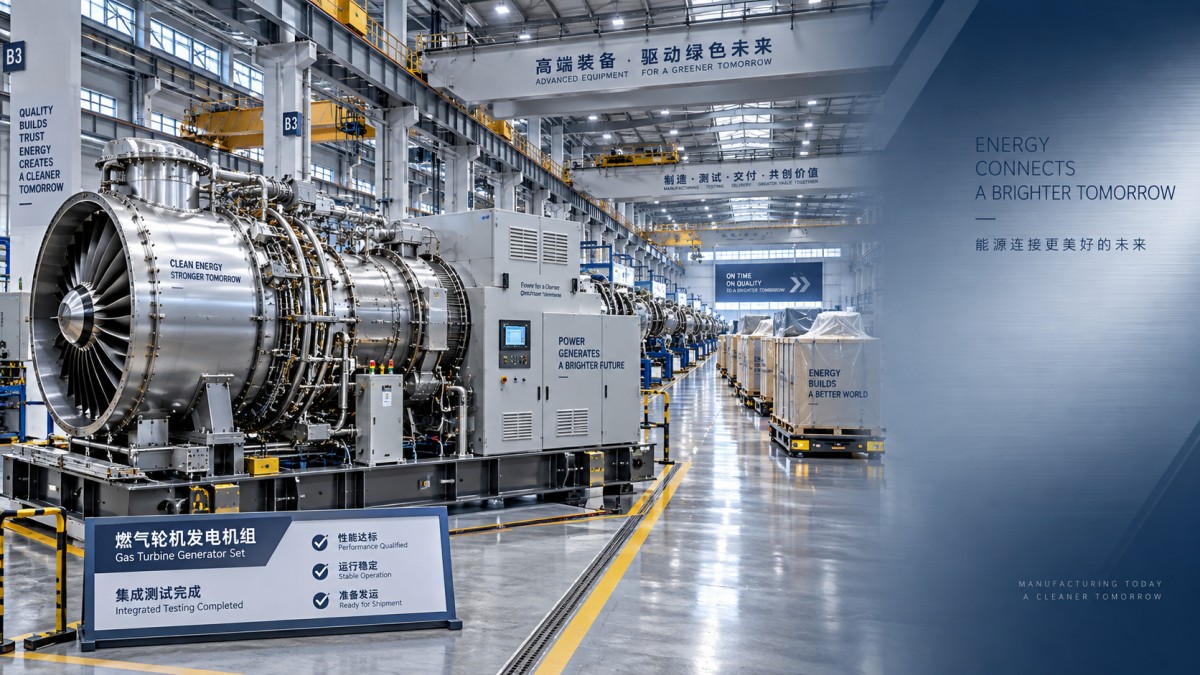
A gas turbine generator lead time does not begin when a production line starts assembly. It usually includes technical clarification, contract review, design release, procurement of long-cycle components, fabrication, package integration, factory testing, export preparation, shipping, and site support planning. Any unresolved item near the beginning can move the final delivery date.
This matters because gas turbine systems are rarely isolated purchases. The turbine, generator, control system, auxiliary equipment, inlet and exhaust arrangements, fuel system interfaces, foundation design, switchgear, transformers, and grid connection work must converge at the right time. If the prime mover arrives later than planned, work may not simply pause. Contractors may demobilize, stored materials may require preservation, and sequence changes can create claims or rework.
For capital approval, the relevant question is therefore not “What is the factory lead time?” It is “What delivery date can be supported by a documented sequence of engineering, sourcing, testing, logistics, and site interfaces?” A credible answer should distinguish between an estimated production window and a committed contractual milestone.
Where Schedule Pressure Becomes Financial Exposure
Delayed equipment can affect project economics in several directions at once. Interest during construction may continue to accrue while the asset is not yet available for operation. A planned shutdown may need to be postponed, extending maintenance costs or exposure to reliability risk in existing equipment. Where temporary generation is being used, fuel, rental, transport, and operating labor can remain in the budget longer than expected.
The impact can be particularly sharp in industrial sites where the generator supports process continuity. A missed energization date may affect upstream construction, commissioning personnel, production ramp-up, or contractual delivery obligations elsewhere in the operation. Even when a delay does not create a direct penalty, it can distort working-capital assumptions and cash-flow forecasts.
It is also important not to confuse a short quoted lead time with low project risk. An aggressive promise may depend on standard configuration, prompt technical approvals, unrestricted access to components, and a shipping route that remains practical. If the project requires unusual ambient conditions, special electrical protection, local-content requirements, nonstandard fuels, or extensive documentation, those assumptions should be tested early.
What to Ask Before Approving the Purchase Order
A financial review does not need to duplicate the engineering team’s work, but it should require enough visibility to identify schedule risk before it is embedded in the contract. The following questions usually reveal whether the supplier’s timeline is robust:
- Which components are on the critical path, and when will they be committed?
- Which specifications must be frozen before procurement can begin?
- Does the delivery date include factory acceptance testing, preservation, packing, and export documentation?
- What assumptions have been made about customer approvals, site readiness, and payment milestones?
- If a key component slips, what recovery options are technically realistic rather than merely contractual?
The quality of the response matters as much as the date itself. A supplier that can explain dependencies, release points, and mitigation measures gives the project team something usable for risk management. A single broad statement such as “delivery in several months” is difficult to build into a financing model.
Price Comparison Should Include the Cost of Waiting
When comparing proposals, finance teams often focus on equipment price, payment terms, warranty scope, and expected operating efficiency. Those remain essential, but schedule should be treated as a commercial variable rather than an operational footnote. The better comparison is total delivered project cost under realistic timing assumptions.
For example, a lower-priced package may require a larger schedule contingency because its design is not finalized or its supply chain is fragmented. Another package may carry a higher initial price but reduce interface management by integrating turbine, generator, controls, auxiliaries, and commissioning support. Neither option is automatically superior. The financial decision depends on the cost of delayed start-up, the certainty of the production schedule, the availability of interim power, and the project’s ability to absorb disruption.
Payment structure should reflect this reality. Milestones tied only to order placement and shipment can leave the buyer exposed if engineering progress is opaque. Depending on the project, it may be more useful to link selected payments to approved drawings, procurement release of critical items, successful factory tests, or documented readiness for dispatch. Contract language and security arrangements require project-specific legal review, but the underlying principle is straightforward: cash outflow should be aligned with verifiable progress.
The Value of an Integrated Manufacturing View
Lead-time control becomes harder when responsibility is divided among multiple parties with unclear boundaries. The turbine supplier may be ready while the generator or controls package is not. The package may be complete, but the customer’s civil contractor may still lack final interface drawings. Such gaps are common in complex power projects; they are manageable only when someone owns the integrated schedule.
SINO-QNP brings more than 30 years of turbomachinery experience across gas turbines, steam turbines, compressors, and generators. Its scope spans R&D and design, manufacturing and sales, EPC projects, spare parts supply, and a global marketing and service network. For buyers, the practical advantage of this breadth is not a generic claim of convenience. It is the ability to examine equipment interfaces and lifecycle support together, instead of treating delivery, installation, and future parts availability as unrelated decisions.
This perspective is increasingly relevant where generation assets are being evaluated alongside grid flexibility investments. In a power-grid application, Air Energy Storage uses surplus electricity to compress air, captures compression heat in a thermal medium such as molten salt, and stores cooled high-pressure air. During discharge, stored thermal energy reheats the air before it expands through machinery to drive a generator. It is a different operating model from conventional gas-fired generation, but it raises a similar procurement issue: compressors, expanders, thermal storage, electrical systems, and civil works must be planned as one schedule, not purchased as disconnected packages.
A More Defensible Approval Decision
Before approving a gas turbine generator investment, ask for a schedule that shows the path from specification freeze to site commissioning, identifies long-cycle items, and names the approvals that could stop progress. Then test the financial model against a reasonable delay scenario. The purpose is not to assume failure; it is to understand which costs begin to accumulate if delivery moves.
A capable Gas Turbine Generator Manufacturer should be willing to discuss those dependencies directly. The strongest procurement decision is seldom based on the earliest stated ship date or the lowest equipment price alone. It is based on whether the supplier can provide enough engineering, manufacturing, logistics, and service visibility for the project schedule—and its capital assumptions—to remain credible.
- ▶ When an extraction steam turbine improves combined heat and power output
- ▶ What happens when process steam demand changes on an extraction steam turbine
- ▶ How to match extraction steam turbine pressure to process demand
- ▶ When local service coverage matters for a gas turbine generator manufacturer
- ▶ How manufacturer lead times can alter a gas turbine generator project
- ▶ Which certifications matter when choosing a gas turbine generator manufacturer
Search from here
Leave a message
