




















Which certifications matter when choosing a gas turbine generator manufacturer
When selecting a Gas Turbine Generator Manufacturer, the most meaningful certifications are those that connect to the actual scope of supply: design control, fabrication, rotating-equipment testing, electrical integration, site installation, and lifecycle documentation. A certificate on its own does not prove that a specific turbine-generator package will meet the required duty. Its value lies in the audited process behind it and in the traceable records available for the proposed equipment.
Start by separating three categories that are often presented together: management-system certification, product conformity, and project-specific compliance. ISO certificates normally assess the management system of a facility or organization. A conformity mark or declaration relates to a defined product and market. Contract specifications, grid rules, pressure-equipment requirements, and owner standards apply to the particular project. Treating these as interchangeable creates gaps during technical evaluation.
Quality management certification: ISO 9001 as the baseline
ISO 9001 certification is usually the first document to examine because it addresses controlled processes for design, purchasing, production, inspection, nonconformance handling, and document revision. For a gas turbine generator package, the useful question is not simply whether the certificate is current. The important issue is whether its scope covers the locations and activities involved in the order.
A certificate covering sales administration does not carry the same weight as one covering engineering, machining, assembly, testing, and service. Review the legal entity, manufacturing site, scope statement, issuing body, and validity period. Where turbine components are made at more than one facility, determine which site controls critical operations such as rotor machining, blade manufacture, combustion-system assembly, balancing, and final package testing.
ISO 9001 is particularly relevant where late engineering changes are likely. A change to fuel composition, ambient temperature, emissions equipment, generator voltage, or enclosure arrangement can affect several interfaces at once. Controlled design inputs, revision records, technical approvals, and traceability of changed parts reduce the chance that an obsolete drawing or bill of materials reaches the shop floor.
Environmental and occupational management certificates
ISO 14001 and ISO 45001 address environmental and occupational health and safety management systems. They are useful indicators of disciplined plant operations, especially where fabrication includes welding, coating, cleaning chemicals, lifting, pressure testing, or high-speed rotating tests. They do not certify the emissions or safety performance of a particular gas turbine generator.
That distinction matters. A supplier may hold ISO 14001 while the proposed unit still requires project-specific evidence for exhaust emissions, noise limits, wastewater arrangements, fuel handling, or disposal of lubricants and filters. Likewise, ISO 45001 does not replace a project safety plan, lifting procedure, lockout documentation, hazardous-area review, or commissioning method statement.
Where installation activities are included in the contract, ask how the certified system extends from the factory to site work. The handover point between package assembly, transport preservation, civil interfaces, electrical connection, and startup is a common source of unclear responsibility.
Standards that govern the equipment itself
For a generator package, compliance with equipment standards is often more technically revealing than a general management certificate. The applicable standards depend on the duty, fuel, power rating, grid arrangement, site jurisdiction, and contract specification. A credible technical submission identifies the standard, edition, applicable clauses, exceptions, and evidence method rather than merely placing familiar standard logos on a brochure.
API standards are frequently cited for industrial gas turbines, lubrication systems, couplings, and related rotating equipment. They are technical specifications rather than a universal manufacturer certification. Their relevance must be tied to the requested package. For example, an API-based requirement may affect bearing arrangement, auxiliary oil-system design, vibration monitoring, materials, inspection hold points, and documentation. A statement of “API compliant” without a clause-by-clause deviation list is too broad to support a final technical judgment.
Factory acceptance evidence carries more weight than a logo
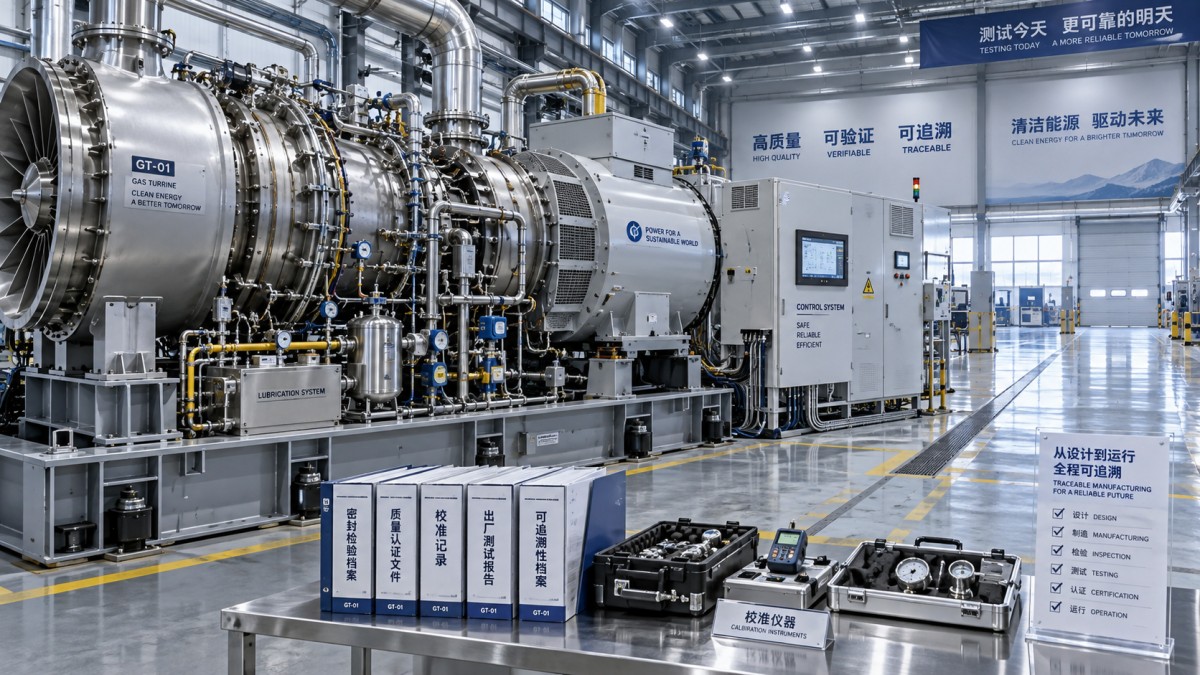
Certification becomes meaningful when it leads to verifiable records. For the proposed configuration, request a quality plan or inspection and test plan showing witness points, hold points, acceptance criteria, and responsible parties. The content should correspond to the actual package, including turbine, generator, control panel, gearbox if fitted, fuel system, lube-oil system, enclosure, and auxiliary equipment.
Useful evidence may include material certificates for pressure-retaining or highly stressed parts, welding procedure qualifications, welder qualifications, nondestructive examination reports, dimensional records, rotor balancing reports, electrical routine-test results, functional test records, and preservation instructions. The exact document set varies with the design, but the document index should show a clear relationship between part numbers, serial numbers, drawing revisions, and inspection records.
Performance testing requires special attention. Site output is influenced by ambient temperature, altitude, inlet pressure loss, exhaust backpressure, fuel properties, humidity, and auxiliary loads. A factory test may demonstrate controls and mechanical operation without reproducing the final site conditions. The test boundary, correction method, instrument accuracy, and guaranteed parameters need to be stated separately. A power figure without those conditions is easy to misread.
Regional conformity and installation obligations
Market-access requirements cannot be assumed from an ISO certificate. Where equipment will be placed in a regulated jurisdiction, the package may need specific conformity assessment, declarations, technical files, markings, or inspection by recognized bodies. The requirements can differ between the generator, control system, low-voltage equipment, pressure components, hazardous-area devices, lifting provisions, and packaged piping.
Electrical compatibility also deserves direct review. Generator voltage, frequency, short-circuit contribution, earthing philosophy, relay coordination, synchronization functions, harmonic conditions, and grid-code obligations belong to the system design. Certification of a generator alone does not establish that the combined turbine-generator-control package will connect correctly to the site network.
For installations handling combustible gas, hazardous-area classification affects instrument selection, cable glands, junction boxes, purge arrangements, and maintenance procedures. A certificate for an individual device must match the designated zone, gas group, temperature class, and installation method. Substituting an apparently similar device late in assembly can invalidate the original classification basis.
Assessing the certificate trail across subcontracted work
Gas turbine generator packages often include externally sourced generators, switchgear, valves, instruments, heat exchangers, acoustic enclosures, and control components. The primary supplier’s quality certificate does not automatically extend to every sub-supplier. Traceability should continue through critical purchased items, especially those affecting containment, overspeed protection, fuel isolation, vibration monitoring, and electrical protection.
Clarify who approves sub-supplier drawings, who owns nonconformance disposition, and who verifies final compatibility. A generator and turbine can each satisfy their individual requirements while the coupled train has unresolved torsional, alignment, or control-interface issues. This is also relevant when a gas turbine package shares utilities or controls with a Compressor train. Common lube-oil systems, shared control logic, fuel headers, and shutdown causes need a defined verification boundary.
Questions that expose weak certification claims
- Which manufacturing location and activities are covered by each management-system certificate?
- What standard edition and contract clauses apply to this exact package, and where are the stated deviations?
- Which components require independent conformity documents, third-party inspection, or jurisdictional approval?
- Can the proposed inspection and test plan be linked to final manufacturing records and serial numbers?
- Do factory test conditions match the guaranteed site-duty basis, including fuel and ambient assumptions?
The strongest certification profile is a coherent chain: audited quality controls, applicable equipment standards, clear regulatory responsibility, and test records that identify the delivered configuration. Missing links are often more important than the number of certificates presented. A technically credible package makes those links visible before fabrication begins, when interface changes and compliance gaps are still manageable.
- ▶ When an extraction steam turbine improves combined heat and power output
- ▶ What happens when process steam demand changes on an extraction steam turbine
- ▶ How to match extraction steam turbine pressure to process demand
- ▶ When local service coverage matters for a gas turbine generator manufacturer
- ▶ How manufacturer lead times can alter a gas turbine generator project
- ▶ Which certifications matter when choosing a gas turbine generator manufacturer
Search from here
Leave a message
