




















When a small gas turbine generator is practical for remote power
A Small Gas Turbine Generator is practical for remote power when the site has a sustained electrical load, a dependable gaseous fuel source or fuel-delivery plan, and a higher cost of outage than of turbine ownership. It is most compelling where diesel logistics are difficult, the available footprint is limited, or operations need continuous power for critical rotating equipment, processing systems, communications, and safety infrastructure.
It is less attractive for a small, highly variable load that runs only occasionally. In that case, a conventional diesel genset, batteries paired with renewables, or a hybrid system may produce a better economic result. The decision should begin with the operating profile rather than the generator's rated output.
Start with the load profile, not the nameplate rating
Remote sites often describe their requirement as a peak demand: the largest expected motor start, process upset, or simultaneous equipment run. That figure matters, but it does not determine whether a gas turbine is a good fit. A turbine generator should be evaluated against the site's base load, peak load, daily load swings, and required operating hours.
Small gas turbines tend to make the strongest operational case where the load is relatively stable for long periods. Examples include unmanned gas facilities, pipeline stations, well pads with continuous treatment equipment, remote industrial utilities, mining support systems, and isolated production assets. A stable load allows the unit to operate closer to its intended range, reducing the operational penalty associated with frequent turndown and repeated starts.
A project with a large gap between normal demand and peak demand requires more careful design. Oversizing a turbine to cover an infrequent peak can leave it operating inefficiently for most of its life. The better answer may be load sequencing, a smaller turbine combined with battery support, or a modular arrangement in which one unit follows the base load and another covers planned peaks or provides standby capacity.
- Map the minimum, normal, peak, and starting loads separately.
- Identify whether high-demand events are predictable or random.
- Separate critical loads from loads that can be shed during an upset.
- Assess how many hours per year the power plant must run at each load band.
For decision-makers, this exercise often changes the procurement question. The issue becomes less about selecting the largest available generator and more about designing a power architecture that can keep the site stable through normal operation, equipment starts, and maintenance events.
Fuel availability can make the business case or undermine it
A small gas turbine generator can be particularly practical at sites with associated gas, field gas, pipeline gas, landfill gas after suitable treatment, or another sustained gaseous fuel supply. Avoiding routine diesel haulage can reduce exposure to difficult roads, weather interruptions, storage constraints, and fuel theft. At some remote sites, the logistics risk of delivering liquid fuel matters as much as the direct fuel cost.
However, “gas available on site” is not enough. Fuel composition, pressure, contaminants, moisture, and supply continuity affect both performance and equipment selection. A remote asset may have gas that is usable in principle but unstable in pressure or variable in heating value. That can require conditioning, compression, filtration, dehydration, or a fuel-control approach designed for the expected variation.
Fuel quality should therefore be treated as an engineering input early in the project. It should not be left as a commissioning detail after the generating package has been selected. Where the gas source may decline, vary seasonally, or be interrupted by upstream operations, the power strategy should also define the fallback: stored liquid fuel, grid connection where available, battery reserve, load shedding, or a secondary generator.
There is also a practical distinction between a site where gas is genuinely surplus and a site where gas is needed elsewhere in the process. Consuming valuable fuel gas for power may still be justified, but it should be compared with alternatives such as exporting the gas, using it for direct process heat, or investing in a lower-load power system. The turbine decision belongs within the site's overall energy balance.
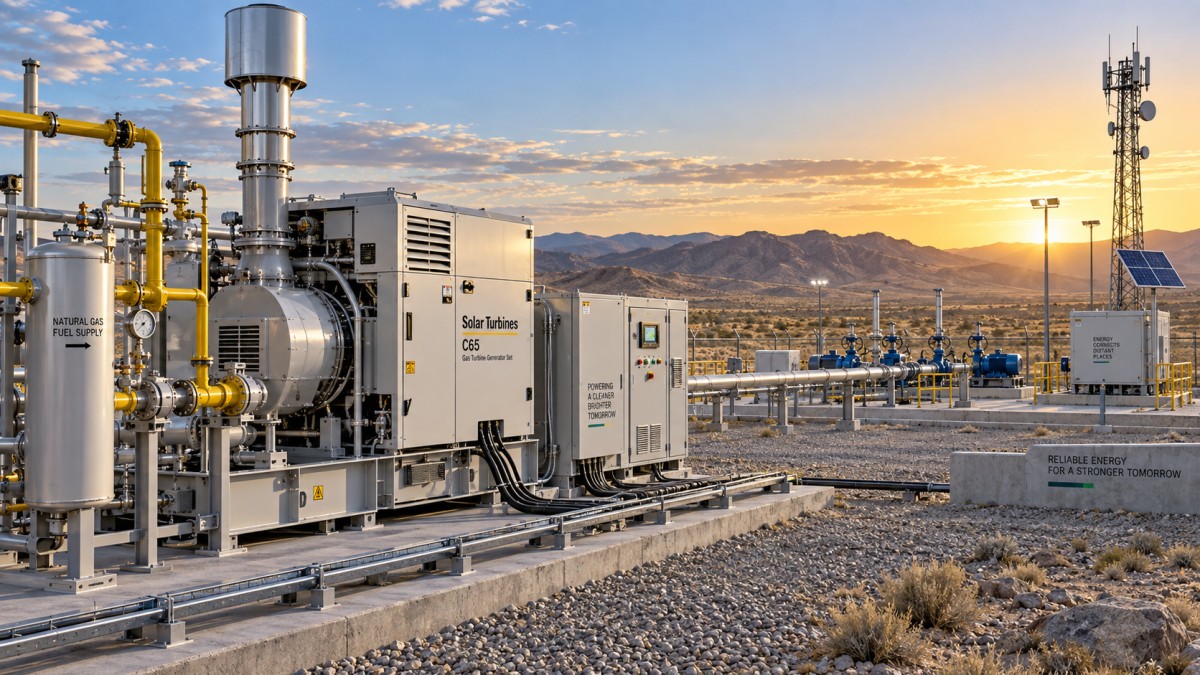
Compact continuous power is useful, but service access still decides uptime
Gas turbines are often selected because they can provide high power density in a compact package. That matters where transport, foundations, platform weight, enclosure space, or installation time constrain the project. They can also integrate well with sites that value continuous duty and centralized power for multiple loads.
Compactness should not be confused with simplicity. A remote installation still needs a viable maintenance concept. The package must be accessible for routine inspections, consumables, controls troubleshooting, and planned component work. A unit installed in a difficult location without lifting provisions, spare-parts planning, remote diagnostics, or trained local support may be technically suitable but operationally fragile.
Before approving the technology, operations teams should ask practical questions:
- Can trained personnel reach the site within the required response time?
- Which maintenance activities can the site team perform, and which require specialist support?
- What critical spares need to be held on site or positioned regionally?
- Can the control system be monitored remotely, including alarms, trends, and shutdown events?
- What lifting, access, ventilation, and safety isolation arrangements are required for planned maintenance?
These questions are especially important in cold climates, dusty mining regions, offshore-like logistics environments, and sites with limited skilled labor. Environmental conditions affect air filtration, enclosure design, cooling arrangements, corrosion protection, and the intervals at which the power package requires attention.
Oilfield loads require an integrated view of the power train
In drilling and well-servicing environments, the generator is only one part of a demanding power system. Loads can include pumps, solids-control equipment, lighting, accommodation systems, controls, communications, and auxiliary drives. Their duty cycles may shift substantially between preparation, circulation, pumping, and shutdown phases.
For example, a drilling package using an API-standard Mud pump driven by a diesel engine or motor creates different electrical planning requirements depending on the drive arrangement. A motor-driven pump can impose high starting and transient demands on the generating system, while a diesel-driven configuration moves more of the power burden away from the electrical plant. The selection should account for motor-starting method, variable-frequency drives where applicable, power quality, and the consequence of a sudden loss of process equipment.
That does not mean a turbine generator is automatically the preferred option for every rig or temporary campaign. Short-duration operations with changing locations may place a higher value on familiar diesel equipment and simple fuel planning. A turbine-based system becomes more credible when the site remains active long enough to justify its infrastructure, local gas is available, and continuous electrical demand is substantial enough to support efficient operation.
Redundancy should be designed around production consequences
Remote power systems are often judged by rated capacity, but availability depends on what happens when one component is unavailable. A single generator sized for the full site load may appear economical, yet an unplanned outage can halt production, freeze process conditions, disrupt safety systems, or require a costly restart sequence.
For critical operations, modular capacity may be more practical than one large unit. Multiple generating units can support maintenance without a full shutdown, allow capacity to follow changing demand, and isolate a fault more effectively. The appropriate arrangement depends on the consequence of losing power and the amount of load that can be safely shed.
Backup design also needs to distinguish between full production continuity and safe shutdown. The former requires enough reserve capacity to maintain operations. The latter may only require power for controls, communications, lighting, lubricating systems, fire protection, or an orderly process shutdown. Treating every load as equally critical can lead to unnecessary capital cost; treating too few loads as critical can create a recovery problem after an outage.
Lifecycle cost should include what remote operation makes expensive
Comparing purchase prices alone rarely produces a sound remote-power decision. The relevant cost includes fuel delivery or conditioning, civil works, installation, operating labor, scheduled maintenance, spare parts, transport to the site, downtime exposure, and the cost of maintaining a backup source.
A turbine can justify a higher initial investment when it removes recurring logistical burden, supports a long operating horizon, or avoids losses linked to unreliable power. Conversely, it can be difficult to justify where annual running hours are low, gas conditioning is extensive, or the site will be decommissioned before the investment is recovered.
The most useful financial comparison uses several operating cases rather than one optimistic forecast. Test a normal production case, a lower-load case, a fuel-interruption case, and a case where the site must rely on backup generation for an extended period. That approach exposes whether the proposed configuration remains workable when the original assumptions change.
A practical selection decision
A Small Gas Turbine Generator is a strong candidate for remote power when four conditions align: the site needs long-duration, dependable electricity; the load is sufficiently steady or can be managed; fuel gas is available in a usable and reliable form; and the owner can support maintenance, spares, and recovery from an outage.
Where one of those conditions is weak, the answer may still involve gas generation, but rarely as a standalone equipment choice. It may require a hybrid design, modular capacity, fuel treatment, additional storage, or a different prime mover. The most disciplined projects define those conditions before selecting a package, because remote power failures usually begin with an operating assumption that was never tested.
- ▶ When an extraction steam turbine improves combined heat and power output
- ▶ What happens when process steam demand changes on an extraction steam turbine
- ▶ How to match extraction steam turbine pressure to process demand
- ▶ When local service coverage matters for a gas turbine generator manufacturer
- ▶ How manufacturer lead times can alter a gas turbine generator project
- ▶ Which certifications matter when choosing a gas turbine generator manufacturer
Search from here
Leave a message
