




















When to specify black-start capability for a natural gas turbine generator
Black-start capability should be specified when a facility must restore at least part of its electrical system after a total loss of grid power without depending on an outside source. For a Natural Gas Turbine Generator, this is not a minor optional feature. It changes the auxiliary-power arrangement, control philosophy, commissioning scope, operating procedures, and budget.
Buyers should include black-start capability when loss of external power would create an unacceptable safety, production, environmental, or recovery risk. It is less compelling where a utility supply is highly secure, process equipment can safely remain idle for an extended period, and another independent onsite source can already energize the turbine package and essential loads.
Start with the consequence of a complete outage
The useful procurement question is not whether black start is technically possible. Most gas-turbine packages can be engineered for it. The question is what happens during the first hours after both normal and standby grid supplies are unavailable.
Black-start capability is often justified in facilities where controlled shutdown alone is insufficient. Examples include plants that must maintain fire protection, cooling, control power, communications, emergency lighting, critical pumps, or a defined safe state for process units. Chemical, municipal, metallurgical, and industrial utility sites may also need an onsite source to restore selected services before their main process can restart.
A power plant may require black start for a different reason: it may have an obligation to assist restoration of an isolated electrical network, or it may need to energize its own station-service system before larger generating equipment can be returned to service. In that case, the turbine generator is part of a restoration sequence, not simply an emergency generator.
By contrast, a facility does not automatically need black start just because it owns a gas turbine. If a separate diesel generator, battery energy storage system, or reliable emergency electrical source already starts the required auxiliaries and supports safe recovery, adding a second black-start path may provide limited practical value. The decision should follow the site recovery plan, not a preference for a longer equipment specification.
Black start is a package-level requirement
A common procurement mistake is to treat black start as a generator feature. The generator may be capable of producing power, but the gas turbine cannot reach firing and synchronization conditions unless its own essential systems are energized. A credible specification must cover the full startup chain.
That chain commonly includes starting equipment, turbine controls, lubrication and sealing systems where applicable, fuel-gas conditioning and shutoff functions, ventilation, ignition, battery chargers, instrumentation, protection relays, and the switchgear needed to connect essential loads in the intended order. The required configuration depends on the turbine design and plant layout, so purchasers should ask suppliers to identify every auxiliary load needed from a dead-bus condition.
For many packages, the black-start source may be a dedicated battery-supported DC system combined with a small emergency generator or another independent AC source. In other arrangements, a diesel genset or battery energy storage system energizes the startup bus, after which the gas turbine takes over the essential load. The important point is independence: an auxiliary source that requires the same unavailable grid connection is not a black-start solution.
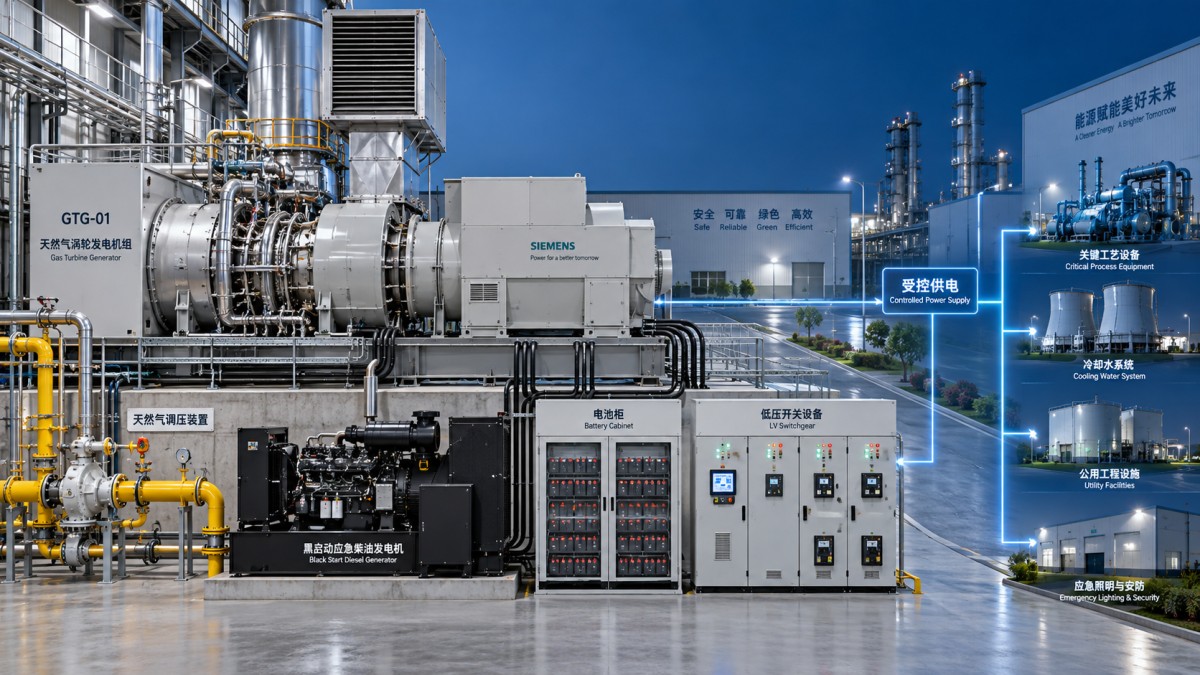
The transition after the turbine generator is online also deserves attention. The package must be able to accept initial auxiliary loads without an unstable voltage or frequency response, then energize additional buses in a controlled sequence. Large motors, transformers, variable-frequency drives, and harmonic-sensitive equipment can materially affect this sequence. Buyers should provide an essential-load list early enough for the supplier and electrical designer to assess starting duty and load steps.
Situations where the requirement is usually justified
- Single-feed facilities: The site has one credible external supply path and a prolonged outage would prevent safe stabilization or orderly restart.
- Remote or weak-grid locations: Restoring the utility connection may take longer than the facility can safely remain without onsite electrical support.
- Critical process islands: A limited group of pumps, controls, treatment systems, or safety systems must be re-energized before the broader plant can recover.
- Power-generation restoration duty: The unit is intended to establish station service, energize a local bus, or support recovery of other generating assets.
- High cost of delayed restart: Production losses, material spoilage, equipment preservation needs, or contractual exposure make an independently initiated restart economically defensible.
These conditions do not all demand the same level of capability. A package intended only to keep safety systems alive may need a modest black-start arrangement and a small essential-load bus. A unit expected to energize transformers, start major motor loads, or support grid restoration requires a more rigorous electrical study, protection design, and operating sequence.
What to place in the inquiry specification
“Black-start capable” is too vague for a purchase order. It can produce bids that appear comparable but rely on different assumptions about batteries, auxiliary generators, fuel availability, operator actions, and load acceptance. The specification should define the intended recovery duty in operational terms.
Autonomy time is particularly important. A battery system sized only for protection and trip duty may not have enough capacity to support repeated start attempts, control functions, switchgear operation, communications, and extended dead-bus preparation. Similarly, a small emergency generator may be adequate for turbine auxiliaries but insufficient for the first required motor start. The supplier should state the assumed load profile and operating duration rather than simply naming a battery voltage or emergency generator rating.
Check the fuel and auxiliary systems before approving the concept
A natural gas fuel supply can be overlooked in outage planning because the gas source itself may remain available. Yet the turbine package may depend on electrically driven valves, gas compressors, heaters, analyzers, pressure-control equipment, or upstream station auxiliaries. If these functions are unavailable after the grid outage, the generator may have an adequate starter and still be unable to fire.
The same logic applies to lube-oil pumps, cooling fans, enclosure ventilation, fire-and-gas systems, and control-room interfaces. Procurement teams should request a cause-and-effect review that separates equipment needed to start the turbine from equipment needed to sustain operation after startup. This prevents an apparently complete black-start package from failing during the handover to normal operating configuration.
Do not confuse emergency generation with resilient recovery
A standby generator that starts automatically during a utility outage is not necessarily configured for black start. It may rely on a live switchboard, operate only a limited emergency panel, or lack the controls and electrical protection required to establish and expand an isolated bus. Likewise, a gas turbine that can start from an auxiliary diesel generator is not necessarily suitable for energizing a larger plant network.
The distinction matters in bid evaluation. A low-cost offer may cover turbine starting only, while another offer includes the upstream emergency source, black-start switchgear logic, auxiliary-load sequencing, commissioning support, and operator training. These are different scopes with different project risks.
For projects delivered under an integrated EPC arrangement, black start should be resolved during electrical system design rather than left as a late package option. The generator set, high- and low-voltage distribution, transmission interface, fire protection, and commissioning procedures all influence whether the restoration sequence works as designed.
Evaluate reliability through testability
Black start is valuable only if it can be demonstrated and maintained. Buyers should require a documented test philosophy covering simulated loss of normal power, operation from the independent startup source, turbine start, dead-bus energization, loading steps, and transfer to the intended operating state. A factory test may verify portions of the controls, but site testing is necessary to prove the actual auxiliary system and electrical interfaces.
Maintenance responsibilities should also be explicit. Battery condition, emergency-generator fuel quality, starting-system readiness, switchgear interlocks, protective-relay settings, and control-sequence changes can all undermine a system that was correctly commissioned. Where the facility has infrequent outages, periodic testing becomes more important because hidden dependencies may otherwise remain undiscovered.
Specify black-start capability when the site needs to recover independently from a defined total-outage scenario and the supporting auxiliary systems can be designed, tested, and maintained as one restoration system. Where the requirement is justified, a precise operating sequence is more valuable than a broad statement of capability: it gives bidders a common basis, exposes missing interfaces early, and lets the procurement team compare both cost and recovery confidence on meaningful terms.
- ▶ When an extraction steam turbine improves combined heat and power output
- ▶ What happens when process steam demand changes on an extraction steam turbine
- ▶ How to match extraction steam turbine pressure to process demand
- ▶ When local service coverage matters for a gas turbine generator manufacturer
- ▶ How manufacturer lead times can alter a gas turbine generator project
- ▶ Which certifications matter when choosing a gas turbine generator manufacturer
Search from here
Leave a message
