




















How part-load operation changes small gas turbine generator efficiency
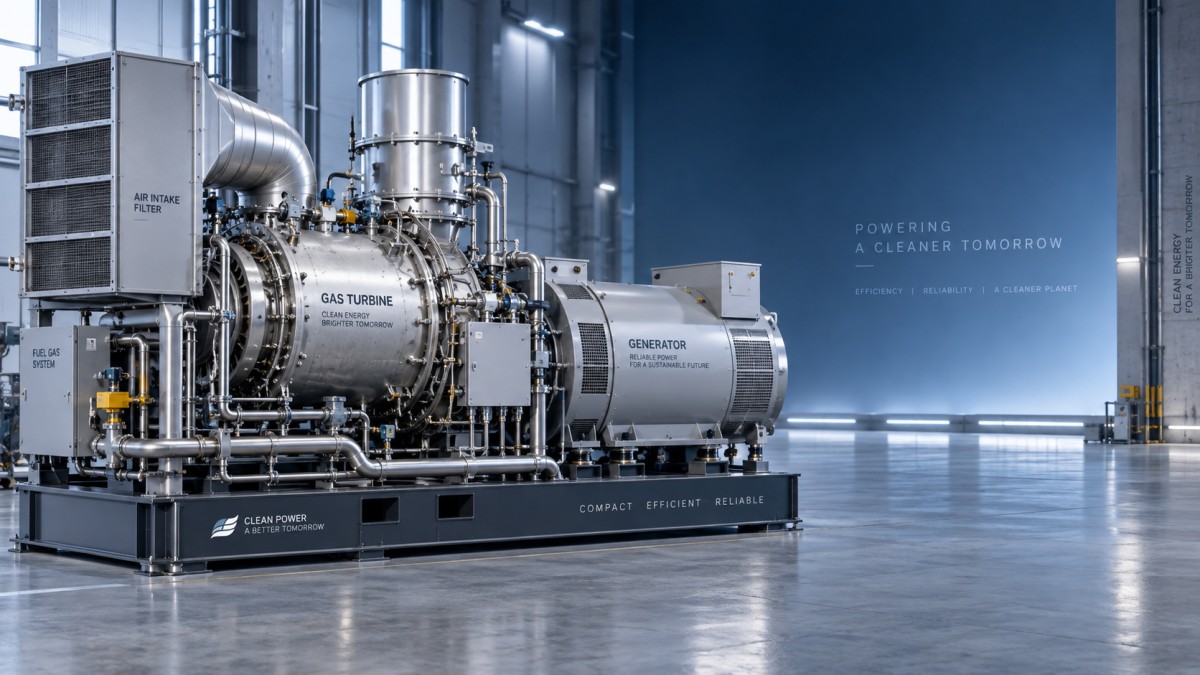
A Small Gas Turbine Generator rarely stays at its rated output for an entire shift. A site may see demand fall after a process line stops, during night operation, or when another power source takes part of the load. The generator still has to maintain frequency and voltage, but the turbine burns fuel under conditions that are less favorable than its design point.
The practical answer is that part-load operation usually increases specific fuel consumption and heat rate: the unit produces fewer kilowatts for each unit of fuel consumed. The size of the penalty depends on turbine design, ambient conditions, control strategy, shaft speed, and the minimum stable load requirement. Operators can limit the impact by identifying the real load profile, avoiding unnecessary low-load running, keeping the air path clean, and verifying that control settings match the operating mode.
Why efficiency falls as load drops
A gas turbine produces power by compressing air, adding fuel in the combustor, and expanding hot gas through the turbine. At the rated point, the compressor, combustor, turbine, generator, and control system are designed to work together near their most efficient operating range.
At part load, electrical demand falls, so the control system normally reduces fuel flow. However, several internal losses do not decline at the same rate as useful electrical output. The compressor still needs significant shaft power to move and compress air. Bearings, lubrication equipment, cooling systems, intake filtration losses, gearbox losses where fitted, and generator losses remain present. As net output becomes smaller, these relatively fixed losses occupy a larger share of the available power.
In a simple-cycle machine, reducing fuel flow also lowers turbine inlet temperature. Lower gas temperature reduces the energy available for expansion through the turbine. The unit may remain stable and responsive, but it is no longer extracting energy under its best thermodynamic conditions. This is why a machine can appear to be running normally while its fuel cost per kilowatt-hour rises noticeably.
The compressor does not “turn off” when demand falls
The turbine’s air compressor is one of the main reasons part-load efficiency changes. It continues consuming power even when the generator produces less electricity. Depending on the machine design, airflow may be controlled by inlet guide vanes, variable geometry, bleed arrangements, speed changes, or a combination of these methods. Each approach has different part-load behavior.
Variable inlet guide vanes can reduce airflow more efficiently than relying only on fuel reduction, but they do not eliminate compressor work. Fixed-speed generator sets may also have less freedom to reduce rotational speed because grid frequency or required electrical output frequency must be maintained. A variable-speed package with power electronics may have a different operating envelope, but it must still comply with its own limits for surge margin, temperature, emissions, and generator conversion losses.
Where a facility changes both power demand and process-air demand, the operating schedule should be reviewed as a whole. A process Compressor unit can alter plant loading patterns significantly, especially when it starts, unloads, or moves between production states. Coordinating these changes may reduce periods in which the turbine generator is left operating inefficiently at a low, steady load.
What operators usually see at low load
The first indication is often a higher heat rate or a rise in fuel used per unit of electrical energy produced. Fuel flow may decrease in absolute terms, yet output may fall faster than fuel consumption. This distinction matters when comparing operating periods: lower fuel flow does not automatically mean better efficiency.
Other effects can include slower response to sudden load changes, larger percentage swings in output, and reduced exhaust temperature. Depending on the turbine and emissions system, very low load can also bring combustion closer to its stable operating boundary. The control system may protect the unit by limiting load reduction, changing fuel staging, opening or closing variable geometry, or initiating a shutdown when minimum operating conditions are no longer met.
Part load is not always the same operating condition
A generator running at 50% load on a cool morning is not necessarily operating like the same generator at 50% load on a hot afternoon. Higher inlet-air temperature reduces air density and can reduce available power. Intake pressure loss from a dirty filter, high exhaust backpressure, humidity, fuel quality, and elevation can further change the result.
This is why comparing two shifts using only “percentage load” can lead to the wrong conclusion. A useful operating review records net electrical output, fuel flow, ambient temperature, inlet and exhaust pressure conditions where available, exhaust temperature, operating mode, and major auxiliary loads. The goal is not to create an excessive reporting burden; it is to separate a genuine part-load efficiency issue from a change caused by the environment or by equipment condition.
Auxiliary consumption deserves particular attention. Pumps, fans, oil systems, enclosure ventilation, fuel conditioning equipment, and driven accessories may use a relatively steady amount of power. At high output, their contribution to the plant’s net efficiency may be modest. At low output, they can materially affect the difference between gross generator output and usable net power.
Deciding whether to keep the unit online
The best decision is not always “run at the highest load possible.” Reliability requirements, spinning reserve, process continuity, grid limitations, and starting time can justify keeping a turbine generator online below its best efficiency point. The key is to recognize the cost of that choice and operate within the approved load range.
When more than one generating unit is available, dispatch should usually consider which machine can carry the required load with the lowest fuel use while maintaining sufficient reserve. In many cases, one appropriately loaded unit is more efficient than two units sharing a small demand. That principle has limits: starting and stopping cycles introduce thermal stress, maintenance considerations, and fuel use during startup. A decision based only on instantaneous heat rate may therefore be incomplete.
A practical review can follow this order:
- Identify the expected demand duration. A short low-load interval may not justify stopping or reconfiguring equipment.
- Confirm the unit’s approved continuous operating range, including combustion, emissions, and thermal restrictions.
- Compare net kW and fuel rate against historical data collected under similar ambient conditions.
- Check whether another generator, energy storage system, or grid connection can carry the base or variable portion of demand more efficiently.
- Consider startup time, required reserve margin, and the maintenance effect of additional starts before changing dispatch practice.
Control actions that can make low-load operation worse
Some efficiency losses are inherent to the turbine cycle, but avoidable control behavior can add to them. A generator that repeatedly hunts around a setpoint may consume more fuel and accumulate unnecessary thermal cycles. Load fluctuations can be caused by poor governor tuning, unstable site demand, incorrect droop or isochronous settings, or interaction between parallel units.
Operators should distinguish between normal response to changing demand and persistent oscillation. A stable trend may show gradual fuel reduction as load falls. A problematic trend may show power output, fuel flow, or exhaust temperature moving up and down without a corresponding change in site demand. Before adjusting control parameters, verify instrument quality and review the applicable operating procedures. Incorrect tuning can affect frequency control, load sharing, and equipment protection.
Another common mistake is using a low-load operating point as the normal baseline after the site process has changed. If the facility’s average demand has permanently moved below the generator’s efficient range, the issue is not simply operator technique. The power arrangement may need reassessment around unit sizing, dispatch logic, process scheduling, or the use of supplementary equipment.
Maintenance links to part-load efficiency
Part-load operation does not automatically damage a gas turbine, but it can make underlying condition problems more visible. Compressor fouling, intake restriction, degraded seals, combustor wear, fuel nozzle condition, and sensor drift can all shift the relationship between fuel flow and electrical output. A unit with degraded airflow may require more fuel to produce the same load, and the penalty can be especially difficult to interpret when the machine is already operating far from its design point.
Trend monitoring is more useful than relying on a single reading. Compare similar load bands over time and account for ambient conditions. A gradual change in corrected heat rate, exhaust temperature spread, pressure ratio, vibration, or startup behavior may indicate that inspection or maintenance planning is needed. Maintenance actions should follow the equipment manufacturer’s instructions and the site’s approved safety process, particularly where fuel systems, hot surfaces, rotating equipment, and electrical isolation are involved.
Operating target: stable, informed, and appropriate load
Part-load efficiency cannot be judged by generator output alone. The useful measure is the relationship between net electrical power, fuel use, auxiliary consumption, and the operating limits of the specific machine. A Small Gas Turbine Generator may be the right choice for a variable-duty application, but its daily cost depends heavily on how often it sits below its efficient operating range.
For routine operation, maintain a clear record of load, fuel, ambient conditions, and control mode; avoid unnecessary low-load idling; and investigate unexpected movement in heat rate rather than assuming it is normal. When low-load operation becomes persistent, reviewing dispatch and demand scheduling is often more effective than trying to correct a thermodynamic limitation through minor control adjustments.
- ▶ When an extraction steam turbine improves combined heat and power output
- ▶ What happens when process steam demand changes on an extraction steam turbine
- ▶ How to match extraction steam turbine pressure to process demand
- ▶ When local service coverage matters for a gas turbine generator manufacturer
- ▶ How manufacturer lead times can alter a gas turbine generator project
- ▶ Which certifications matter when choosing a gas turbine generator manufacturer
Search from here
Leave a message
