




















How to compare noise limits for a small gas turbine generator site
How to Compare Noise Limits for a Small Gas Turbine Generator Site
Comparing noise limits for a Small Gas Turbine Generator site is not a matter of placing one supplier sound level beside one regulatory number. The two figures may refer to different locations, time periods, operating conditions, frequency weightings, or measurement methods. A package described as “quiet” at one metre from the enclosure may still create a property-line issue if the site is close to residences, hospitals, offices, or other sensitive receptors.
For quality and safety managers, the practical objective is clear: establish whether the complete operating site can meet the applicable environmental and occupational noise requirements before equipment is installed. That requires a comparison method that accounts for the gas turbine package, generator, intake and exhaust systems, ventilation openings, transformers, cooling equipment, and any other sources that operate at the same time.
Start with the limit, not the equipment datasheet
The first document to confirm is the requirement issued by the relevant authority, project owner, industrial park, or environmental permit. Local rules vary considerably. Some establish limits at the site boundary, while others assess noise at the nearest affected building or designated receptor. Some distinguish daytime, evening, and nighttime periods. Others set different limits according to land use, such as industrial, commercial, or residential zoning.
Before comparing any turbine-generator quotation, record exactly what the limit means. A useful compliance brief should state:
- the assessment location: property line, receptor façade, workplace, or a defined distance from equipment;
- the metric: commonly A-weighted equivalent continuous sound level, maximum sound level, or a limit by octave band;
- the averaging interval and the applicable time period;
- whether background noise, tonal content, impulsive noise, or low-frequency components require adjustments;
- the operating condition to be assessed, including normal load, startup, shutdown, and emergency operation.
A limit expressed as dB(A) Leq over a defined period is not interchangeable with a supplier’s instantaneous or near-field reading. Likewise, an occupational exposure criterion inside the plant does not prove environmental compliance outside the fence. These are related but separate risk controls.
Make the acoustic quantities comparable
The most frequent comparison error is mixing sound power and sound pressure. Sound power level describes the acoustic energy emitted by a source and is useful for predicting performance at different distances or within a site model. Sound pressure level is what a microphone measures at a particular position; it changes with distance, barriers, reflections, terrain, weather, and adjacent equipment.
A Small Gas Turbine Generator package should therefore be specified with enough detail to determine what is being reported. Ask whether the stated value is sound power or sound pressure, the reference distance and height, whether the reading is free-field or reflects nearby surfaces, and whether intake, exhaust, enclosure radiation, and ventilation discharge are included. If the answer is simply “low-noise package,” the information is not yet adequate for a compliance decision.
Where environmental compliance depends on tonal or low-frequency performance, octave-band data are particularly valuable. A-weighting can reduce the apparent significance of low-frequency energy, yet low-frequency noise may travel farther and remain noticeable inside nearby buildings. Gas-path noise, ventilation fans, and exhaust systems can each contribute differently across the frequency spectrum.
Define the operating scenarios that matter
A comparison based only on rated-load operation can leave a material gap. The noise assessment should reflect how the generator is actually expected to run. Continuous prime-power duty, peak shaving, standby service, black-start capability, and emergency operation each create a different exposure pattern. A short event may be treated differently under local requirements, but that should be confirmed rather than assumed.
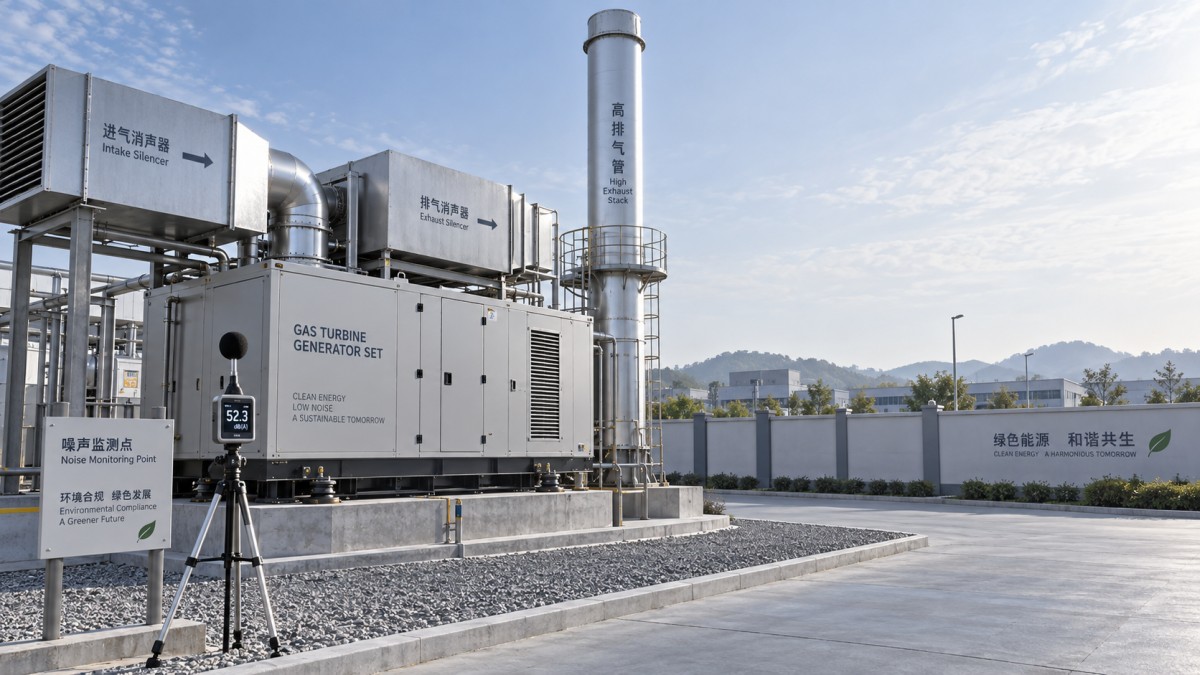
For a turbine package, the exhaust stack is often the source that deserves the earliest attention. Exhaust silencers are selected for acoustic insertion loss, pressure-drop limits, temperature, flow conditions, and maintenance access. A design that achieves the required attenuation but imposes an unacceptable pressure drop may affect turbine performance. Intake silencers, enclosure panels, combustion-air openings, and ventilation paths need the same coordinated review. Noise control is not a bolt-on exercise after mechanical design is complete.
Site layout also affects the result. The direction of an intake or exhaust discharge, the height of a stack, a solid boundary wall, building reflections, and the position of cooling equipment can all alter receptor levels. Screens and barriers can be effective where the line of sight is interrupted, but they do not solve every low-frequency or elevated-source problem. A barrier placed without considering the source and receiver geometry may add cost with little practical benefit.
Use a consistent measurement and verification plan
The project specification should identify how final acceptance will be checked. Environmental measurement practices often draw on frameworks such as ISO 1996 for environmental noise description and assessment, while sound level meter performance is commonly addressed through IEC 61672. These references do not replace local regulations or contract requirements, but they help teams ask the right questions about instrumentation, calibration, microphone position, meteorological conditions, background sound, and reporting.
A reliable verification plan normally establishes baseline conditions before commissioning, identifies representative operating loads, and records concurrent equipment operation. Measurements should not be treated as a pass/fail number detached from the operating log. If a measured level is higher than expected, the investigation needs to distinguish turbine operation from transformer hum, fan noise, temporary construction activities, process equipment, or reflected sound from a new structure.
It is also sensible to separate environmental obligations from worker protection. Personnel near a turbine enclosure, exhaust duct, or auxiliary systems may require engineering controls, restricted access, hearing-protection procedures, and signage even when boundary noise is compliant. Quality and safety teams should ensure that the two assessments use the correct criteria and do not allow one result to stand in for the other.
Treat cumulative noise as a design input
Decibels are logarithmic. Two sources with similar levels do not produce a total equal to their simple numerical sum, but the combined level can still be meaningfully higher than either source alone. That is why a generator package cannot be reviewed in isolation when it shares a site with process compressors, pumps, air-cooled heat exchangers, substations, or other generation units.
At an early project stage, an acoustic model or structured prediction can help test alternative layouts and determine where attenuation is needed most. The quality of that exercise depends on the source data supplied to it. Request octave-band sound-power information where available, not only a single overall value. Include future expansion if it is reasonably foreseeable; a plant that meets the limit at initial commissioning may have little margin once another fan bank or auxiliary package is added.
Build noise responsibilities into the project scope
Acoustic compliance often falls between disciplines: the turbine supplier controls package emissions, the civil contractor controls buildings and barriers, the electrical scope may add transformers, and the owner determines site operation. Assigning interfaces early prevents gaps around penetrations, ventilation louvres, stack silencers, and final field testing.
For broader power-plant work, integrated delivery can make these interfaces easier to manage. SINO-QNP has more than 30 years of turbomachinery experience across gas turbines, steam turbines, compressors, and generators, alongside design, manufacturing, spare-parts, and project support capabilities. In a coordinated EPC scope, feasibility work, environmental assessment, civil engineering, generator-set selection, electrical systems, auxiliary installation, and commissioning can be reviewed against the same acoustic design basis rather than handled as unrelated packages.
The strongest comparison is therefore a traceable chain: a confirmed local limit, a defined receptor, comparable source data, realistic operating scenarios, cumulative-site evaluation, and a documented acceptance method. If any link is missing, a quoted decibel value is only an indication—not evidence that the Small Gas Turbine Generator site will meet its actual noise obligation.
- ▶ When an extraction steam turbine improves combined heat and power output
- ▶ What happens when process steam demand changes on an extraction steam turbine
- ▶ How to match extraction steam turbine pressure to process demand
- ▶ When local service coverage matters for a gas turbine generator manufacturer
- ▶ How manufacturer lead times can alter a gas turbine generator project
- ▶ Which certifications matter when choosing a gas turbine generator manufacturer
Search from here
Leave a message
