




















Can a small gas turbine generator run in parallel with the grid
Yes, a small gas turbine generator can run in parallel with the utility grid, but it cannot simply be connected to the site switchboard and started. Successful grid-parallel operation depends on matching the grid before connection, controlling how power is shared after connection, and protecting both the facility and the utility system when conditions become abnormal.
For a business evaluating on-site generation, the practical question is not only “can it operate in parallel?” It is whether the project can meet the site’s operating objectives without creating excessive interconnection cost, control complexity, fuel exposure, or downtime risk. A well-designed Small Gas Turbine Generator system can support peak shaving, continuous site power, combined heat and power applications, and improved resilience. The value depends on the load profile and grid connection strategy.
What grid-parallel operation actually involves
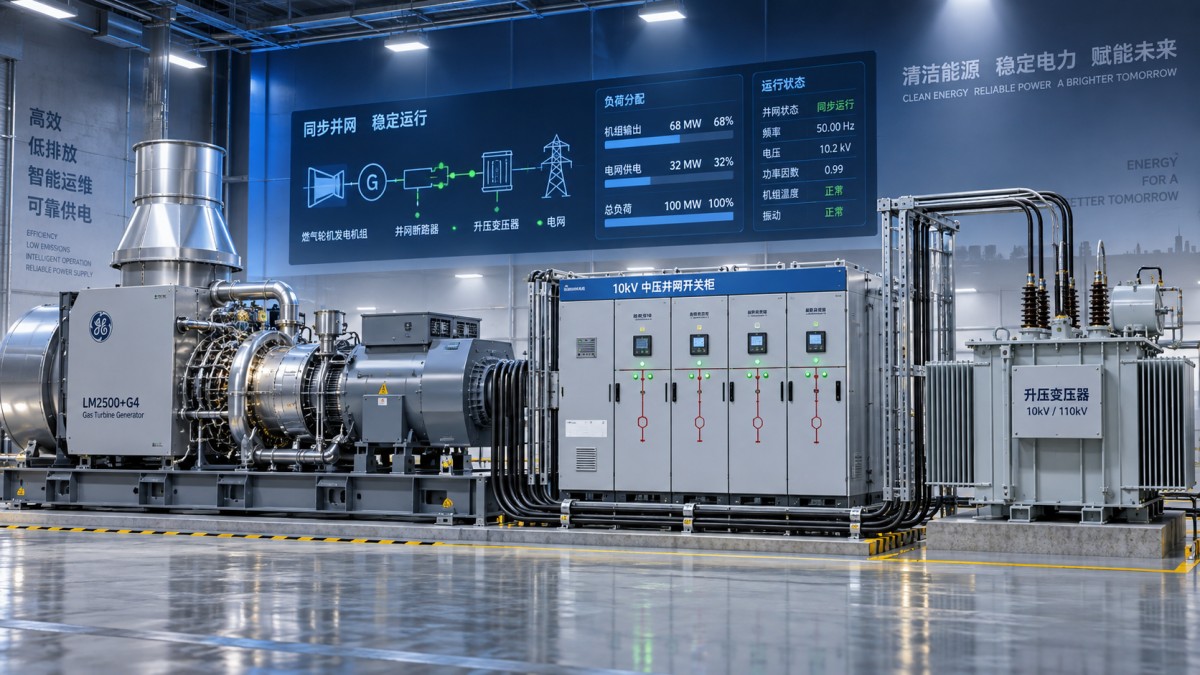
When a turbine generator runs in parallel with the grid, both sources supply the same electrical bus. Before the generator breaker closes, the control system must synchronize generator voltage, frequency, and phase angle with the grid. Closing out of synchronization can cause severe mechanical and electrical stress, so this function is handled by dedicated synchronizing equipment and properly coordinated controls.
Once connected, the generator does not “follow” the grid automatically in every respect. Its governor, excitation system, generator protection, and plant controller must work together to regulate active power, reactive power, voltage, and power factor according to the agreed operating mode. This is why a packaged turbine alone is not the complete solution. The electrical balance-of-plant is central to the project.
Choose the operating mode before choosing the package
The required controls, protection philosophy, and commercial case change substantially depending on how the facility intends to use the generator. Most projects fall into one of these modes:
A common planning error is to assume that a grid-parallel generator automatically provides backup power during an outage. In many installations, the unit is designed only to operate while the grid is present. If islanding is required, it must be specified early because the switchgear, controls, protection, load management, and testing requirements are different.
The technical items that determine whether the connection will work
Synchronization and breaker control. The system needs an automatic synchronizer and a generator breaker arrangement suitable for the site voltage and fault level. Manual synchronization may have a place in controlled maintenance procedures, but it is not a sound basis for routine commercial operation.
Load sharing. In parallel operation, the turbine must be able to accept a defined megawatt setpoint without hunting or causing unstable import from the grid. For zero-export applications, a site controller monitors the point of common coupling and adjusts turbine output to keep export within the agreed limit. The more rapidly the site load changes, the more carefully this control response must be evaluated.
Reactive power and voltage control. Active power is measured in kilowatts or megawatts; reactive power supports the electrical system’s voltage behavior. The utility or site electrical design may require a power-factor target, reactive-power limit, or voltage-control mode. This requirement affects generator excitation capability and must not be left until after equipment selection.
Protection and anti-islanding. Protection systems detect faults, abnormal voltage or frequency, reverse power, loss of mains, and other conditions that require the generator to disconnect. Anti-islanding protection is especially important: the generator must not continue energizing a separated portion of the utility network after the grid source is lost. Protection settings need coordination across the generator, transformer, switchgear, and utility interface.
Short-circuit contribution. Adding a generator changes the fault-duty calculation of the site electrical system. Existing breakers, cables, transformers, and switchboards may require review. A project can appear viable based on turbine capacity yet become impractical if the existing electrical infrastructure cannot accommodate the revised fault level or protection arrangement.
Where the commercial case is strong, and where it is not
Grid-parallel gas turbine generation tends to make the most operational sense where electricity is needed alongside useful heat, steam, or process energy. In a combined heat and power arrangement, the thermal output can improve the value obtained from the fuel. It can also be appropriate where grid capacity is limited and a facility needs additional dependable on-site supply before a utility upgrade is available.
It is less compelling when the generator would run only occasionally, the site load is well below the turbine’s efficient operating range, or there is no credible use for recovered heat. A larger unit selected solely to cover the site’s maximum demand can spend much of its life at low load, weakening both economics and operating flexibility. In those cases, a smaller package, multiple units, or another technology may provide a better fit.
Do not treat the generator as an interchangeable component
The gas turbine, driven generator, controls, transformer, and switchgear should be evaluated as one electrical system. Generator selection affects available voltage control, fault behavior, cooling arrangement, physical layout, and maintenance access. For projects spanning gas-fired or steam combined-cycle duty, the Generator selection should be matched to the prime mover, grid code requirements, and expected operating profile rather than selected only by rated output.
Equipment is available across a wide power range, but the relevant specification is not merely capacity. Ask whether the generator is two-pole or four-pole, how it will be cooled, how its insulation system suits site conditions, and how its electrical characteristics integrate with the selected control and protection scheme. Standards such as IEC 60034-3 and GB/T 7064 can be useful reference points for generator design and performance expectations, but they do not replace a project-specific interconnection study.
A practical decision sequence before issuing an inquiry
- Define the operating objective: lower peak import, continuous self-generation, export, thermal integration, outage resilience, or a combination of these.
- Collect interval load data and identify the site’s minimum, normal, peak, and rapidly changing loads. This determines a realistic generation setpoint and whether zero-export control is feasible.
- Establish the point of interconnection, existing switchgear ratings, transformer configuration, voltage level, and available space for electrical equipment.
- Decide whether the unit must remain grid-following only or operate in island mode after a utility outage. Do not assume one control philosophy covers both.
- Develop the interconnection and protection concept with the utility-facing requirements in mind, including metering, communications, export limits, and trip functions.
- Compare proposals on complete scope: turbine, generator, controls, protection, switchgear, transformer, commissioning, spares, and service support. A low equipment price can conceal a large integration gap.
Questions that expose weak proposals
During supplier evaluation, ask what happens when site load falls suddenly, grid voltage leaves its normal range, the utility supply is lost, or the generator trips while carrying a substantial portion of plant demand. The answers reveal whether the proposed design includes coordinated load control, protective relaying, and an appropriate shutdown or islanding strategy.
Also ask for clear boundaries of responsibility. In grid-parallel projects, gaps frequently occur between turbine package supply, electrical engineering, utility coordination, civil works, and commissioning. A provider with turbomachinery, generator, EPC, spare-parts, and service capability, such as SINO-QNP, can support a more integrated project approach, but the final scope should still identify who owns the grid study, relay coordination, interconnection documentation, and site acceptance testing.
A small gas turbine generator can operate successfully alongside the grid when the application, electrical design, and utility interface are defined as one project. Start with the site load and operating objective, then size the package and controls around that reality. That sequence is more reliable than beginning with a turbine rating and trying to fit the grid connection afterward.
- ▶ When an extraction steam turbine improves combined heat and power output
- ▶ What happens when process steam demand changes on an extraction steam turbine
- ▶ How to match extraction steam turbine pressure to process demand
- ▶ When local service coverage matters for a gas turbine generator manufacturer
- ▶ How manufacturer lead times can alter a gas turbine generator project
- ▶ Which certifications matter when choosing a gas turbine generator manufacturer
Search from here
Leave a message
