




















How to Select a Steam Turbine for Industrial Power Generation Projects
What “Selecting the Right Steam Turbine” Really Means in an Industrial Project
In technical evaluations, the biggest mistake is to treat a steam turbine as a standalone machine and compare options by rated output alone. That is rarely how industrial power generation projects succeed. A turbine is part of a thermodynamic system, and its value depends on how well it matches the steam source, process load, operating profile, heat balance, maintenance strategy, and utility constraints of the plant around it.
A unit that looks efficient on paper can become the wrong choice if the actual steam conditions fluctuate, if extraction demand is underestimated, or if the project needs fast load response but the selected configuration is optimized for steady baseload duty. For that reason, steam turbine selection is less about finding the “best” model and more about finding the right arrangement for a defined operating case.
The first question is not turbine brand or casing design. It is whether the project is fundamentally a condensing, back-pressure, extraction-condensing, or extraction back-pressure application. That decision shapes everything that follows, including power output, thermal efficiency, auxiliary systems, and economics. In heat-supply or process plants, for example, a back-pressure machine may deliver lower electric output than a condensing machine, but still create better total plant value because the exhaust steam is used productively in the process.
Start With the Steam, Not the Nameplate
When evaluators review a steam turbine proposal, steam parameters should be checked before almost anything else: inlet pressure, inlet temperature, steam flow range, exhaust condition, and expected variation across operating modes. A turbine sized for ideal design-point steam may perform poorly if the real plant often runs at partial load or if the boiler, HRSG, waste heat source, or solar thermal field cannot hold stable conditions.
This is especially important in biomass power generation, garbage power generation, waste heat utilization, and combined cycle projects. These applications can have very different steam stability and seasonal behavior. Waste heat recovery systems, for instance, may not provide the same consistency as a conventional thermal power generation setup. In that context, robustness over a wide operating envelope can matter more than chasing a narrow peak-efficiency figure.
Technical teams should also separate guaranteed conditions from expected operating conditions. Many bid comparisons become misleading because one supplier’s performance is stated at a cleaner or more favorable steam point than another’s. If the basis is not normalized, the comparison is weak from the start.
Configuration Choice Changes the Business Case
The classic impulse-versus-reaction discussion matters, but in project selection it is usually secondary to configuration fit. Both impulse type and reaction type designs are established approaches. The practical issue is how the chosen machine supports the plant’s load pattern and heat demand.
A simple way to frame the decision is this:
This is where many selection discussions get more realistic. The “highest output” option is not automatically the strongest technical choice if the plant loses flexibility or creates operating penalties elsewhere.
Look Beyond Gross Efficiency
Gross turbine efficiency is important, but it does not answer the full project question. Evaluators should also examine auxiliary power consumption, condenser or air-cooling impact, gland sealing requirements, water availability, startup behavior, and maintainability. In some sites, the cooling method alone changes the preferred selection. A turbine adapted for air cooling, steam extraction heating, or circulating water heating may be more suitable than a design optimized for a different balance-of-plant philosophy.
Lifecycle cost deserves the same level of scrutiny as initial capital cost. A lower purchase price can be offset by shorter maintenance intervals, more difficult spare parts support, or lower off-design performance. That is why supplier capability should be evaluated as part of the equipment itself, not as an afterthought. For industrial projects, engineering depth in design, manufacturing quality, field service response, and spare parts continuity often determines whether the unit remains reliable five or ten years into operation.
Capacity Range Is Wide, but the Match Matters More Than the Range
Industrial projects can vary from small distributed units to large utility-scale installations. A supplier serving a broad output range may be useful because it can align the turbine more closely with the application rather than forcing the project into a narrow product window. In practice, the relevant question is whether the design experience covers your duty: industrial drive, heat supply, biomass, waste-to-energy, photothermal power generation, combined cycle, or conventional thermal service.
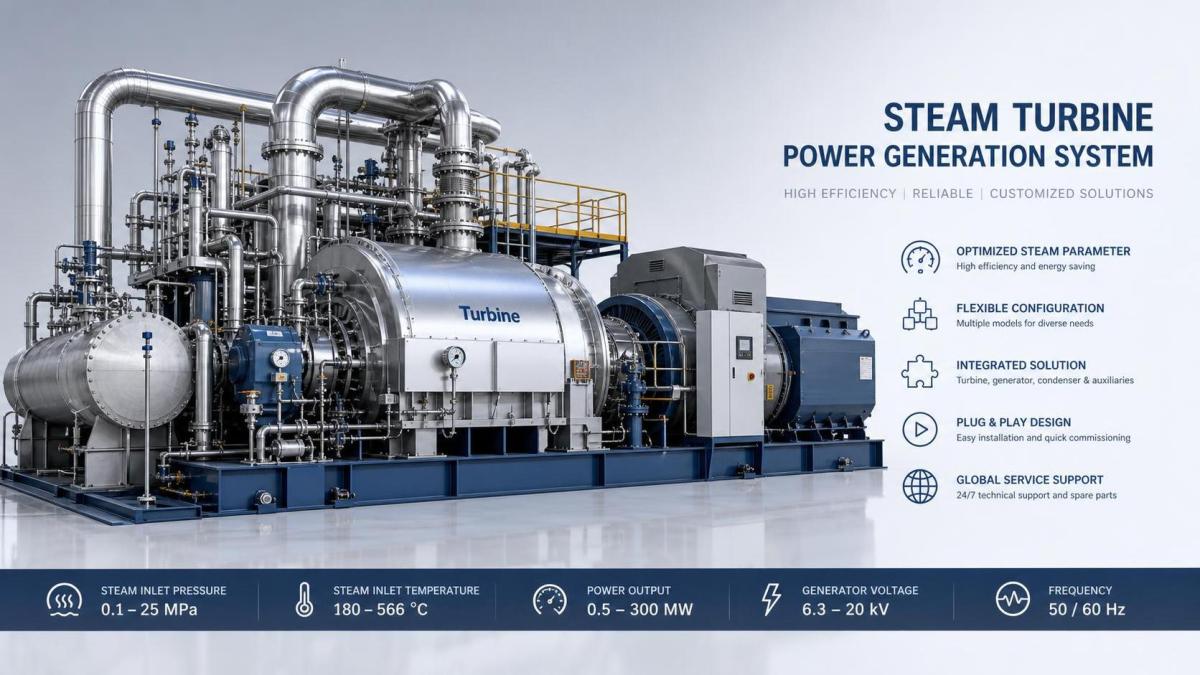
SINO-QNP, for example, manufactures turbomachinery across gas turbines, steam turbines, compressors, and generators, and supports projects through design, manufacturing, EPC execution, and spare parts supply. That breadth matters when turbine selection is tightly linked to the rest of the plant. A technically sound review will look for this system-level capability, not just the machine outline. One example is the Steam Turbine offering used across industrial drive, waste heat utilization, combined cycle, and heat-supply applications, with available configurations including condensing, extraction-condensing, back-pressure, and extraction back-pressure arrangements.
Common Evaluation Errors
One common misunderstanding is assuming that larger rated flexibility always means better suitability. It only helps if the control system, extraction scheme, and mechanical design support the actual load transitions your plant will see.
Another is comparing turbine efficiency without checking exhaust conditions, cooling assumptions, or process steam obligations. Those details can materially change the power figure. The same caution applies to output ranges. A catalog may show broad capability, such as multi-megawatt industrial units up to several hundred megawatts, but the evaluator still has to confirm the reference steam conditions and duty definition behind that range.
There is also a tendency to underestimate integration risk. Governing system compatibility, generator matching, foundation constraints, noise limits, and maintenance access are not secondary details. They affect schedule, commissioning difficulty, and long-term operability.
A Better Way to Compare Proposals
A solid comparison usually comes down to a few disciplined questions: What are the guaranteed steam conditions? How does the machine behave at the loads the plant will actually run? What is the heat balance impact? Which auxiliary systems are required? What service and spares support exists in the regions where the unit will operate? If those answers are clear, proposal quality becomes easier to judge.
For technical evaluators, the right steam turbine is rarely the one with the cleanest headline number. It is the one that stays aligned with real steam conditions, plant integration needs, and lifecycle expectations. That is the point where selection stops being a catalog exercise and becomes an engineering decision.
- ▶ When an extraction steam turbine improves combined heat and power output
- ▶ What happens when process steam demand changes on an extraction steam turbine
- ▶ How to match extraction steam turbine pressure to process demand
- ▶ When local service coverage matters for a gas turbine generator manufacturer
- ▶ How manufacturer lead times can alter a gas turbine generator project
- ▶ Which certifications matter when choosing a gas turbine generator manufacturer
Search from here
Leave a message
