




















How enclosure ventilation prevents small gas turbine generator derating
Enclosure ventilation is often treated as an accessory to a Small Gas Turbine Generator package. In practice, it can determine whether the unit delivers its expected electrical output through the hottest operating periods. When heat accumulates inside an enclosure, the turbine may ingest air that is materially hotter than the ambient condition used for its rating. The resulting loss of air density reduces mass flow through the compressor and can force a reduction in available power.
For procurement teams, this is not simply a cooling question. A package may meet its nameplate rating in an open or well-ventilated test condition, yet derate in service because enclosure air recirculates, exhaust heat is drawn back toward the intake, or ventilation capacity does not match the installed heat load. The practical objective is to keep the turbine inlet environment close to the site ambient condition assumed in the performance guarantee, while also protecting electrical and auxiliary equipment from excessive temperature.
Why enclosure heat causes generator derating
A gas turbine depends on the mass of air entering its compressor. As inlet temperature rises, air becomes less dense. For a given compressor size and rotational limit, less air mass is available for combustion. The control system may reduce fuel flow or limit turbine temperature to remain within safe operating boundaries. The generator then produces less power, even though no mechanical fault is present.
Enclosure heat can amplify the normal effect of a hot climate. A site may have a high daytime ambient temperature, which already reduces turbine output. If the enclosure adds another temperature rise between the outdoor air and the package intake, available capacity can fall below the load that the buyer expected the unit to carry. This gap is especially disruptive where the generator supports continuous process loads, critical pumps, compression auxiliaries, or remote operations with little standby capacity.
Ventilation also affects more than turbine inlet air. Hot enclosure conditions can shorten the operating margin of generator windings, control panels, batteries, cable insulation, lube-oil equipment, and electronic controls. The unit may continue running, but repeated high-temperature exposure can increase alarms, trips, maintenance demand, and uncertainty around dependable output.
Ventilation design must manage airflow, not just move air
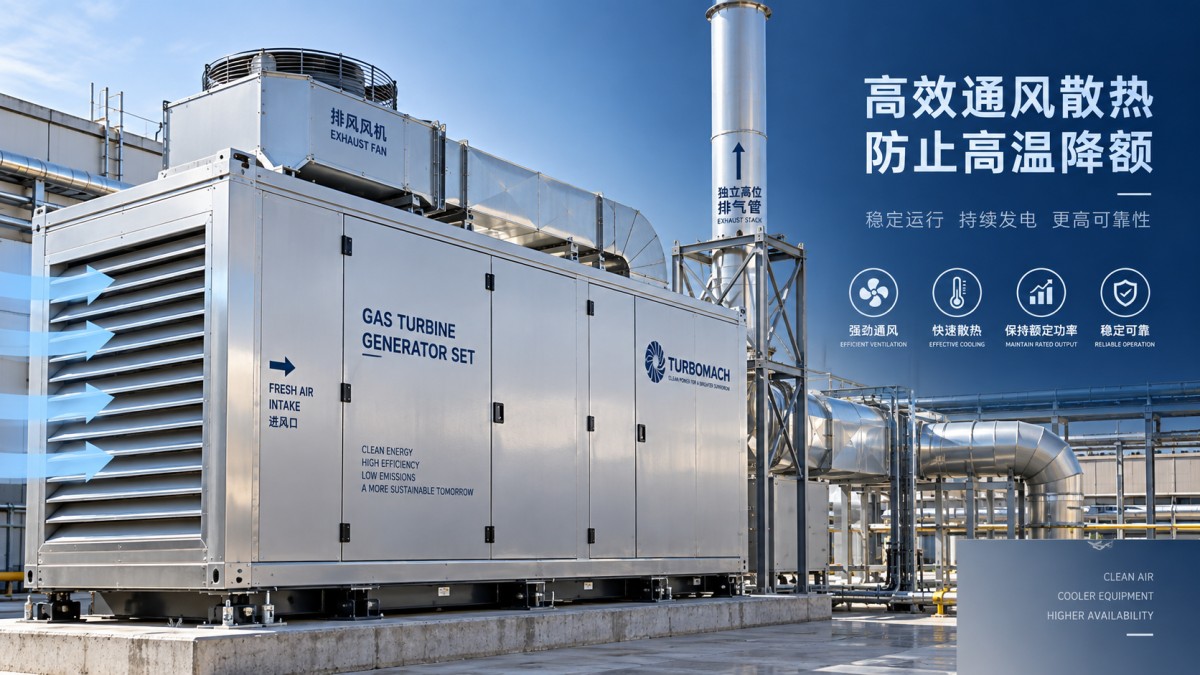
A high fan airflow figure alone does not demonstrate an effective enclosure design. The air must enter at useful locations, sweep heat-producing equipment, and leave without creating short circuits between supply and exhaust openings. Poorly directed ventilation can leave hot zones around the turbine package or electrical cabinet while a large share of cooling air bypasses those components.
A workable design normally considers four linked paths:
- Combustion and turbine intake air: The inlet should draw the coolest practical air available and be protected from exhaust plume recirculation.
- Enclosure ventilation air: Fresh air must absorb heat from the turbine casing, generator, accessories, and local piping before exiting the enclosure.
- Radiator or cooler airflow: Where package cooling equipment rejects heat into or through the enclosure, its discharge path must not raise the temperature at the turbine intake.
- Exhaust discharge: Exhaust routing must prevent hot gases from re-entering louvers, intake filters, or nearby building openings under expected wind conditions.
These paths should be reviewed together. A ventilation fan can be correctly sized while the overall system still fails because an exhaust stack discharges near the intake side, a louver has excessive pressure loss, or a weather hood blocks effective air entry. In a compact skid, even modest layout changes can alter the path of heat and create recirculation that was absent during an open-package test.
The temperature rise is the procurement check that matters
Buyers should ask the supplier to define the expected enclosure temperature rise above site ambient at the intended duty, rather than accepting a general statement that the package is “ventilated.” The design basis should distinguish between the outdoor ambient temperature, the air temperature at the turbine inlet, and the highest local enclosure temperature near sensitive components. Those are related values, but they are not interchangeable.
The required ventilation volume is driven by the heat rejected within the enclosure and the acceptable temperature rise of the ventilation air. That heat load can include radiation and convection from the turbine, generator losses, lube-oil systems, electrical equipment, chargers, lighting, and any cooling equipment located within the same space. A calculation that considers only the turbine casing may underestimate the duty. Conversely, specifying more airflow without considering louver losses, duct resistance, fan static pressure, and make-up-air openings can create a design that performs poorly after installation.
The right acceptance criterion depends on the turbine model and site conditions. Procurement documents should therefore ask for the supplier’s stated ambient rating, allowable turbine inlet temperature, ventilation design temperature, and operating conditions used in the output calculation. If the required power must be available at a particular high ambient condition, that requirement should be explicit. “Rated output” without a defined ambient condition leaves room for an avoidable mismatch.
Site layout can defeat a well-designed package
Enclosure ventilation is influenced by installation conditions that may sit outside the generator supplier’s standard scope. A package installed against a wall, beneath a canopy, inside a process building, or in a narrow equipment corridor will not see the same airflow as a free-standing unit. Nearby equipment may discharge hot air toward the generator intake. Wind can either improve extraction or push exhaust and hot ventilation air back toward louvers.
Dust and airborne contaminants add another layer of risk. Filtration is needed to protect the turbine, but dirty filters increase intake resistance and can reduce delivered airflow. Ventilation louvers and insect screens also accumulate debris. In locations with fine dust, salt-laden air, oil mist, or seasonal debris, access for inspection and cleaning should be treated as part of the enclosure design rather than a maintenance afterthought.
For a drilling or field-power application, the generator may operate close to diesel-driven equipment such as an Mud pump. The placement of those loads matters. Their radiator discharge, engine exhaust, and dust plume should not be allowed to migrate toward the turbine enclosure intake. A capacity calculation can be sound on paper and still produce derating if the generator is positioned in the hot-air wake of adjacent machinery.
Common assumptions that lead to avoidable derating
One common assumption is that an enclosure fan rated for a large airflow automatically provides enough cooling. Fan ratings are often published under particular static-pressure conditions. Installed ductwork, louvers, filters, silencers, and guard screens can reduce actual flow substantially. The installed operating point, not the catalog maximum, is what matters.
Another is that the generator room only needs to meet a general personnel-comfort temperature. Turbine performance is more sensitive to the temperature of the air entering the compressor than to the average temperature elsewhere in the room. A room can feel adequately ventilated while a localized hot pocket raises the turbine inlet temperature.
It is also risky to rely on a single temperature sensor. Sensors placed away from the intake, in a high-airflow zone, or near a cool wall may not reveal recirculation. Temperature monitoring should cover the turbine intake area and relevant enclosure zones, with alarms set to prompt investigation before a high-temperature trip or recurring output shortfall occurs.
What to request before placing an order
A procurement review does not need to prescribe every duct and fan detail, but it should establish the evidence needed to assess derating exposure. Useful supplier deliverables include an enclosure general arrangement showing air inlets and outlets, ventilation airflow and static-pressure information, heat-rejection assumptions, exhaust routing, filter specification, and the basis for the generator output at the stated site temperature and altitude.
It is also sensible to define responsibility for the interface between the packaged enclosure and the installation. Where the project adds a building, acoustic enclosure, external ducting, or shared ventilation system, the original package performance assumptions may no longer apply. The party responsible for confirming final airflow paths should be identified before equipment is delivered.
Ventilation should be evaluated as part of available power, not as a separate enclosure feature. When the airflow path is engineered for the actual ambient condition, heat sources, installation geometry, and maintenance environment, a Small Gas Turbine Generator has a far better chance of delivering its planned output without routine high-temperature derating.
- ▶ When an extraction steam turbine improves combined heat and power output
- ▶ What happens when process steam demand changes on an extraction steam turbine
- ▶ How to match extraction steam turbine pressure to process demand
- ▶ When local service coverage matters for a gas turbine generator manufacturer
- ▶ How manufacturer lead times can alter a gas turbine generator project
- ▶ Which certifications matter when choosing a gas turbine generator manufacturer
Search from here
Leave a message
