




















Gas Turbine Emissions and Efficiency: What Engineers Need to Evaluate
Gas Turbine Emissions and Efficiency: What Engineers Need to Evaluate
A gas turbine is rarely judged by one headline number, yet that is still where many evaluations go wrong. A quoted efficiency figure may look strong on paper, or an emissions guarantee may appear comfortably low, but neither means much until the operating basis is clear. For technical evaluation work, the real task is to understand how combustion behavior, turbine configuration, fuel flexibility, ambient conditions, control philosophy, and maintenance strategy interact. That is where one machine separates itself from another.
In power equipment projects, emissions and efficiency are often treated as parallel requirements. In practice, they are tightly linked. Lower NOx performance usually depends on combustion system design, flame temperature control, and air-fuel mixing quality. Those same factors can influence part-load stability, turndown capability, and maintenance intervals. A gas turbine that meets a low-emissions target only in a narrow operating window may create more trouble than value in an industrial setting where dispatch conditions are not steady.
The first question is not “What is the guaranteed efficiency?” but “Under what conditions is that number valid?” ISO base conditions are useful for comparison, yet few sites operate at ISO ambient temperature, pressure, and humidity year-round. Elevation, seasonal heat, inlet pressure losses, exhaust backpressure, and fuel composition all move actual performance away from catalog values. For evaluators, the correction curves matter nearly as much as the nominal figure. A machine with a modest headline rating can outperform a higher-rated alternative once local site conditions are applied.
Emissions need the same level of scrutiny. NOx and CO guarantees should be read together, not separately. Very low NOx combustion can become less convincing if CO rises sharply during startup, low-load operation, or frequent cycling. In many industrial plants, operating profiles include load swings, reserve duty, or partial-load operation for extended periods. That makes emissions stability across the load range more relevant than a single full-load data point. It also changes how combustion tuning, control response, and hardware durability should be assessed.
Dry low NOx combustors are often central to modern gas turbine selection, but they are not a universal answer. Their performance depends on fuel quality consistency, combustion dynamics management, and proper controls integration. Water or steam injection can reduce NOx in some configurations, though it introduces its own penalties in water demand, system complexity, and possibly efficiency. There is no single best approach in the abstract. The right evaluation depends on environmental permit requirements, utility interfaces, operating regime, and the site’s tolerance for additional balance-of-plant complexity.
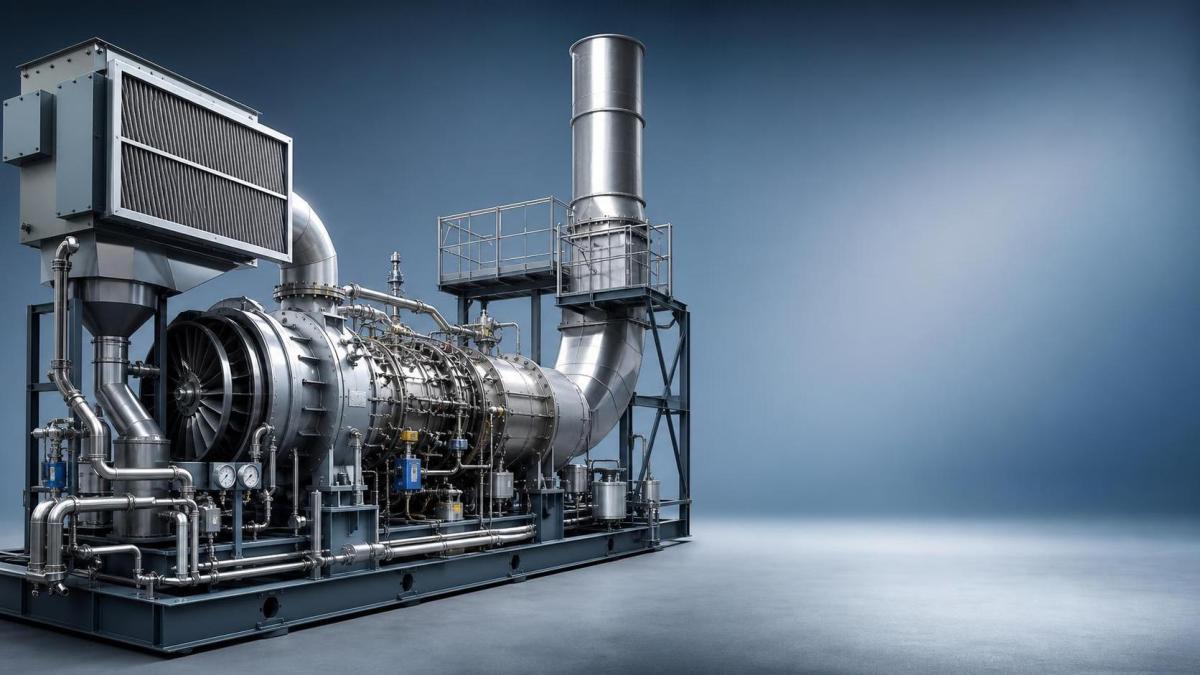
Another common mistake is to discuss efficiency without separating simple-cycle and combined-cycle context. A simple-cycle machine may be appropriate for peaking service, fast response, mechanical drive duty, or locations where heat recovery is not practical. Combined-cycle evaluation changes the picture because exhaust temperature, mass flow, and heat recovery steam generator integration become part of the value equation. Two turbines with similar electrical output can produce very different plant results once the downstream thermal system is considered.
That broader systems view matters even more when gas turbines are assessed alongside storage or grid-balancing assets. In some power grid applications, evaluators now compare thermal generation not only against alternative turbines, but against flexible assets such as Air Energy Storage. Compressed air energy storage changes the discussion from standalone heat rate to dispatch strategy: when excess electricity drives compressors, thermal energy can be captured in media such as molten salt and later reused during power release. It is not a replacement for every turbine duty, but it is a reminder that efficiency should be evaluated at the system boundary that matches the project objective.
What experienced evaluators check behind the headline numbers
Serious comparison work usually comes down to a few questions:
- What fuel is the machine optimized for, and what happens when composition varies?
- How do NOx and CO behave at startup, part load, and cycling duty?
- What are the site-corrected output and heat rate, not just ISO values?
- How sensitive is performance to inlet filtration, fouling, and ambient temperature?
- What inspection intervals and hot-section maintenance assumptions support the lifecycle model?
- How much auxiliary load is required by the full package, not only the core engine?
These questions sound basic, but they expose most weak comparisons. A technically sound proposal should show its assumptions clearly enough that output, efficiency, and compliance expectations can be traced back to operating conditions rather than marketing language.
Lifecycle cost is where emissions and efficiency finally become commercial, not just technical. A turbine with better heat rate can still underperform in ownership terms if combustion hardware wears quickly under the required emissions setting, or if frequent tuning is needed to keep compliance margins stable. Likewise, a robust machine with slightly lower peak efficiency may be the better choice for plants that prioritize availability, maintenance predictability, and fuel adaptability. SINO-QNP’s long involvement in turbomachinery manufacturing, engineering integration, EPC execution, and spare parts support reflects this reality: the machine itself is only part of the evaluation; serviceability and system fit are part of performance.
Standards and local regulations also shape the decision, but evaluators should be careful not to reduce the matter to a checklist. Emissions limits are enforced under defined testing and operating conditions, and those details affect interpretation. A guarantee tied to a narrow reference condition may not answer the practical compliance question for the intended site. The same applies to performance testing. Contract language, correction methodology, degradation assumptions, and acceptance criteria deserve close attention because they determine whether a nominal advantage survives commissioning and real operation.
One more point is often underestimated: operational flexibility has emissions consequences. Fast starts, deep turndown, frequent stop-start cycling, and reserve operation all place stress on combustion control strategies. A machine selected for flexible dispatch should not be judged only by baseload efficiency. The more relevant question is whether it can remain stable, compliant, and economically maintainable across the actual duty profile. That is especially true in grids with rising renewable penetration, where thermal assets may run less predictably than they did in traditional baseload service.
A useful evaluation, then, treats the gas turbine as a working system rather than an isolated rated machine. Read the emissions numbers with the operating map beside them. Read the efficiency claim with the site conditions beside it. Read the maintenance plan with the duty cycle beside it. When those three views align, the comparison becomes much more reliable, and the technical decision tends to hold up long after bid stage assumptions have been forgotten.
- ▶ When an extraction steam turbine improves combined heat and power output
- ▶ What happens when process steam demand changes on an extraction steam turbine
- ▶ How to match extraction steam turbine pressure to process demand
- ▶ When local service coverage matters for a gas turbine generator manufacturer
- ▶ How manufacturer lead times can alter a gas turbine generator project
- ▶ Which certifications matter when choosing a gas turbine generator manufacturer
Search from here
Leave a message
