




















When a natural gas turbine generator suits peak-shaving projects
A Natural Gas Turbine Generator is well suited to a peak-shaving project when the site needs firm power quickly during limited but high-value demand periods. It is most compelling where utility demand charges, constrained grid capacity, production continuity, or renewable intermittency create costly peaks that cannot be managed reliably by load reduction alone.
The decision should not start with generator nameplate capacity. A peak-power system succeeds only when its start sequence, ramp capability, fuel supply, operating mode, and maintenance plan match the actual load event. A turbine that looks efficient on a specification sheet can be a poor peak-shaving asset if it starts too late, runs too lightly, or requires fuel infrastructure that the site cannot support.
Start with the shape of the peak, not the annual electricity total
Peak shaving is about reducing the highest grid draw, not replacing all purchased electricity. The first question is therefore: when do peaks occur, how long do they last, and how predictable are they?
A gas turbine generator is usually a stronger fit when peaks are recurring and operationally visible. Examples include a factory that reaches maximum demand during shift overlap, a commercial facility with predictable cooling loads, or an industrial site whose grid connection is adequate for normal operation but insufficient during specific production windows.
It becomes less attractive when peak events are extremely short, highly irregular, or separated by long periods with no operational need for on-site generation. In those cases, a battery, demand-response arrangement, grid upgrade, or a hybrid solution may address the peak with less mechanical standby exposure.
Load data should be reviewed at intervals short enough to expose the real peak pattern. Monthly utility bills show the consequence of demand peaks, but they do not always show how quickly the peak appears, whether it is caused by one process, or whether the generating set has enough time to respond.
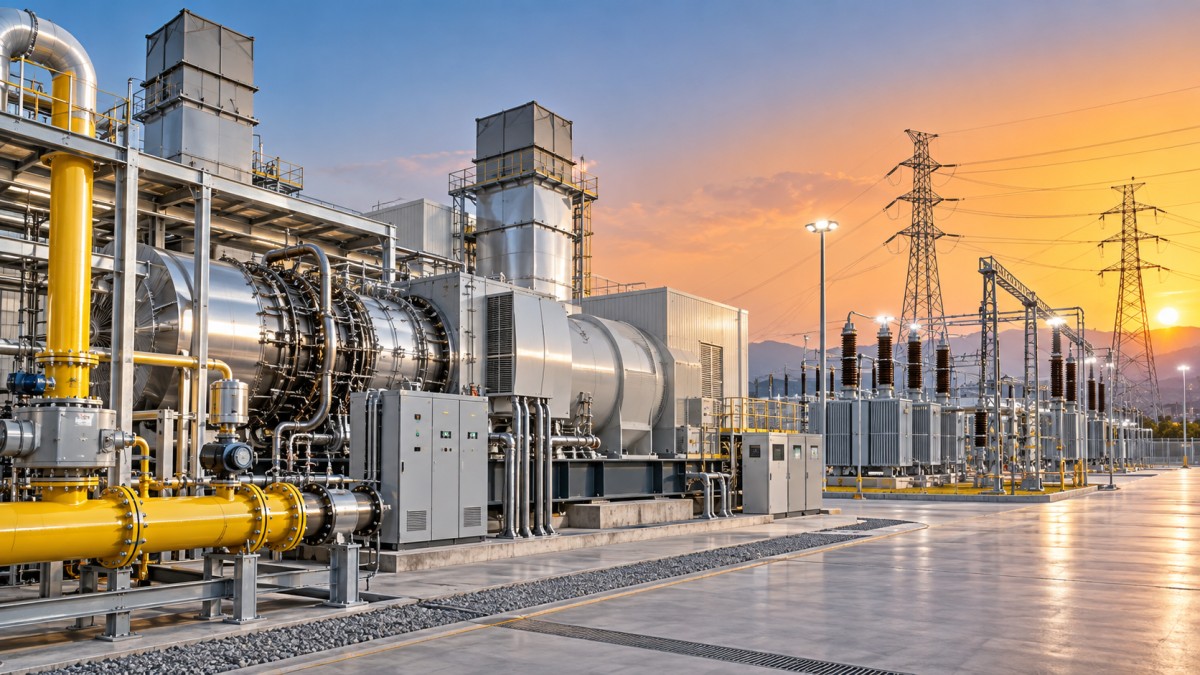
When fast, controllable output creates real value
The main practical advantage of a natural-gas-fired turbine is controllable on-site capacity. For a site facing a predictable grid-demand threshold, the turbine can be dispatched before the facility crosses that limit. This is different from emergency backup: the unit is operated as part of the energy strategy, not held only for an outage.
This approach fits projects where a missed peak has consequences beyond an electricity bill. A process plant may need to avoid curtailing critical equipment. A data-intensive facility may need a reliable power margin while a utility upgrade is pending. A site with variable renewable generation may need dispatchable power when solar or wind output falls during a high-load period.
However, “fast start” should be assessed as a complete site function. The relevant time is not merely engine or turbine start-up. It includes control-system signals, fuel readiness, synchronization, breaker operation, load acceptance, and the time needed to reach the planned output. A dispatch strategy must also account for the site load that remains on the grid during this sequence.
Fuel availability is a project condition, not a procurement detail
A dependable natural gas connection can make turbine peak shaving practical. The evaluation should consider pressure stability, delivery capacity during the local network's own peak periods, gas quality, metering arrangements, and the contractual structure for fuel supply. A nominal gas connection is not automatically sufficient for rapid, repeated high-load operation.
Fuel-system design deserves the same attention as the generator package. Filtration, pressure regulation, shutoff arrangements, ventilation, controls, and safety systems influence availability. Where the project also includes industrial compressed-gas or process-air needs, it may be useful to assess turbomachinery scope together. An integrated review of a Compressor package and the generation system can clarify shared utilities, controls, maintenance access, and EPC interfaces without treating two separate systems as isolated purchases.
Natural gas can offer a cleaner local operating profile than many liquid-fuel alternatives, but it does not remove emissions obligations. Air permits, local limits, monitoring requirements, noise boundaries, and the operating profile all need to be reflected in the project design. A solution intended for occasional use may face a different approval and operating context from one expected to run regularly during peak periods.
Evaluate lifecycle cost against the avoided problem
A sound business case compares the full cost of peak shaving with the cost of doing nothing or choosing another solution. The calculation should include equipment, civil and electrical works, interconnection, gas infrastructure, controls, commissioning, maintenance, staffing or service support, fuel, and expected operating hours. It should also assign value to capacity resilience where the project protects production or enables growth before a grid upgrade is available.
A common mistake is to compare only fuel cost with the utility energy rate. Peak shaving is often driven by demand charges, capacity constraints, avoided production interruptions, or deferred infrastructure work. The correct comparison is the cost of supplying power during the relevant peak event against the financial and operational consequence of remaining dependent on the grid at that moment.
Part-load behavior also matters. If a unit is selected far above the practical peak-shaving requirement, it may spend most of its dispatch hours at an unfavorable operating point. Oversizing is sometimes justified for standby capacity or future expansion, but that choice should be explicit rather than hidden inside a broad capacity margin.
Where alternative solutions may be better
A turbine is not the default answer to every high-demand problem. Batteries can be effective when peak events are short and sharply defined, particularly when rapid discharge is more valuable than extended run time. Demand management can be the lowest-cost route when non-critical loads can be shifted or curtailed without affecting output. A grid upgrade may be preferable when demand is rising permanently and the facility will need additional capacity throughout the day.
Hybrid systems can be practical when the load pattern changes. A battery can cover the first part of a sudden spike while the gas turbine reaches dispatch condition, reducing the need to operate the turbine for very short events. Renewable generation can lower daytime energy purchases, while dispatchable generation provides coverage when renewable output and site demand do not align.
A practical screening sequence
- Map demand peaks by time, duration, frequency, and operational cause.
- Define the required response: how much load must be removed from the grid and how quickly.
- Confirm whether the natural gas supply can support the intended dispatch profile.
- Compare turbine generation with batteries, load control, grid reinforcement, and hybrid options on lifecycle cost and operational risk.
- Review interconnection, protection, controls, emissions, noise, space, and maintenance access before final equipment selection.
- Specify performance around the real operating duty, including ambient conditions and expected part-load operation.
For projects that proceed, package coordination has substantial value. SINO-QNP provides turbomachinery spanning gas turbines, steam turbines, compressors, and generators, with capabilities covering design, manufacturing, EPC delivery, spare parts, and service support. For a peak-shaving installation, the useful outcome is not simply a generator supplied to site; it is a generation system whose fuel, controls, auxiliaries, grid interface, and long-term service plan are aligned with the duty it must perform.
The most suitable project is one where the peak is material, recurring, and operationally important; natural gas is available with dependable capacity; and the turbine can be dispatched early enough to reduce the actual grid maximum. When those conditions are absent, the right answer may be a smaller hybrid system, load management, or an upstream grid solution rather than a larger generating asset.
- ▶ When an extraction steam turbine improves combined heat and power output
- ▶ What happens when process steam demand changes on an extraction steam turbine
- ▶ How to match extraction steam turbine pressure to process demand
- ▶ When local service coverage matters for a gas turbine generator manufacturer
- ▶ How manufacturer lead times can alter a gas turbine generator project
- ▶ Which certifications matter when choosing a gas turbine generator manufacturer
Search from here
Leave a message
