




















How to assess spare-parts support from a gas turbine generator manufacturer
A spare-parts review should begin before the gas turbine generator is ordered, because the commercial impact of poor support often appears years later during a forced outage. A low equipment price can lose its advantage quickly if critical parts are unavailable, repair routes are unclear, or the manufacturer cannot provide the technical records needed to install replacement components safely.
For a procurement team, the practical question is not whether a Gas Turbine Generator Manufacturer says it supplies spare parts. Nearly every supplier will say that. The useful question is whether its parts organization can support the specific unit, operating profile, and expected service life under the buyer's outage and budget constraints.
A credible assessment connects four areas: which parts will be needed, how quickly they can be obtained or repaired, how their quality and configuration will be controlled, and how the supplier will support decisions when the original component is no longer available.
Start with the parts that can stop the unit
Do not evaluate spare-parts support through a generic catalogue alone. Ask the manufacturer to classify the recommended spares by operational consequence and maintenance timing. A useful list separates commissioning spares, routine maintenance consumables, planned-outage spares, insurance spares, and long-lead critical items.
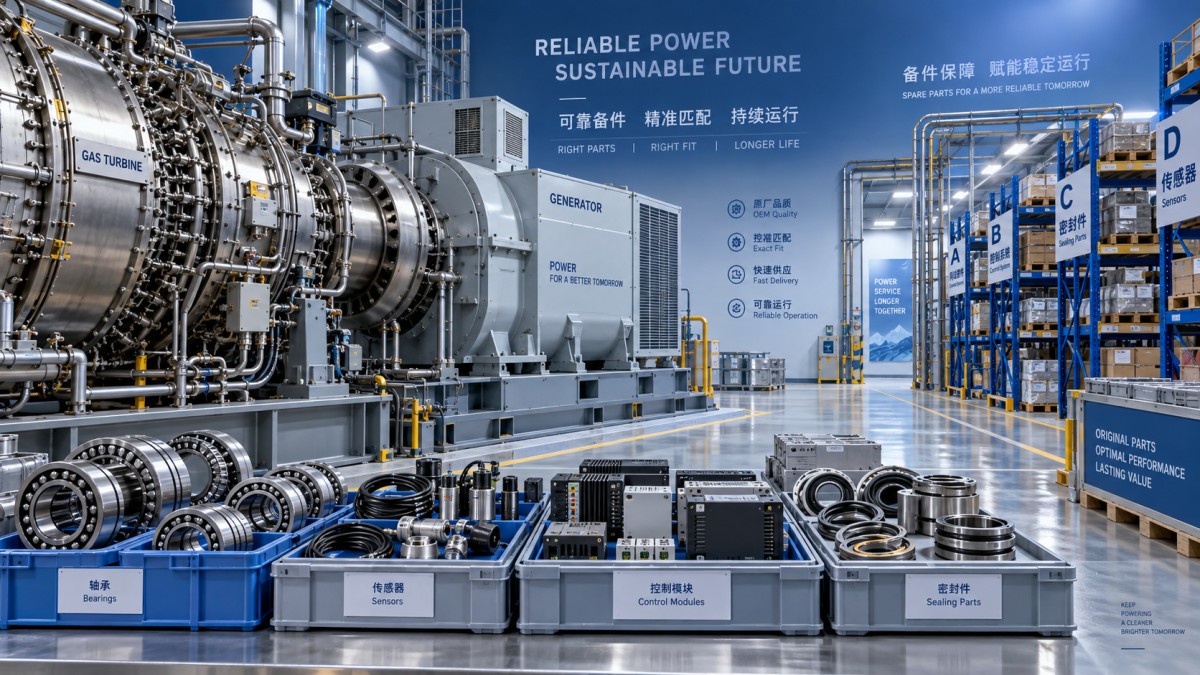
For a gas turbine generator package, the critical list may extend beyond turbine hardware. It can include control-system modules, sensors, fuel-system components, ignition equipment, bearings, seals, lube-oil-system items, generator excitation components, filters, couplings, and selected electrical parts. The exact list depends on the turbine configuration and balance of plant, but the buyer should know which missing component can turn a manageable maintenance activity into an extended shutdown.
Ask for each critical item:
- Part number, description, equipment position, and applicable unit configuration.
- Whether the item is expected to be consumed, inspected, refurbished, or replaced at a scheduled interval.
- The normal manufacturing or procurement lead time, rather than only an estimated shipping time.
- Whether stock is held, built to order, sourced from an approved sub-supplier, or recovered through repair exchange.
- The consequences of using an alternative or repaired part.
- Storage requirements, shelf-life limitations, preservation method, and recommended site inventory.
A manufacturer that cannot distinguish between a standard consumable and a long-lead outage risk is difficult to assess on lifecycle cost. Procurement should also resist a common shortcut: purchasing the lowest-priced initial spare package without checking whether it covers the first planned inspection and the most consequential unplanned failures. A thin initial package often shifts risk to a later outage, when pricing and lead time are less controllable.
It is also sensible to ask what constitutes a “critical” spare in the supplier's recommendation. A part may be technically important but readily available from a qualified source. Another may be inexpensive yet difficult to replace because it requires a specific firmware version, machining process, balance requirement, or field calibration. The second item may deserve more attention in the stock strategy.
Test lead-time claims against a real outage scenario
Lead time is one of the most frequently misunderstood parts of a spare-parts offer. “Available” may mean the supplier can accept an order, has raw material reserved, can source an equivalent item, or has a finished component in stock. These are very different conditions.
Use a scenario-based review. Select several parts from the critical-spares list and ask the manufacturer to explain the complete fulfillment path: stock location, ownership of inventory, release approvals, manufacturing steps if stock is unavailable, export documentation, transport arrangements, and field support after delivery. The aim is not to demand a guarantee for every emergency, but to identify where a stated lead time relies on assumptions outside the supplier's control.
For example, a control component may be physically available but unusable until the correct software version and parameter set are confirmed. A hot-section component may require a serial-number check, matching hardware, or engineering review before release. A repaired assembly may shorten delivery time but still need inspection, test documentation, and acceptance procedures. These details matter when an outage schedule is measured in days.
Procurement teams should request separate answers for planned and forced outages. Planned-outage support can rely on forecast demand, manufacturing slots, and consolidated shipping. Forced-outage support depends more heavily on stock visibility, escalation procedures, decision authority, and logistics coverage. A global service network has value only when the buyer can understand where the relevant parts and technical resources are located, and what process activates them outside normal ordering cycles.
Check configuration control before comparing part prices
A replacement part is not automatically suitable because its name or external dimensions match the removed component. Gas turbine generator equipment changes over time through design revisions, material updates, control logic changes, and service bulletins. Without disciplined configuration control, a buyer can receive a part that fits mechanically but creates installation, performance, reliability, or warranty complications.
Ask the manufacturer how it links a part order to the exact unit configuration. The response should cover serial-number traceability, revision status, engineering change records, approved substitutions, and the documentation supplied with the component. For critical parts, confirm whether certificates, inspection records, balancing data, material records, test results, or calibration information are available where relevant.
This review is especially important if the site operates more than one unit, has equipment from different delivery periods, or has undergone prior upgrades. Similar turbine generator packages may contain different control platforms, auxiliary equipment, or revised interfaces. A manufacturer that offers a single part number for multiple configurations should be able to explain the interchangeability boundaries clearly.
Quality assurance should also be assessed beyond a broad statement that parts are “OEM quality.” Procurement should ask who manufactures the part, how sub-suppliers are approved, how incoming materials are controlled, and whether critical components receive defined inspection and release procedures. The objective is to understand accountability. If a supplied component fails or is found incompatible, the buyer needs one party that can investigate the issue against the unit's technical baseline.
Evaluate documentation as part of the spare-parts package
Technical documentation affects both maintenance speed and purchasing accuracy. A strong support model provides more than an itemized price list. It gives the owner enough information to identify the correct part, plan inventory, install it correctly, and maintain records over the equipment life.
Before contract award, review the quality of the proposed documents rather than simply adding “manuals” to a specification. Useful materials may include illustrated parts lists, recommended-spares schedules, maintenance instructions, storage and preservation requirements, overhaul scope definitions, inspection criteria, drawings where appropriate, and notices covering design changes or superseded components.
The buyer should also establish how updates will be managed. A parts manual that is accurate at commissioning but never updated can become a source of purchasing errors. Clarify whether revised documents are issued automatically, available through a controlled portal, or supplied upon request. Confirm how obsolete part numbers and substitute parts are communicated.
For sites with integrated rotating equipment, documentation consistency becomes more important. A manufacturer supporting turbines, generators, and related turbomachinery can help align maintenance records and component interfaces across the package. The same discipline matters when adjacent equipment is included in the operating scope, such as a Compressor train or shared auxiliary systems. The procurement requirement should still define which equipment is covered and who owns technical responsibility at each interface.
Look beyond inventory: repair capability can determine cost
New-part availability is only one side of long-term support. Some high-value components may be repaired, refurbished, exchanged, or inspected for continued service, depending on their condition and the manufacturer's approved process. This can materially affect outage planning and lifecycle cost, but only when the repair route is technically defined and commercially transparent.
Ask whether the supplier can evaluate removed parts, provide a repair scope before work begins, identify limits beyond which repair is not recommended, and issue records of the completed work. The buyer should understand who makes the repair decision, where the repair is performed, how turnaround time is calculated, and whether an exchange unit can be used while the original part is being processed.
Do not assume repair is always the cheaper choice. A repair quotation may be attractive until inspection reveals extensive damage, required upgrades, or limited remaining life. For critical rotating components, the cost comparison should include inspection, transport, downtime exposure, reinstallation requirements, and the expected service interval after repair. A well-supported manufacturer will explain these variables instead of presenting repair as a universal answer.
Put support commitments into the commercial evaluation
Spare-parts capability should be scored alongside equipment price, delivery schedule, guarantees, and service scope. Leaving it as a post-award discussion weakens the buyer's position, especially where the project includes long-term operating obligations.
A practical tender evaluation can compare suppliers on a small number of evidence-based questions:
Commercial terms should reflect the findings. For selected long-lead items, the buyer may negotiate reserved stock, defined replenishment arrangements, pricing principles, or planning windows for major maintenance events. For control systems and proprietary assemblies, access to software support, parameter management, and engineering approval can be as important as the physical item itself.
The right level of site inventory will differ by operating duty, outage tolerance, location, logistics exposure, and the cost of lost generation. A remote or continuously operated site may justify holding more insurance spares than a facility with redundancy and flexible maintenance windows. The decision should be based on the cost of an unavailable unit, not on a fixed percentage of the equipment purchase price.
In the end, spare-parts support is credible when a manufacturer can show how it will identify the right component, deliver or repair it within a realistic timeframe, preserve its technical integrity, and help the owner manage changes over the equipment life. Those answers give procurement a more reliable basis for comparing lifecycle exposure than an initial spare-parts discount alone.
- ▶ When an extraction steam turbine improves combined heat and power output
- ▶ What happens when process steam demand changes on an extraction steam turbine
- ▶ How to match extraction steam turbine pressure to process demand
- ▶ When local service coverage matters for a gas turbine generator manufacturer
- ▶ How manufacturer lead times can alter a gas turbine generator project
- ▶ Which certifications matter when choosing a gas turbine generator manufacturer
Search from here
Leave a message
