




















How steam supply interruptions affect a steel plant steam turbine
How steam supply interruptions affect a steel plant steam turbine
When steam supply drops unexpectedly, a steel plant steam turbine can lose output, become unstable, or trip—potentially disrupting the processes it supports. The immediate temptation is to watch the inlet pressure and wait for it to recover. But pressure alone does not tell you whether the turbine is safe to keep running or ready to restart.
Flow, temperature, steam quality, and the driven equipment’s response all matter. Drawing on SINO-QNP’s more than 30 years in turbomachinery design, manufacturing, and service, the practical approach is to assess the whole train: what changed in the steam system, how the turbine responded, and what conditions remain after supply returns.
A falling header pressure is only part of the disturbance
Steelworks may distribute steam from boilers and waste-heat recovery sources through shared headers. A source trip, a valve malfunction, or a sudden increase in another consumer’s demand can reduce the steam available to a turbine. These events can look similar on an inlet-pressure display, but their recovery patterns differ.
With less available steam flow or a reduced usable pressure drop, turbine power generally falls. The governor may open the control valve further to maintain speed or load. Once the valve reaches its available limit, additional demand cannot restore the missing energy. A valve approaching full opening while output continues to decline is therefore a useful warning—not evidence that the turbine simply needs a higher load command.
The consequences depend on the duty. A grid-connected generator will generally lose electrical output rather than immediately slow down; protection requirements depend on the generator and electrical configuration. A turbine driving a process machine may lose speed as torque becomes insufficient. For a backpressure turbine, the disturbance can also reduce steam delivered to downstream users.
Check exhaust pressure as well. Rising backpressure reduces the available expansion even if inlet pressure appears acceptable. On a condensing unit, deteriorating condenser vacuum can compound a supply problem.
The less visible risks: cooling, condensate, and recovery
Reduced pressure does not automatically mean wet steam. Steam condition depends on pressure and temperature together. However, interrupted flow can allow supply piping to cool and condensate to collect, especially in low points and inadequately drained sections. When supply returns, that accumulated water can be carried toward the turbine.
Water induction is more serious than ordinary output loss. It can cause impact loading, rapid local cooling, abnormal vibration, and mechanical damage. A normal-looking pressure reading is not proof that the steam line is dry. Temperature trends, drain performance, and any evidence of water hammer deserve attention before admission resumes.
Thermal conditions also change during the interruption. The rotor and casing do not necessarily cool at the same rate. A quick return of hot steam can create temperature gradients and alter internal clearances. Whether a restart should follow a hot, warm, or cold procedure depends on actual metal temperatures and the manufacturer’s criteria—not simply how many minutes the turbine has been stopped.
The return of steam can be a second disturbance. If the control valve remains substantially open when header pressure recovers, admission may increase rapidly. Overspeed is not the usual direct result of steam starvation, but it can become a concern when steam returns while the driven load is reduced or disconnected. Working governors, stop valves, and independent protection are essential.
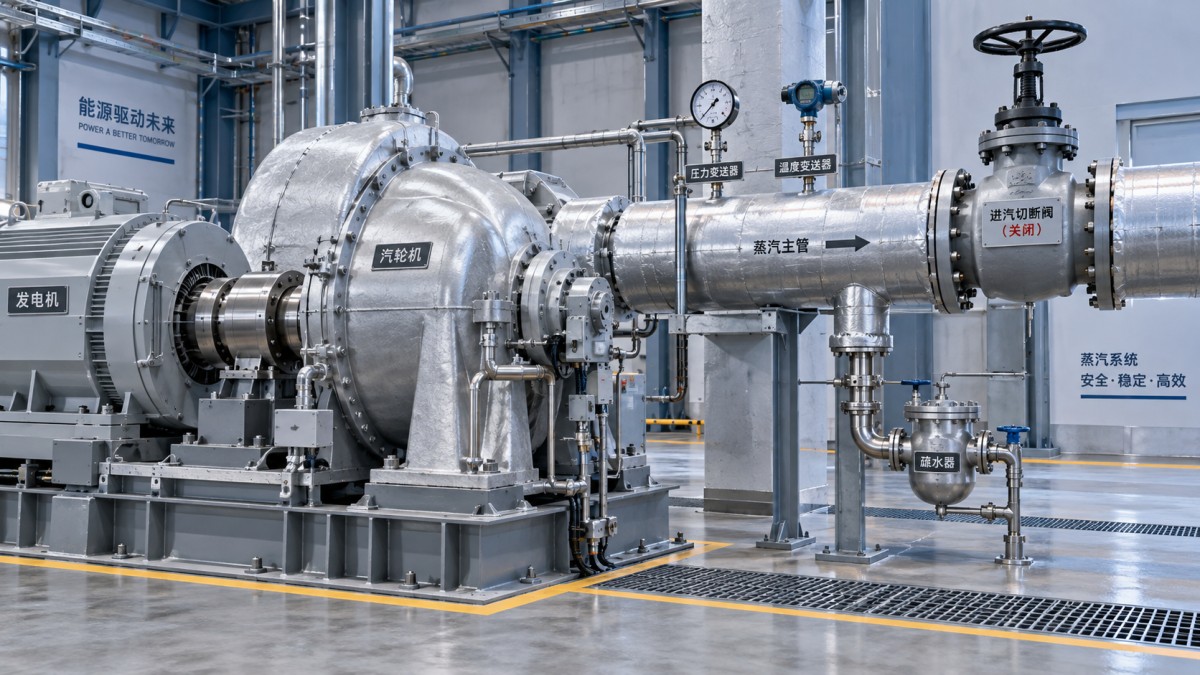
Read the trends together before deciding to continue
One isolated alarm rarely explains the event. Compare inlet pressure and temperature with steam flow, control-valve position, turbine speed, output, and exhaust conditions. Add vibration, bearing temperatures, axial position where monitored, and lubricating-oil pressure to understand whether the disturbance is still mainly a supply issue or has affected machine condition.
- Pressure falling, valve opening, output declining: available steam is likely limiting performance. Coordinate with the steam-system operator rather than repeatedly increasing demand.
- Temperature changing sharply or water hammer reported: investigate steam condition and drainage. Do not treat this as a pressure-only event.
- New vibration or axial-position movement: follow the unit’s alarm and trip procedures. Do not assume the indication will disappear once steam recovers.
- Speed oscillation during header recovery: check the relationship between valve movement, supply pressure, and driven load. Do not change governor tuning during an unexplained transient.
Operating at reduced load may be acceptable within the unit’s approved envelope. It is not automatically safe for an indefinite period. Some turbines have minimum-flow or exhaust-temperature constraints, and the driven machine may have its own minimum operating requirements. Those limits must come from the equipment documentation.
The driven machine may need attention before the turbine does
For a turbine-driven centrifugal or axial compressor, falling speed changes the available head and operating point. Depending on process pressure and flow, the machine may approach surge. Anti-surge protection and process controls therefore need to respond alongside turbine controls. This reasoning should not be applied unchanged to reciprocating or screw machines, which have different operating constraints.
SINO-QNP’s Compressor offering covers centrifugal, axial, reciprocating, and screw equipment, including design, manufacturing, service, and turnkey unit solutions. For steam-interruption planning, the relevant point is matching the turbine’s rundown and recovery behavior to the specific driven machine—not treating every train as the same package.
A turbine trip also does not end the operating response. Coastdown lubrication, auxiliary oil-pump operation, seal arrangements, and turning-gear requirements remain important where applicable. Follow the installed unit’s shutdown procedure, particularly if auxiliary power availability is uncertain.
Restart readiness is more than restored pressure
Before restarting a steel plant steam turbine, establish why the interruption occurred and whether the source is stable. A header that has recovered briefly but continues cycling can expose the train to another trip during acceleration or loading.
Use the approved restart checklist to confirm:
- Steam pressure, temperature, and available flow meet the unit’s admission requirements.
- Supply lines are warmed and drained using the specified procedure, with drain paths functioning correctly.
- Lubrication, required auxiliaries, exhaust conditions, and driven-machine permissives are established.
- Metal temperatures and thermal-condition indications support the selected startup sequence.
- The trip cause has been reviewed, and protection systems are available without bypassing required interlocks.
If the event included suspected water induction, unusual noise, significant vibration, or abnormal axial movement, obtain the required engineering assessment before restarting. Resetting a trip does not establish mechanical readiness.
Preserve the event trends and sequence-of-events record before they are overwritten. Inlet conditions, valve response, load changes, and protection timing help distinguish a steam-system disturbance from a control or mechanical problem. That distinction determines the next action: correct the supply issue, inspect the machine, or revise the coordinated operating procedure before the next interruption.
- ▶ Gas Turbine vs. Gas Engine for On-Site Industrial Power
- ▶ Gas Turbine Performance Explained: Heat Rate, Output and Site Conditions
- ▶ How Does a Gas Turbine Generate Power in an Industrial Plant?
- ▶ Can a Surplus Steam Turbine Fit Your Plant's Steam Conditions?
- ▶ New vs. Used Steam Turbines: Comparing Cost, Lead Time and Risk
- ▶ How steam supply interruptions affect a steel plant steam turbine
Search from here
Leave a message
